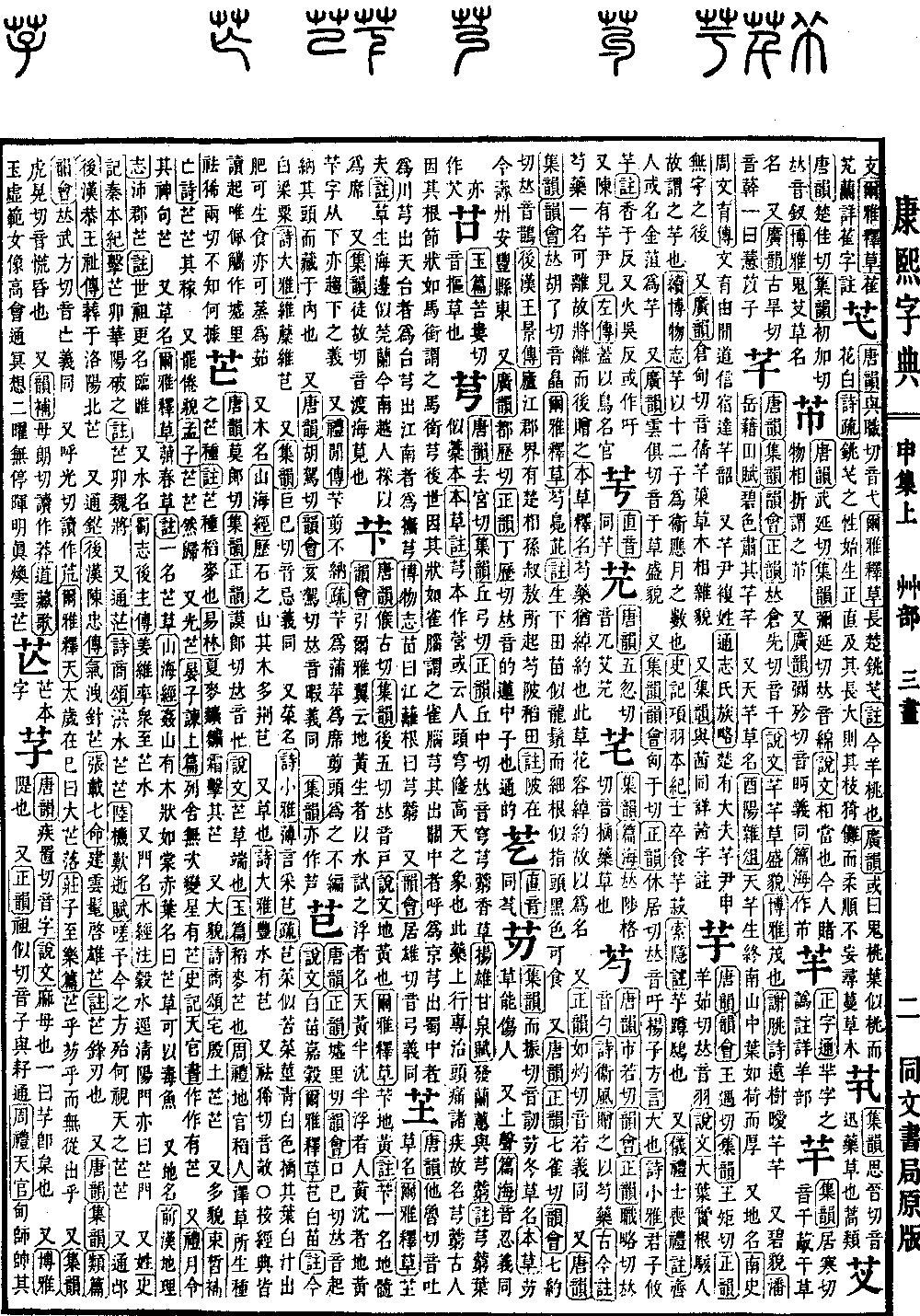
Shen Collection, Upper Volume
Radical: Grass (cǎo)
Page 1018, Entry 20
Pronounced mang.
Shuowen Jiezi (Shuowen): The sharp point of a blade of grass.
Yupian: The awn or prickle of rice or wheat.
Book of Rites (Zhouli), Earth Official, Rice Official: Areas where marsh grasses grow densely are suitable for planting rice and wheat (mangzhong).
Commentary: Mangzhong refers to the time for planting rice and wheat.
Yilin: The summer wheat is struck by cold frost upon its awns.
Also means vast.
Classic of Poetry (Shijing), Odes of Shang: Residing in the vast lands of the Shang dynasty.
Also means numerous.
Shu Xi, Supplementing the Lost Odes (Buwang Shi): The crops are vast and extensive.
Also describes a tired appearance.
Mencius: Returning home in exhaustion.
Also refers to brilliance or rays of light.
Yanzi Chunqiu, Advice to the Ruler: The stars are disordered, and the shifting stars emit rays of light.
Records of the Grand Historian (Shiji), Treatise on the Celestial Offices: Flashing with brilliant light.
Also, Book of Rites (Liji), Monthly Ordinances (Yueling): Its deity is Jumang.
Also, a type of grass.
Erya, Explaining Plants: The ji plant is also known as mang grass.
Commentary: Also called mang grass.
Classic of Mountains and Seas (Shanhaijing): On Jian Mountain there is a tree shaped like a flowering pear with red leaves called mang grass, which can be used to poison fish.
Also a place name.
History of the Former Han (Qian Han Shu), Treatise on Geography: Mang County in Pei Commandery.
Commentary: Emperor Shizu renamed it Linshui.
Also a river name.
Chronicles of Shu (Shu Zhi), Biography of the Latter Ruler: Jiang Wei led the army to the Mang River.
Also a gate name.
Commentary on the Water Classic (Shuijing Zhu): The Gu River flows past the Qingyang Gate, also known as Mang Gate.
Also a surname.
Records of the Grand Historian (Shiji), Annals of Qin: Attacked Mang Mao and defeated him at Huayang.
Commentary: Mang Mao was a general of the state of Wei.
Also used as an equivalent for mang (vast/vague).
Classic of Poetry (Shijing), Odes of Shang: The floodwaters are vast and boundless.
Lu Ji, Rhapsody on Lamenting the Departed (Tan Shi Fu): I sigh that I am now in such a precarious state, why does the heavens appear so vast and indistinct.
Also used as an equivalent for Mang (the Mang Mountains).
History of the Latter Han (Hou Han Shu), Biography of Prince Gong of Zhi: Buried at Mang Mountain north of Luoyang.
Also used as an equivalent for mang (a sharp point).
History of the Latter Han (Hou Han Shu), Biography of Chen Zhong: The aura leaks from the tip of a needle.
Zhang Zai, Seven Admonitions (Qi Ming): Raising flags like clouds, sharpening the violent blades.
Commentary: Mang refers to the sharp edge of a blade.
Also pronounced wang. The meaning is the same.
Also pronounced huang.
Records of the Grand Historian (Shiji), Treatise on the Calendar: The Daman Luo (a calendrical term).
Erya: Mang is written as huang.
Zhuangzi, Supreme Joy: Indistinct and vague, not knowing from whence it comes.
Also pronounced huang (third tone). Meaning dim or dark.
Also pronounced mang (rising tone).
Daozang Ge: The image of the Jade Void Consort Fan, the grand assembly inspires meditation. The sun and moon do not pause in their brilliance, the bright truth illuminates the radiance of the clouds.
Textual Research: Erya, Explaining Heaven: The Grand Year (taisui) in the position of Si is called Damanluo. Note: Erya does not write it as mang. It has been corrected to Damanluo as in the Records of the Grand Historian, Treatise on the Calendar. In the Erya, mang is written as huang.