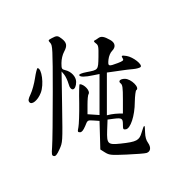
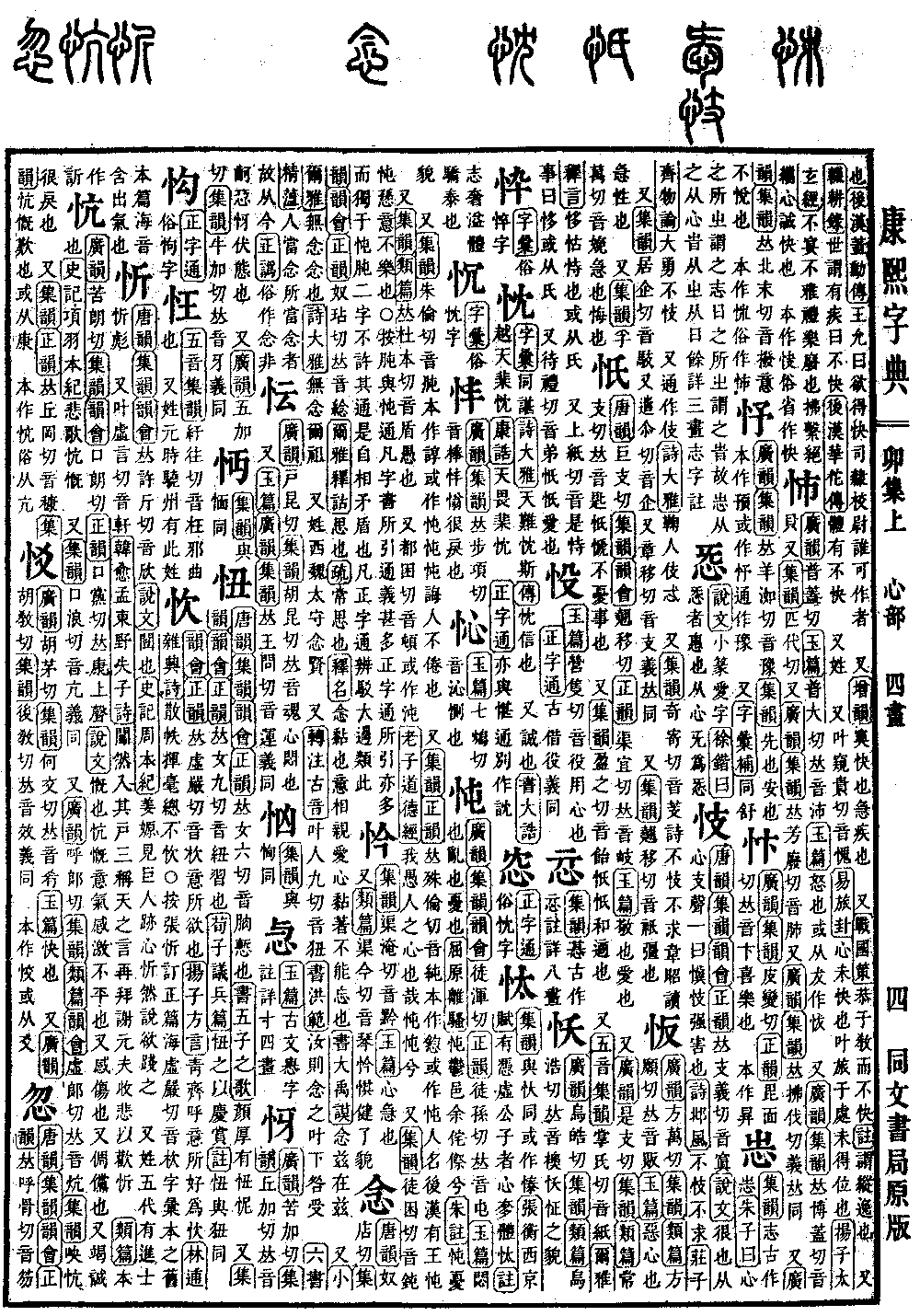
Mao Collection, Upper Volume. Radical: Heart (xīn). Kangxi stroke count: 8. Page 378, Entry 19.
Broad Rhymes (Guangyun), Collected Rhymes (Jiyun), and Rhyme Compendium (Yunhui) state it is pronounced tun. Correct Rhymes (Zhengyun) states it is pronounced tun. Jade Chapters (Yupian) defines it as grieved, disordered, or worried. Encountering Sorrow (Lisao) by Qu Yuan states: "Grieved and melancholy, I am depressed and dejected." Zhu's Commentary notes: "The appearance of being worried."
Additionally, Collected Rhymes (Jiyun) states it is pronounced zhun. Originally written as the character for earnest instruction. Sometimes written as the variant form (tun). The phrase repeated as tun tun means to teach others without becoming weary.
Additionally, Collected Rhymes (Jiyun) and Correct Rhymes (Zhengyun) state it is pronounced chun. Originally written as the variant form (chun). Sometimes written as the variant form (tun). Used in personal names. During the Later Han dynasty, there was a man named Wang Tun.
Additionally, Collected Rhymes (Jiyun) and Classified Chapters (Leipian) state it is pronounced dun. Defined as foolish.
Also pronounced dun. Sometimes written as the variant form (dun). The Laozi (Daodejing) states: "My heart is that of a foolish man, so simple and confused."
Additionally, Collected Rhymes (Jiyun) states it is pronounced dun. The phrase tun xun describes a state of being unhappy. Note that the character for flesh and the character for tun are interchangeable. In general, dictionaries cite many such instances of shared meaning, and the Correct Character Guide (Zhengzitong) also cites many, yet it inexplicably refuses to allow these two characters to be interchangeable, which is a contradiction in itself. Many such cases of excessive refutation exist in the Correct Character Guide.