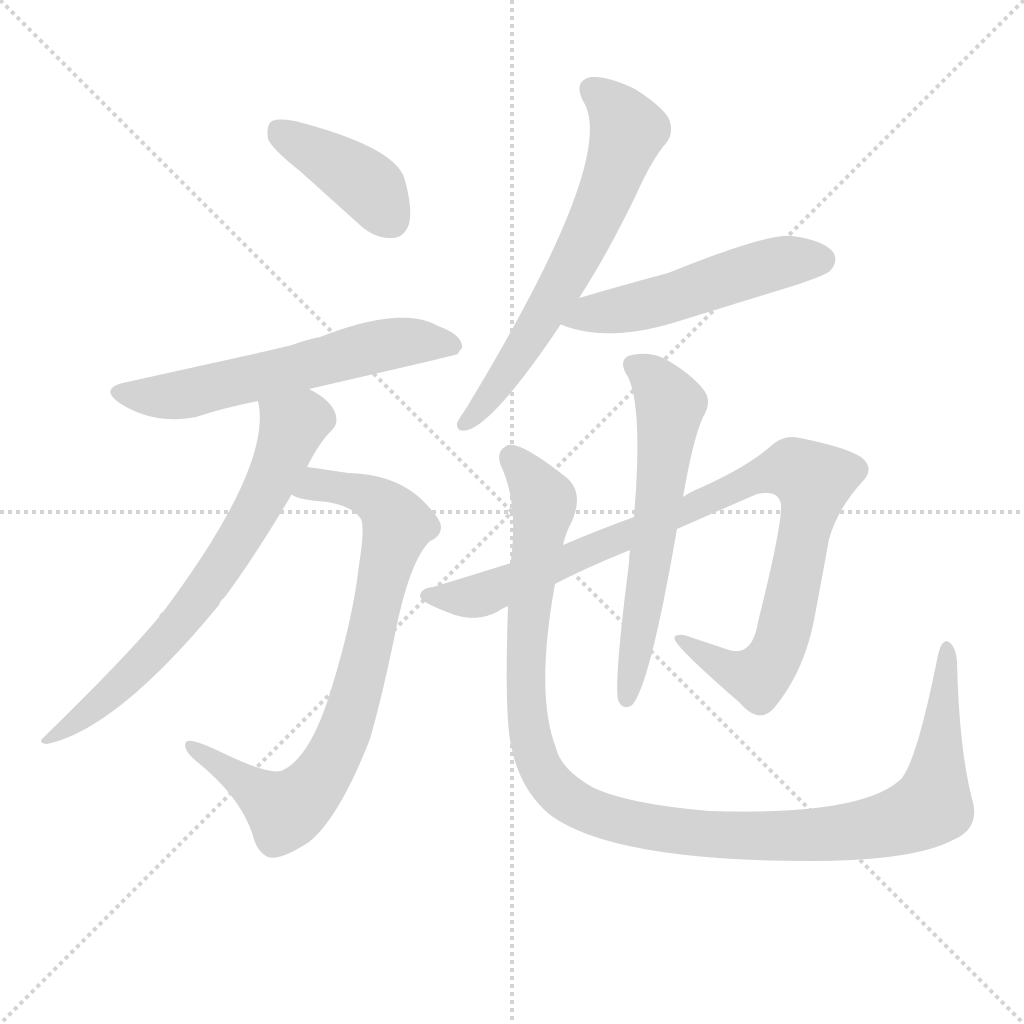
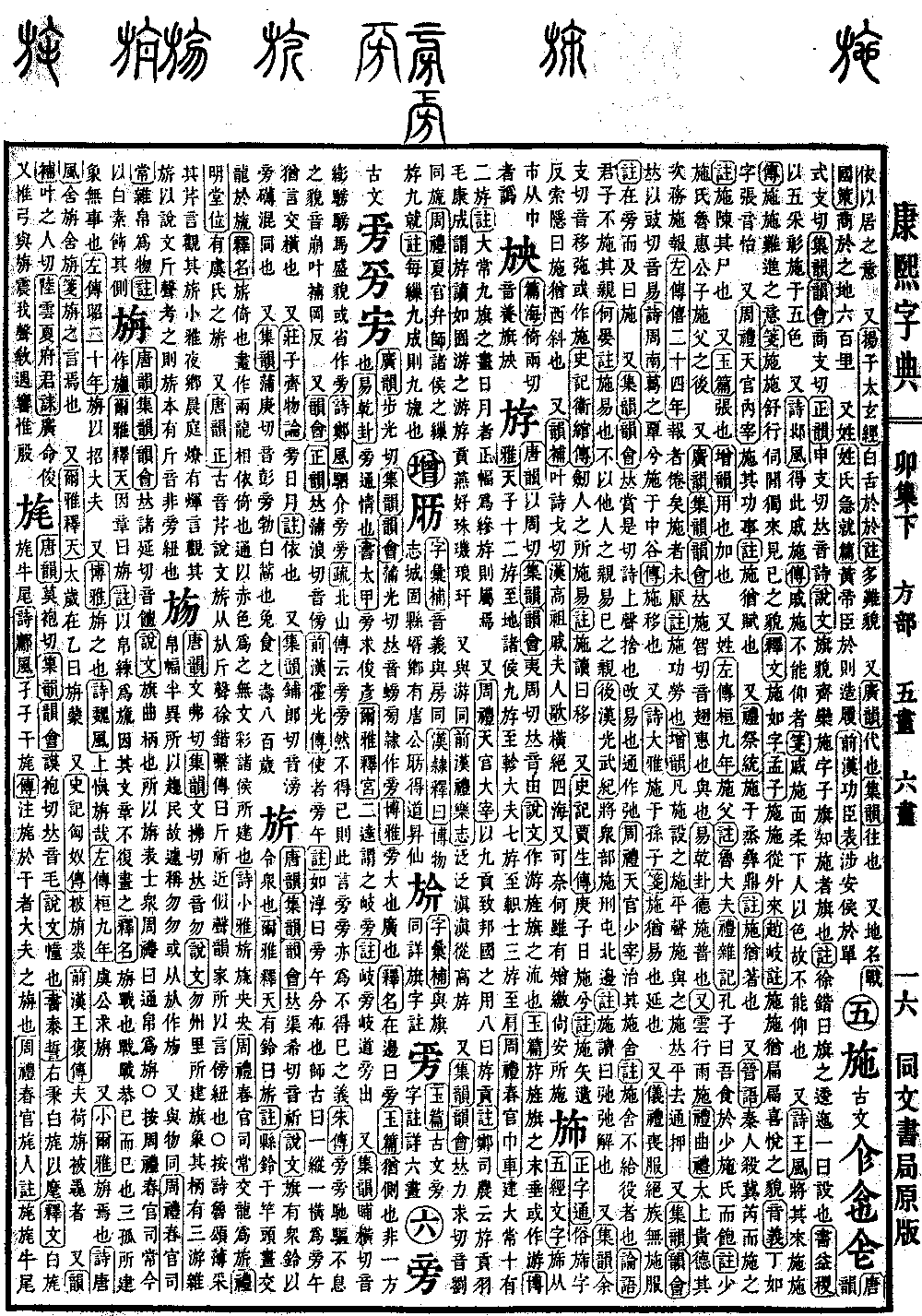
Mao Collection, Lower Volume, Radical: Square (fāng). Kangxi stroke count: 9. Page 482, Entry 01.
Ancient text. Pronounced shi.
According to the Shuowen Jiezi (Explanation of Graphs and Analysis of Characters), it denotes the appearance of a banner. The musician Shi Ziqi of the state of Qi serves as evidence that the term originally referred to a banner. The commentator Xu Kai states that it refers to the appearance of a banner waving and spreading out. Another interpretation suggests it means to set up or display.
In the Book of Documents (Shujing): To display and reveal with five colors upon five-colored surfaces.
In the Book of Odes (Shijing): Obtaining this qishi. The commentary notes that qishi refers to a person who cannot raise their head. The annotation suggests it refers to serving others with a fawning expression, hence the inability to look up.
In the Book of Odes (Shijing): Bringing him here shishi. The commentary notes shishi describes a hesitant appearance. The annotation describes it as walking slowly, waiting for an opportunity, and approaching alone to see me. The explanation of pronunciations notes to read it by its base pronunciation.
In the Mencius: Shishi, coming from outside. Zhao Qi's annotation notes that shishi implies a look of happiness. The phonetic and semantic guide notes that Ding reads it by its base pronunciation, while Zhang reads it as yi.
In the Rites of Zhou (Zhouli): To allocate the tasks. The annotation notes that shi here is like the word for taxation, meaning to distribute or arrange.
In the Book of Rites (Liji): Applied to the steam-sacrificial tripods. The annotation notes that shi here is like attaching or carving.
In the Discourses of the States (Guoyu): The people of Qin killed Ji Rui and displayed him. The annotation notes that shi here means to lay out a corpse for public view.
According to the Yupian: To set up or unfold. According to the Zengyun: To use or to bestow.
A surname. In the Zuo Tradition (Zuozhuan): Shi Fu, a grandee of the state of Lu. In the Book of Rites (Liji): Confucius said, I ate my fill at the home of the Shao Shi clan. The annotation states that the Shao Shi clan were descendants of Duke Hui of Lu and descendants of Shi Fu.
Pronounced chi. Kindness or bestowing.
In the Book of Changes (Yijing): Virtue is bestowed universally. Also: The clouds drift, and rain falls and is bestowed.
In the Book of Rites (Liji): In ancient times, people revered virtue; next to that, they were dedicated to bestowing kindness and seeking reciprocation.
In the Zuo Tradition (Zuozhuan): Those who reciprocate become tired, while those who bestow have yet to be satisfied. The annotation notes that shi refers to meritorious service. According to the Zengyun: Whenever it refers to the installation of facilities, it is read with a level tone. For the sense of bestowing, the level and departing tones are interchangeable.
Pronounced yi.
In the Book of Odes (Shijing): The kudzu vines are long, spreading into the valleys. The commentary notes that shi means to spread out.
In the Book of Odes (Shijing): To continue to one's descendants. The annotation notes that shi is like extending or prolonging.
In the Book of Etiquette and Ceremonial (Yili): When the kinship bond is severed, there is no mourning attire that extends to them. The annotation notes that involving those from the side is called shi.
Pronounced shi (rising tone). To abandon or to alter. Interchangeable with the character for relax or slacken (chi).
In the Rites of Zhou (Zhouli): To manage those who are exempt from corvee labor. The annotation notes that shishe refers to those not provided for labor.
In the Analects (Lunyu): A gentleman does not neglect his own kin. He Yan's annotation notes that shi is interchangeable with the word for relax (chi), meaning to be negligent. It means not neglecting one's own relatives because of the relatives of others.
In the History of the Later Han (Hou Hanshu): Led all the units to release their garrison duties and return to the north. The annotation notes that shi is read as chi, meaning to release or remove.
Pronounced yi. Sometimes written as a variant form.
In the Records of the Grand Historian (Shiji): The sword is an object that people exchange and move. The annotation notes that shi is read as yi.
In the Records of the Grand Historian (Shiji): On the gengzi day, the sun slants to the west. The annotation notes that shi is read as shi. The commentary notes that shi here means the slanting of the west.
In the Yunbu: Rhymes with the word for poetry (shi) and the word for spear (ge).
In the Song of Lady Qi: Moving across the four seas, what else can be done? Although there are arrows with silk cords, where can they still be used?