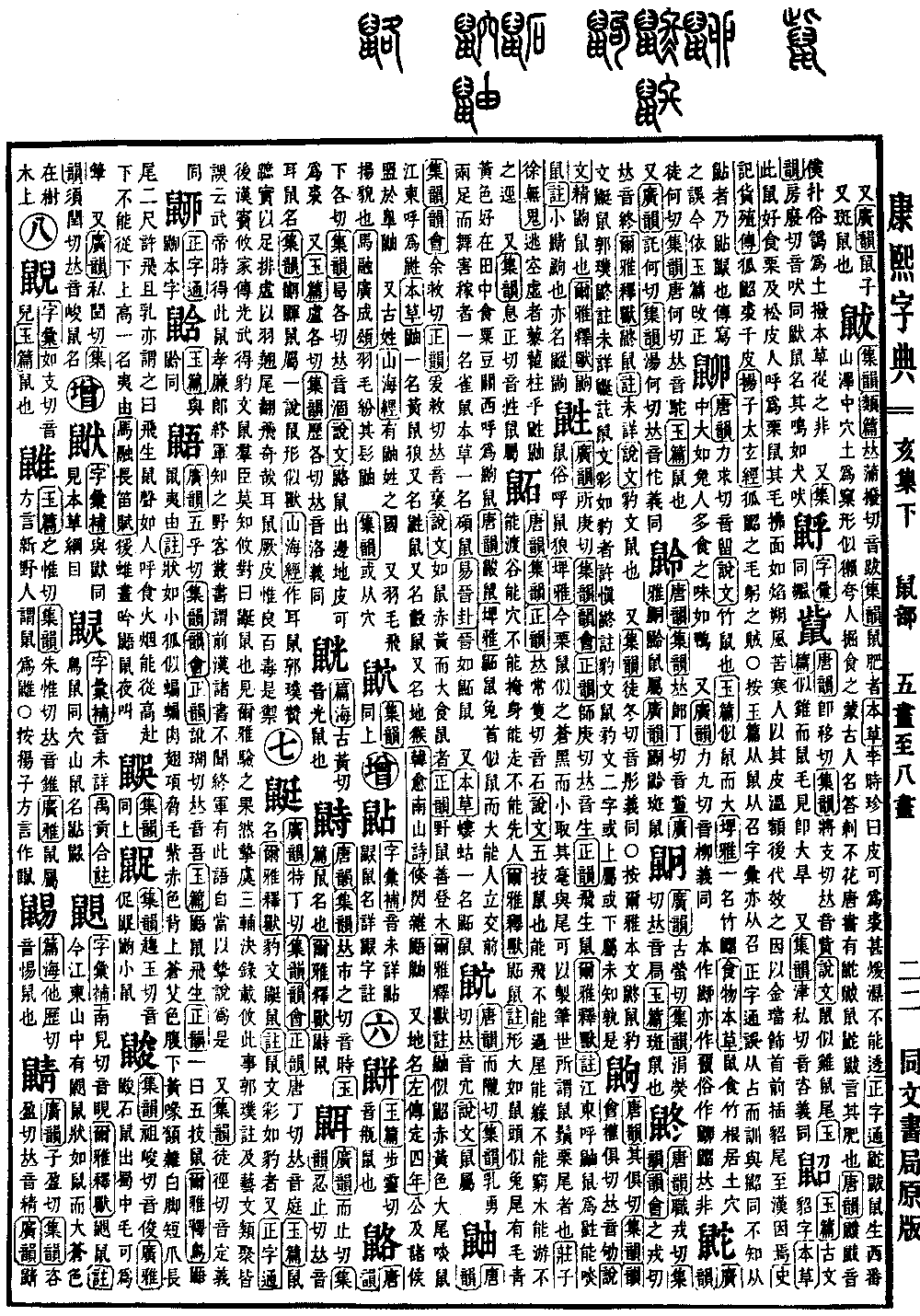
Hai Collection, Lower Volume
Radical: Mouse (shǔ)
Kangxi Strokes: 18
Page 1528, Entry 11
According to the Guangyun (Guangyun), the pronunciation is sheng. According to the Jiyun (Jiyun), the Yunhui (Yunhui), and the Zhengyun (Zhengyun), the pronunciation is also sheng. The Zhengyun (Zhengyun) defines it as a weasel-like rodent. According to the Erya: Interpretation of Beasts (Erya: Shishou), and its commentary, in the regions east of the Yangtze River, a weasel is called sheng; it is capable of eating mice. It is commonly referred to as a mouse-wolf. According to the Piya (Piya), it is similar to the squirrel in appearance, being dark green in color and small in size. Its hair and tail can be used to make writing brushes. This is what the world refers to as the mouse-whisker and squirrel-tail brush. According to the Zhuangzi: Xu Wugui (Zhuangzi: Xu Wugui), those who flee to vacant and desolate places walk along small paths overgrown with goosefoot and wild weeds where weasels and mice appear.
Furthermore, according to the Jiyun (Jiyun), it is pronounced xing. It refers to a type of rodent.