Wu Collection, Lower Volume
Radical: Stand (lì)
Kangxi Strokes: 13
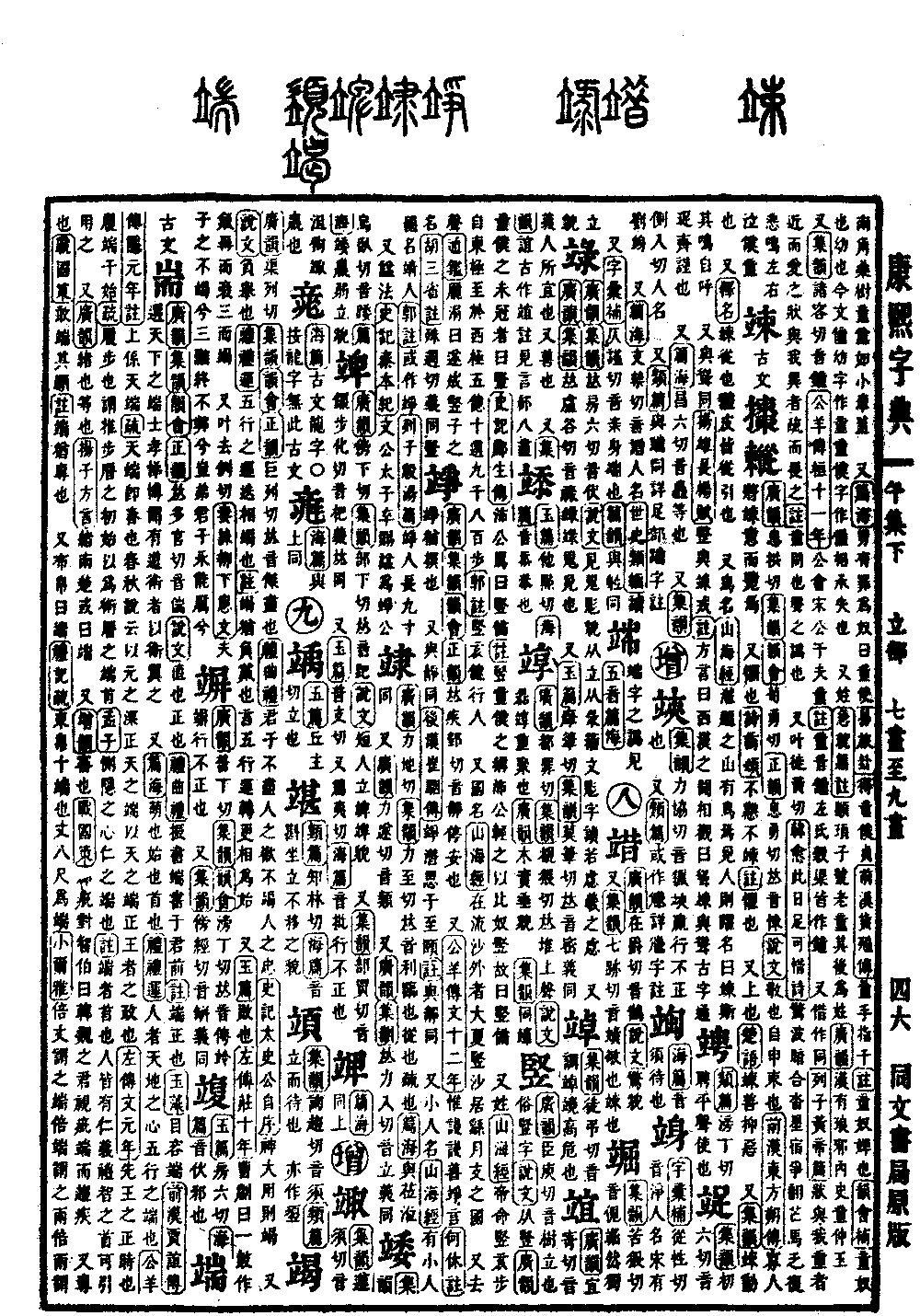
Page 872, Entry 17
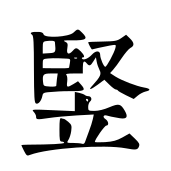
Pronounced shu. To stand. It is the common form of the character for vertical.
According to the Explaining Graphs and Analyzing Characters (Shuowen), it is derived from the graph for vertical.
According to the Broad Rhymes (Guangyun), servants who have not yet reached adulthood are called shu.
In the Records of the Grand Historian (Shiji), Biography of Li Sheng, the Duke of Pei scolded him, saying, "You immature Confucian." The commentary notes that shu is a term for servants. The Duke of Pei held him in contempt, comparing him to a common slave, hence the term "immature Confucian."
Also a surname.
In the Classic of Mountains and Seas (Shanhaijing), the Emperor commanded Shu Hai to walk from the eastern limit to the western limit, a distance of five hundred million, ten thousand, nine thousand, and eight hundred steps. The commentary by Guo notes that Shu Hai was a man with great walking endurance.
Also the name of a state. In the Classic of Mountains and Seas (Shanhaijing), beyond the shifting sands, there are the states of Daxia, Shusha, Juyou, and Yuezhi.
Also pronounced in the departing tone (qu). In the Comprehensive Mirror for Aid in Government (Tongjian), Pang Juan said, "Thus the name of this worthless boy is established." The commentary by Hu Sansheng notes that it is pronounced shu, with the same meaning as the previous entry.