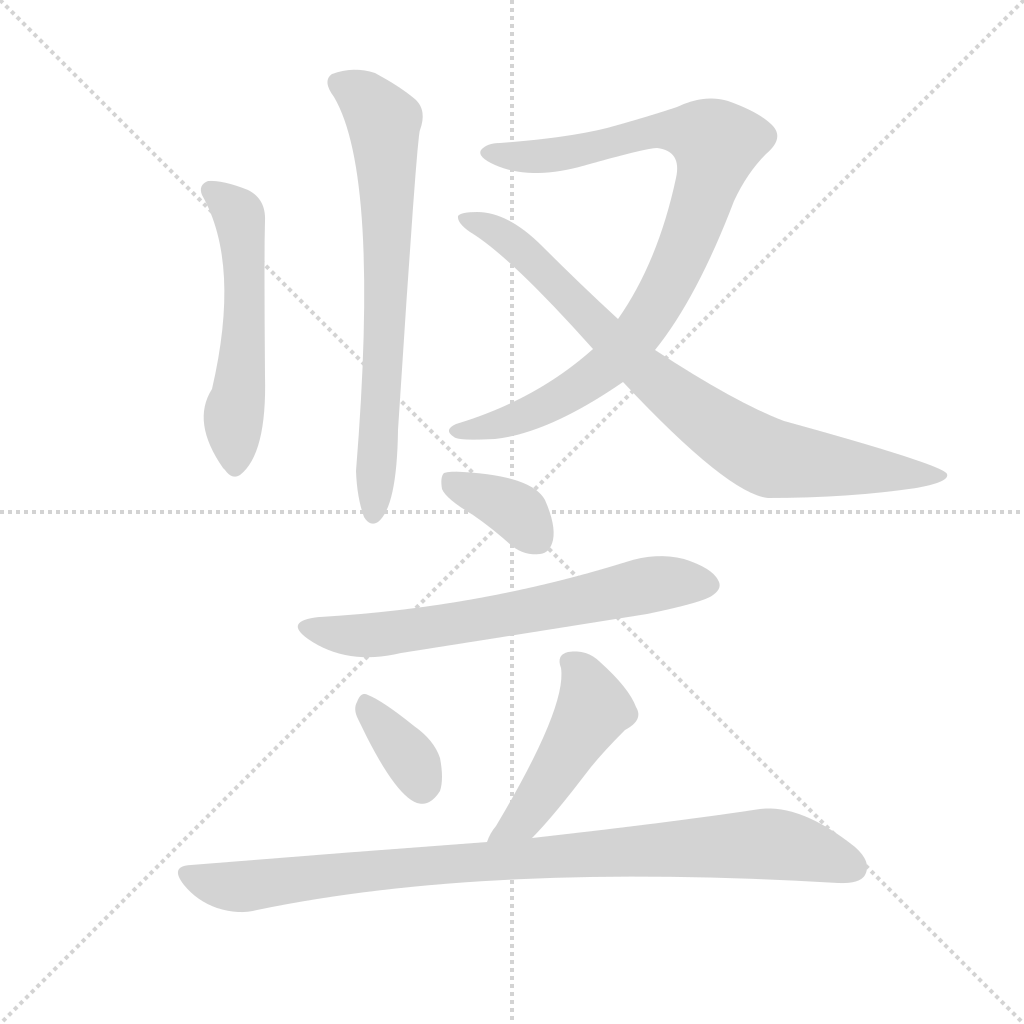
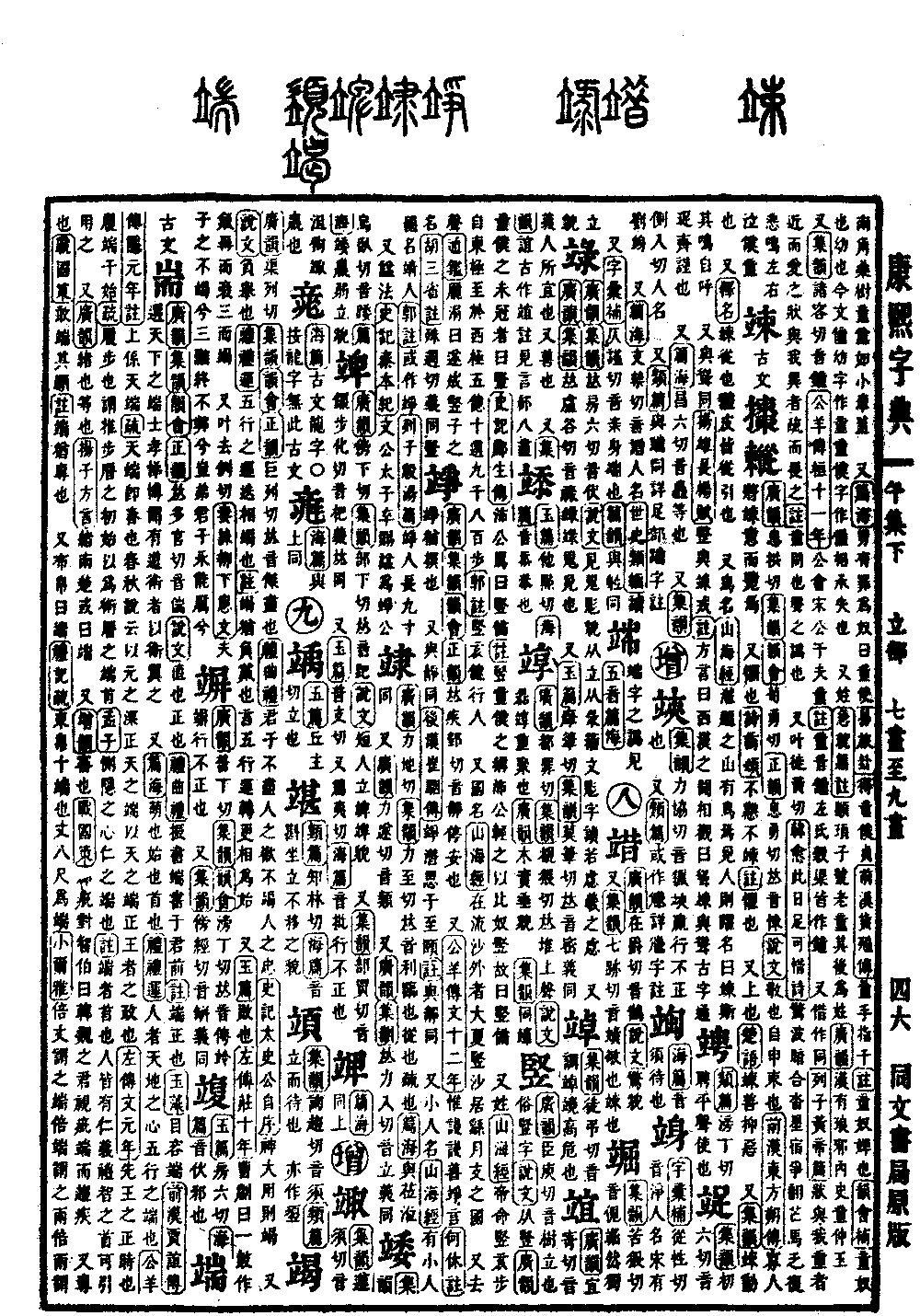
You Collection, Middle Volume
Radical: Bean (dòu)
Kangxi strokes: 15
Page 872, Entry 01
Pronounced shu
Shuowen Jiezi (Explaining and Analyzing Characters): To stand erect.
Xu Shen says: Derived from the bean vessel, therefore implies standing erect.
Book of the Later Han (Hou Hanshu), Chronicle of Emperor Ling: The pagoda trees pulled themselves up and stood upside down.
Records of the Three Kingdoms (Sanguozhi), Biography of Zhong Yao: Raising the prostrate to the vertical.
Yunhui (Collection of Rhymes): Straight.
Zihui (Compendium of Characters): Straight.
Guangyun (Broad Rhymes): A young male servant who has not yet reached adulthood (and performed the capping ceremony).
Liezi, Chapter on Sign Verification (Shuofu): A neighbor lost a sheep and asked the servant of Master Yang to pursue it.
Book of Song (Songshu), Biography of Zhou Lang: Servants have no fixed grade.
Also, a low-ranking official in the inner court.
Rites of Zhou (Zhouli), Offices of Heaven: The inner servant manages the transmission of orders between the inner and outer, and all minor affairs.
Commentary: A title for an official who has not reached adulthood.
Zuo Tradition (Zuozhuan), 24th Year of Duke Xi: The servant of the Duke of Jin, Tou Xu, was a keeper of the treasury.
Commentary: A minor official in the ruler's entourage.
Also used to describe someone vulgar or base.
Records of the Grand Historian (Shiji), Biography of the Marquis of Liu: This vulgar scholar nearly ruined my affairs.
Book of Jin (Jinshu), Biography of Ruan Ji: At that time there were no heroes, allowing this mere boy to make a name for himself.
Also a surname.
Zuo Tradition (Zuozhuan), 16th Year of Duke Zhao: The Zheng official Shu Fu.
Yunhui: Interchangeable with the character pronounced shu (shortened garment).
Records of the Grand Historian (Shiji), Annals of Qin Shi Huang: The cold benefit from short, coarse garments.
Commentary: Also written as short, or as this character. It refers to garments cut vertically for labor, which are short and narrow; thus, they are called short-coarse or servant-coarse garments.
Xunzi, Summary Chapter (Dalue): Clothing consists of servant-coarse garments, not even complete.
Commentary: The coarse garments of a servant, also known as short-coarse garments.
Jiyun (Collection of Rhymes): Sometimes written as a variant form.
Zhengyun (Correct Rhymes) and Zihui Bu (Supplement to the Compendium of Characters): Pronounced shu (falling tone).
Zizhi Tongjian (Comprehensive Mirror in Aid of Governance): Pang Juan said: Consequently, the name of a mere boy was established. Hu Sanxing reads this with a falling tone.
Jiyun: The seal script form is a variant. Sometimes written as a variant. The common form written with the character standing on the bottom is incorrect.