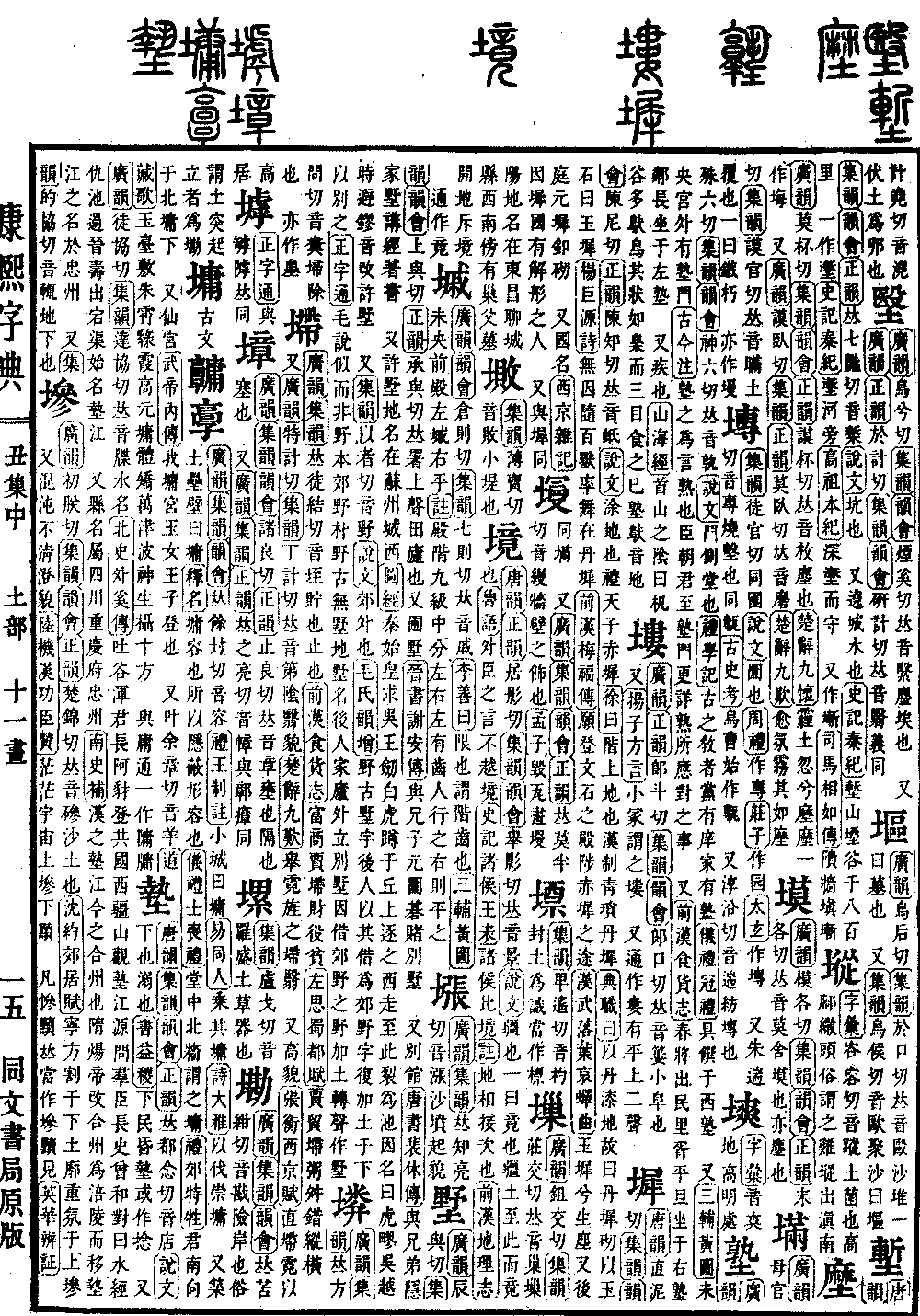
Chou Collection, Middle Volume
Radical: Earth (tǔ)
墅
Kangxi strokes: 14
Page 237, Entry 20
Pronounced shu (rising tone). Refers to houses in the fields. Also refers to garden villas.
Book of Jin (Jinshu), Biography of Xie An: Records that he played a game of Go with his nephew Xie Xuan, wagering a villa as the stake.
Also refers to a detached residence.
Book of Tang (Tangshu), Biography of Pei Xiu: States that he and his brothers lived in seclusion in their home villa, discussing classical scriptures and writing works.
Also, Xushu, a place name located west of the city of Suzhou.
Illustrated Classic (Tujing): Records that when the First Emperor of Qin sought the sword of the King of Wu, a white tiger crouched on a hill. It was pursued and ran west to this location, where the ground cracked to become a pool; thus it was named Huliu. During the Wu and Yue period, to avoid the taboo of the name of Qian Liu, it was renamed Xushu.
Also pronounced ye (dipping tone), sound identical to the character for wilderness (yě).
Explanation of Simple and Compound Characters (Shuowen Jiezi): Defines it as the suburbs or countryside.
Mao’s Additions to the Rhyme Dictionary (Mao Shi Yun Zeng): States that the character for wilderness (yě) is the ancient form of this character. Later generations, because the character for wilderness was borrowed to mean suburban fields, added the earth radical below it to distinguish it.
Correct Explanation of Characters (Zhengzitong): Considers Mao’s theory to be seemingly correct but actually incorrect. The original meaning of the character for wilderness (yě) is countryside or rustic. In ancient times, there was no such place or name as this. Later, when people built villas outside of their main residences, they borrowed the character for wilderness, added the earth radical, changed the pronunciation, and created this character.