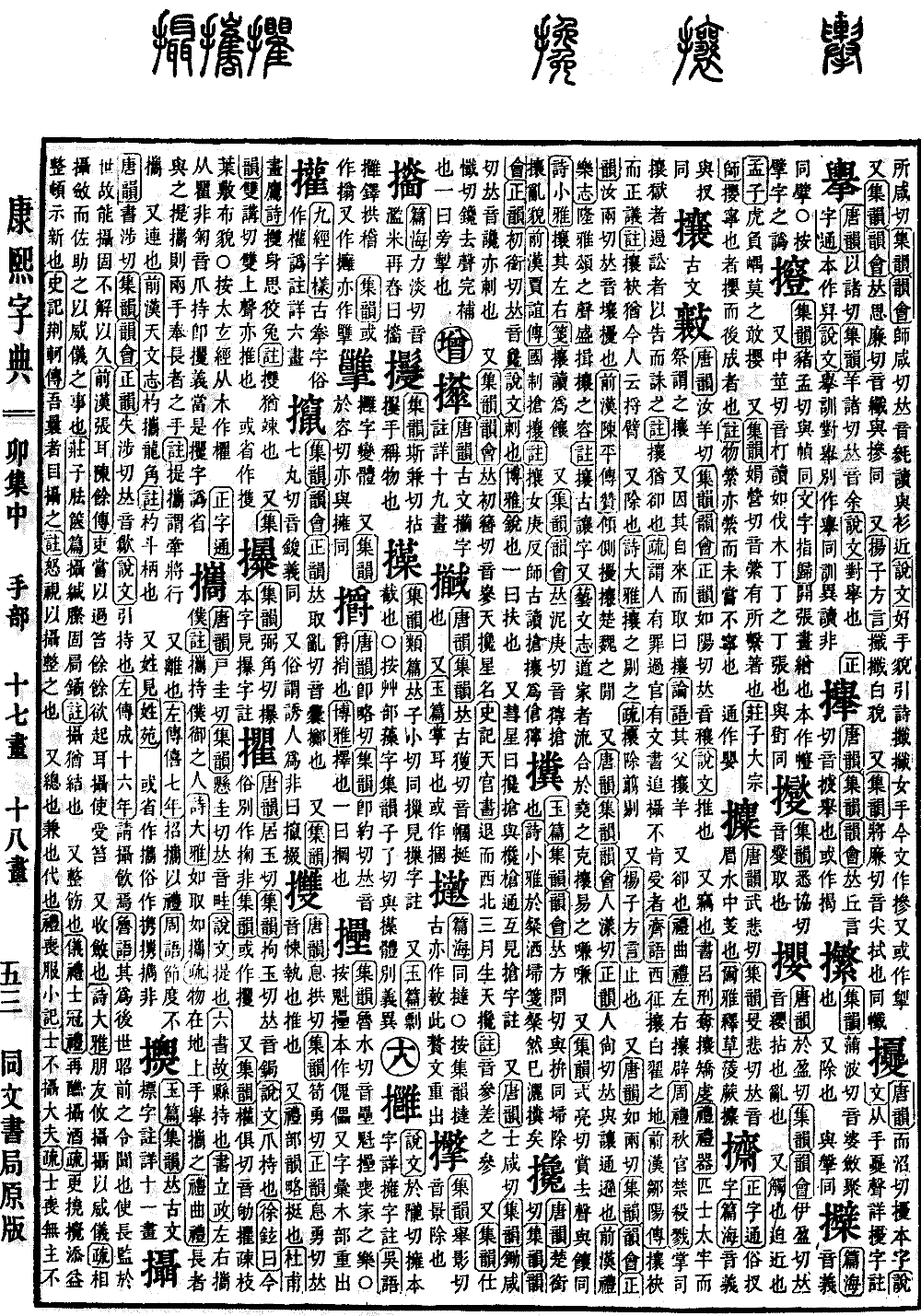
Mao Collection, Middle Volume
Radical: Hand (shǒu)
Kangxi Strokes: 22
Page 463, Entry 12
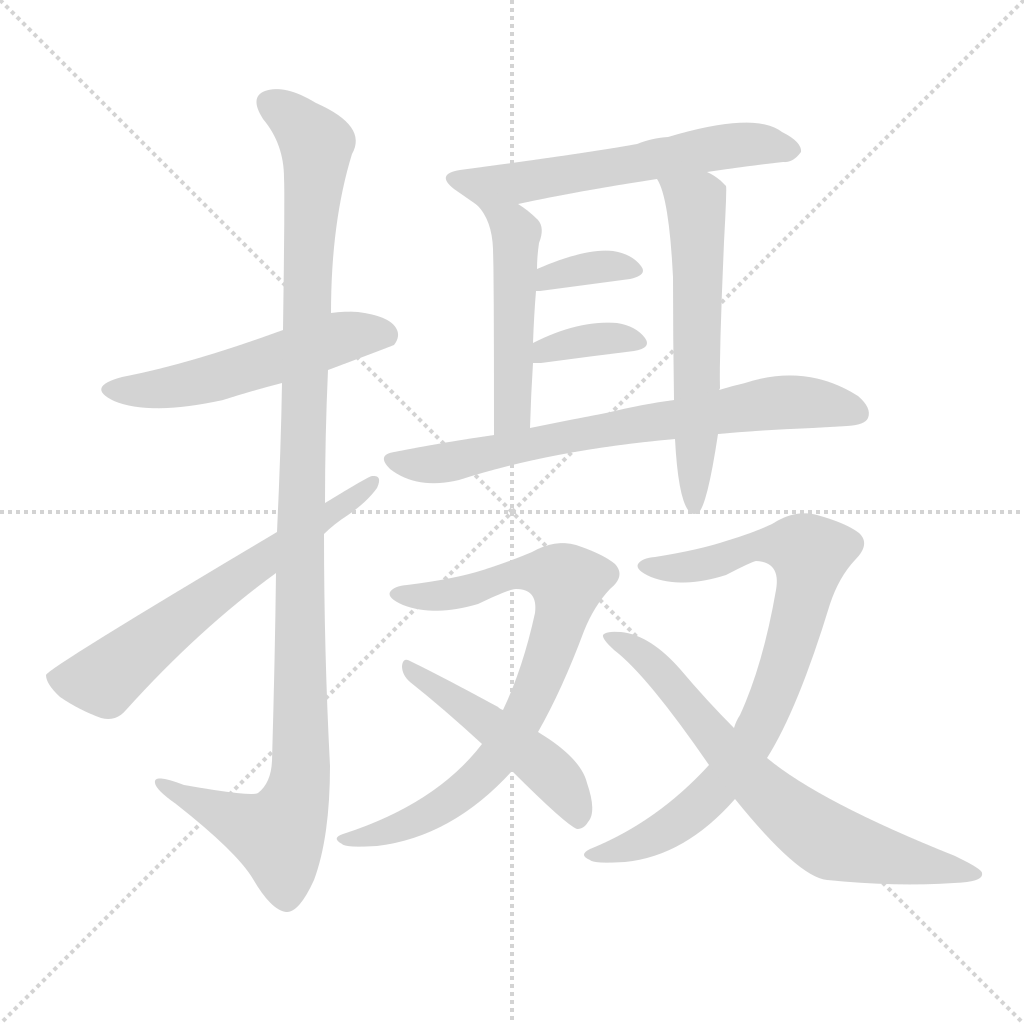
Pronounced she.
According to the Shuo Wen Jie Zi (Explaining Graphs and Analyzing Characters), it means to hold or grasp. In the Zuo Zhuan (Chronicle of Zuo), it says, "I request to hold the wine for him." In the Lu Yu (Discourses of Lu), it says, "By illuminating the virtuous deeds of the past for future generations, one can hold them fast and maintain them long without slackening." In the Biography of Zhang Er and Chen Yu in the History of the Former Han (Hanshu), it says, "The officials once punished Yu with the cane for a transgression. Yu wanted to stand up, but Er held him down to receive the punishment."
Also means to gather or restrain. In the Book of Odes (Shijing), it says, "Friends gather and restrain each other with dignified demeanor." The commentary explains this as assisting and restraining one another through proper etiquette. In the Zhuangzi, it says, "Fasten the cords and ties, and secure the locks and bolts." The commentary notes that here, it means to knot or secure.
Also means to adjust or tidy. In the Book of Etiquette and Ceremonial (Yili), it says, "For the second offering of wine, adjust the wine." The commentary explains this as stirring or adding to it, tidying it up to make it seem new. In the Biography of Jing Ke in the Records of the Grand Historian (Shiji), it says, "I previously intimidated him with my gaze." The commentary notes this means to look at someone angrily to intimidate and constrain them.
Also means to total, to include, or to act as a substitute. In the Book of Rites (Liji), it says, "A scholar does not act as a substitute for a senior official." The commentary explains that if a scholar has no one to preside over his funeral, he does not dare ask a senior official to act as a substitute to preside over it. In the Zengzi Wen (Questions of Zengzi), it says, "High officials and scholars follow the acting lord, facing north south of the western steps." The commentary explains that the acting lord is the senior minister acting on behalf of the ruler to manage state affairs. In the Zuo Zhuan, it says, "To hold an office as a temporary substitute."
Also means to borrow. In the Book of Rites, it says, "At the funeral of Bogao, Ruzi borrowed a bundle of silk and a horse to manage it." The commentary notes that here, it means to borrow.
Also means to record, to pursue, or to capture.
Also means to be overawed. In the Biography of Huo Qubing in the History of the Former Han, it says, "Do not take those who are overawed and submissive." The commentary notes that this refers to those whose spirit and will have been shaken.
Also the name of a turtle. In the Erya (Approaching Elegance), it says, "The third is called the She turtle."
Pronounced nie. Also means to hold. One source says it means to be settled or peaceful, as in a quiet and calm appearance. In the Biography of Yan Zhu in the History of the Former Han, it says, "The world was peaceful, and the people were content with their lives."
Pronounced she. Means to bend or fold. Also the name of a turtle.
Pronounced qie. According to the commentary on the Erya, the She turtle is a small turtle whose plastron is folded, allowing it to open and close itself; people in the Jiangdong region call it the Ling turtle, as explained by Guo Pu.
Pronounced sha. Same as the character for a fan (sha). In the Chu Yu (Discourses of Chu), it says, "The position of the screen and the fan." The commentary notes that the screen is a folding screen, and the fan is like a waist fan of today, used to distinguish ranks and mark positions for sacrificial rites.