Shen Collection, Upper Volume
Radical: Grass (cǎo)
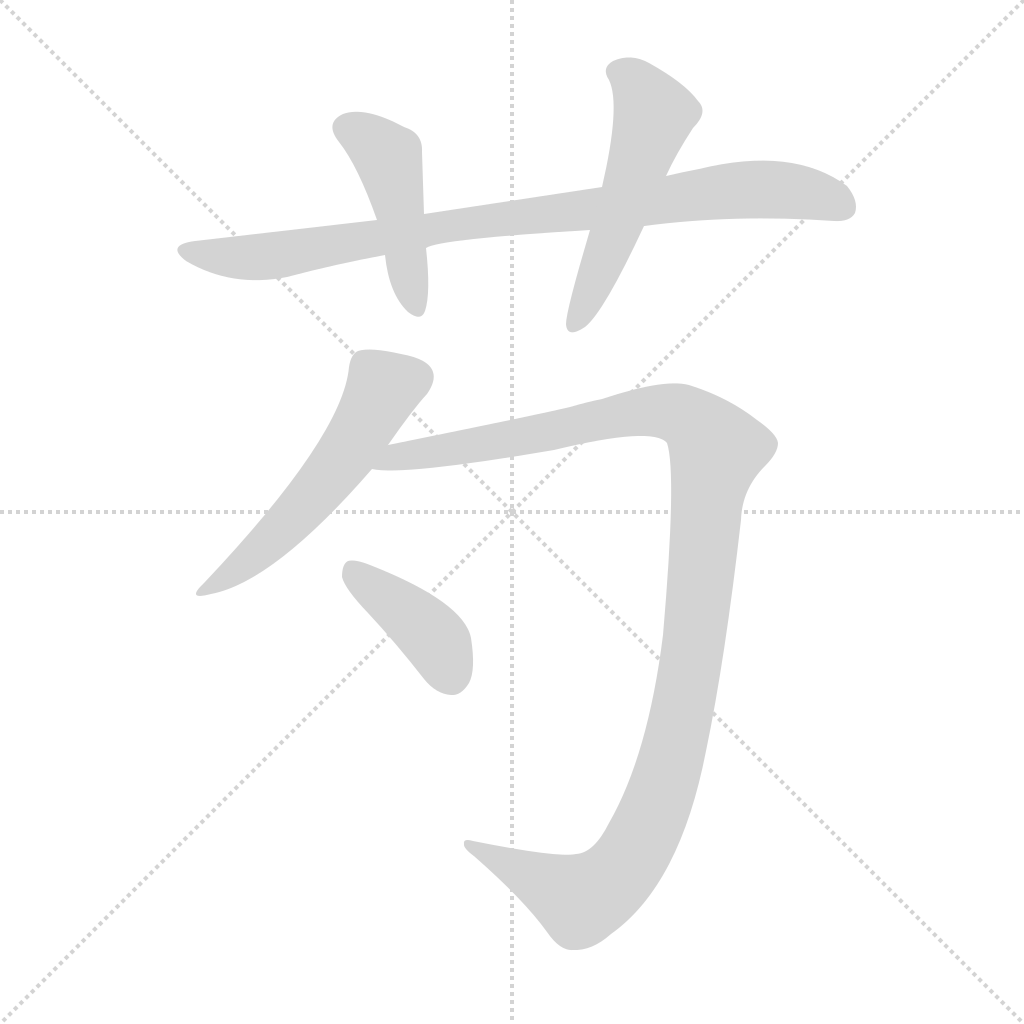
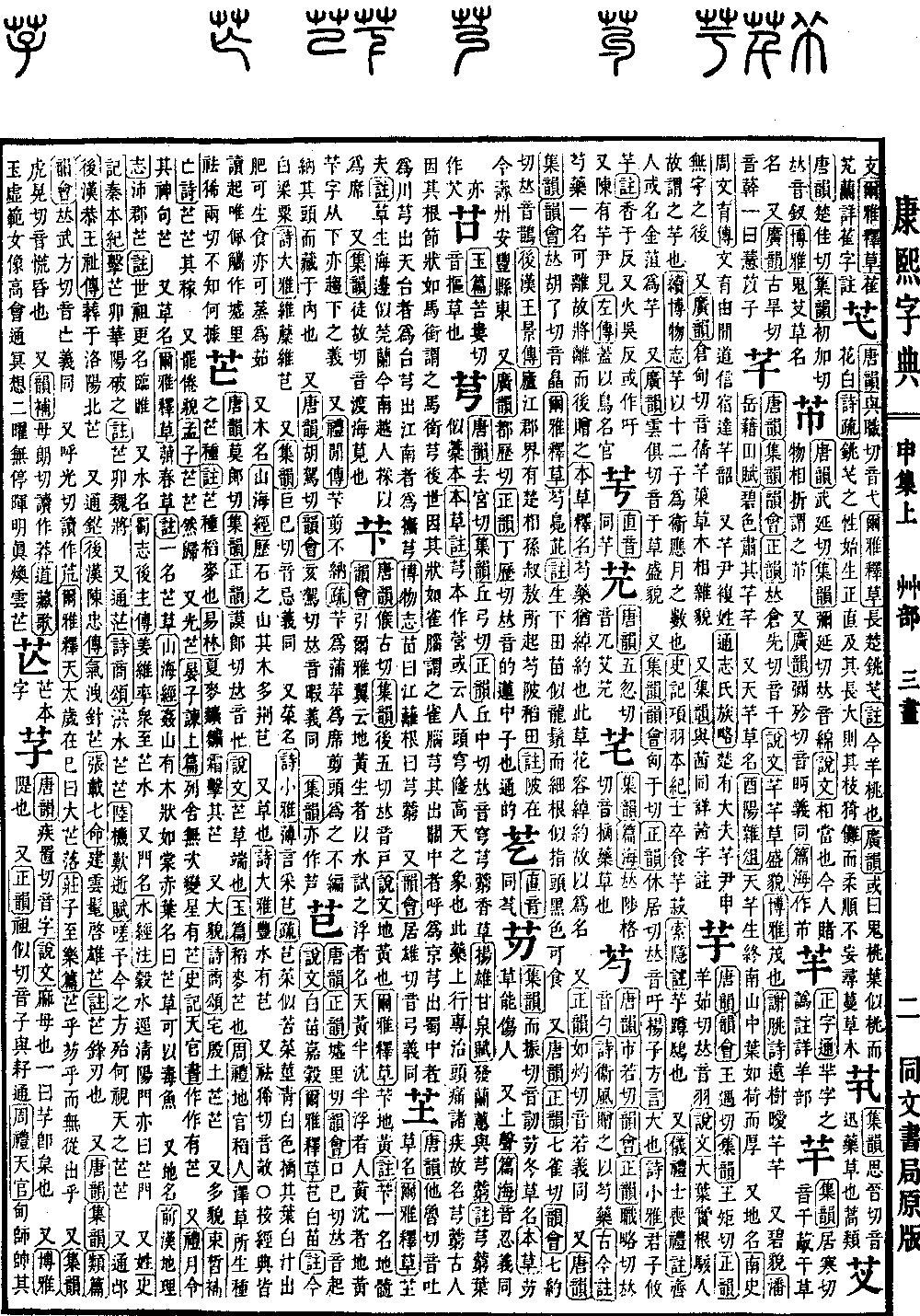
芍; Kangxi stroke count: 9; Page 1018, Entry 12
Tang Dynasty Rhyme Dictionary (Tangyun) states: pronounced shuo. Rhyme Association (Yunhui) and Correct Rhymes (Zhengyun) state: pronounced shuo.
Book of Odes (Shijing), Odes of Zheng: Presented to her with a peony.
Ancient and Modern Notes (Gujinzhu): Another name for the peony is keli (that which can be parted); thus, one presents it upon departure.
Explanations of Names in Materia Medica (Bencao Shiming): The peony is named for its graceful and delicate appearance, as the flower possesses a charming, supple quality.
Also, Correct Rhymes (Zhengyun) states: pronounced re. The meaning is the same.
Also, Tang Dynasty Rhyme Dictionary (Tangyun), Collection of Rhymes (Jiyun), and Rhyme Association (Yunhui) state: pronounced jiao.
Erya: Explanations of Plants (Erya Shicao): The shao is the water chestnut. Commentary: It grows in low-lying fields; the sprouts resemble dragon whiskers but are finer; the roots resemble fingers, are black in color, and are edible.
Also, Tang Dynasty Rhyme Dictionary (Tangyun) and Correct Rhymes (Zhengyun) state: pronounced que.
Biography of Wang Jing in the History of the Later Han (Hou Hanshu): Within the borders of Lujiang Commandery, there are the rice paddies of the Que Reservoir, constructed by the Chu minister Sun Shu'ao. Commentary: The reservoir is located east of Anfeng County in modern Shou Prefecture.
Also, Extensive Rhymes (Guangyun) and Correct Rhymes (Zhengyun) state: pronounced di. It refers to the seed inside a lotus; it is interchangeable with di.
Textual Research: Regarding the citation Book of Odes (Shijing), Odes of Wei, it has been corrected to Odes of Zheng in accordance with the original text.