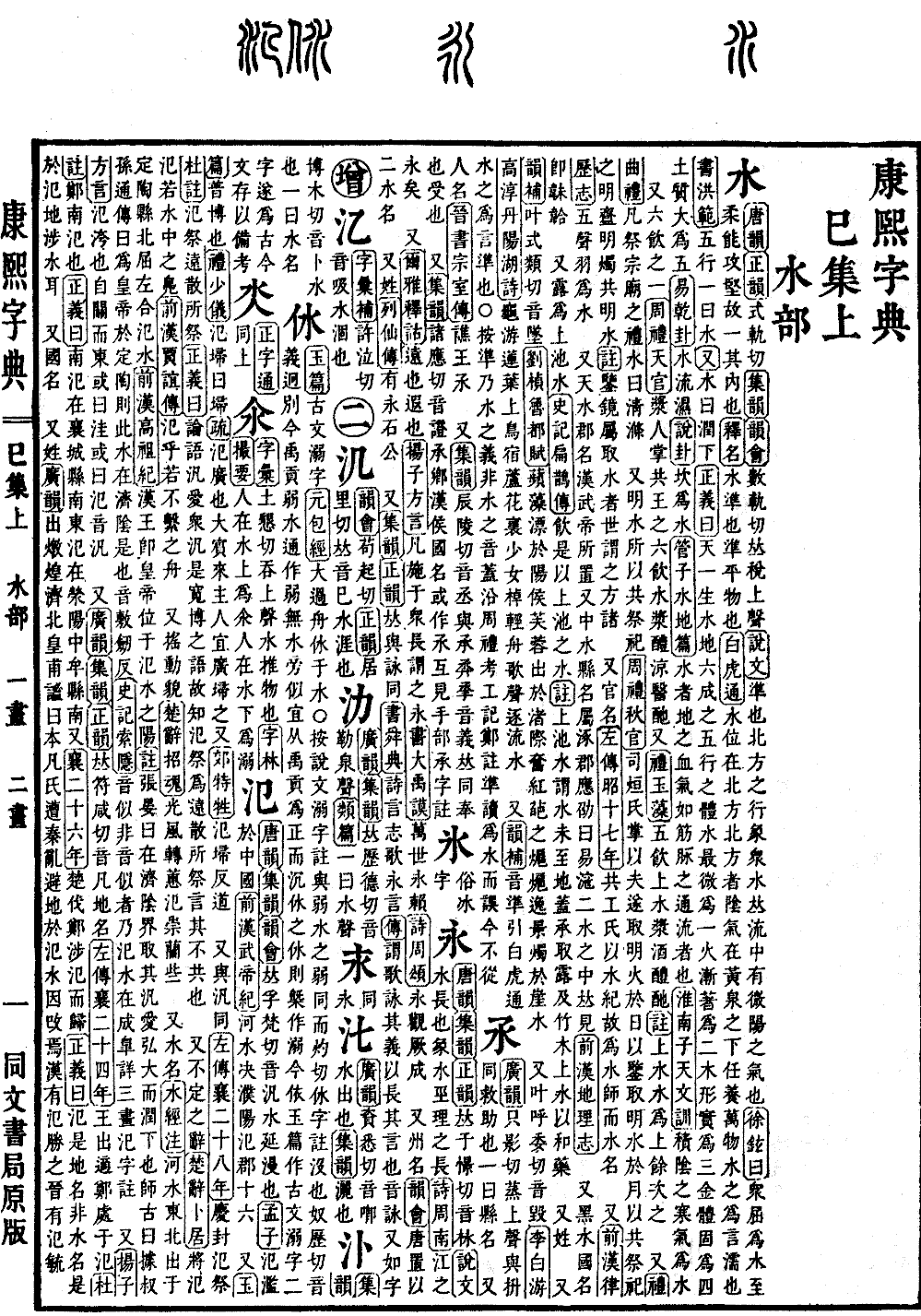
Si Collection, Upper Volume
Radical: Water (shuǐ)
Page 603, Entry 01
Pronounced shuǐ.
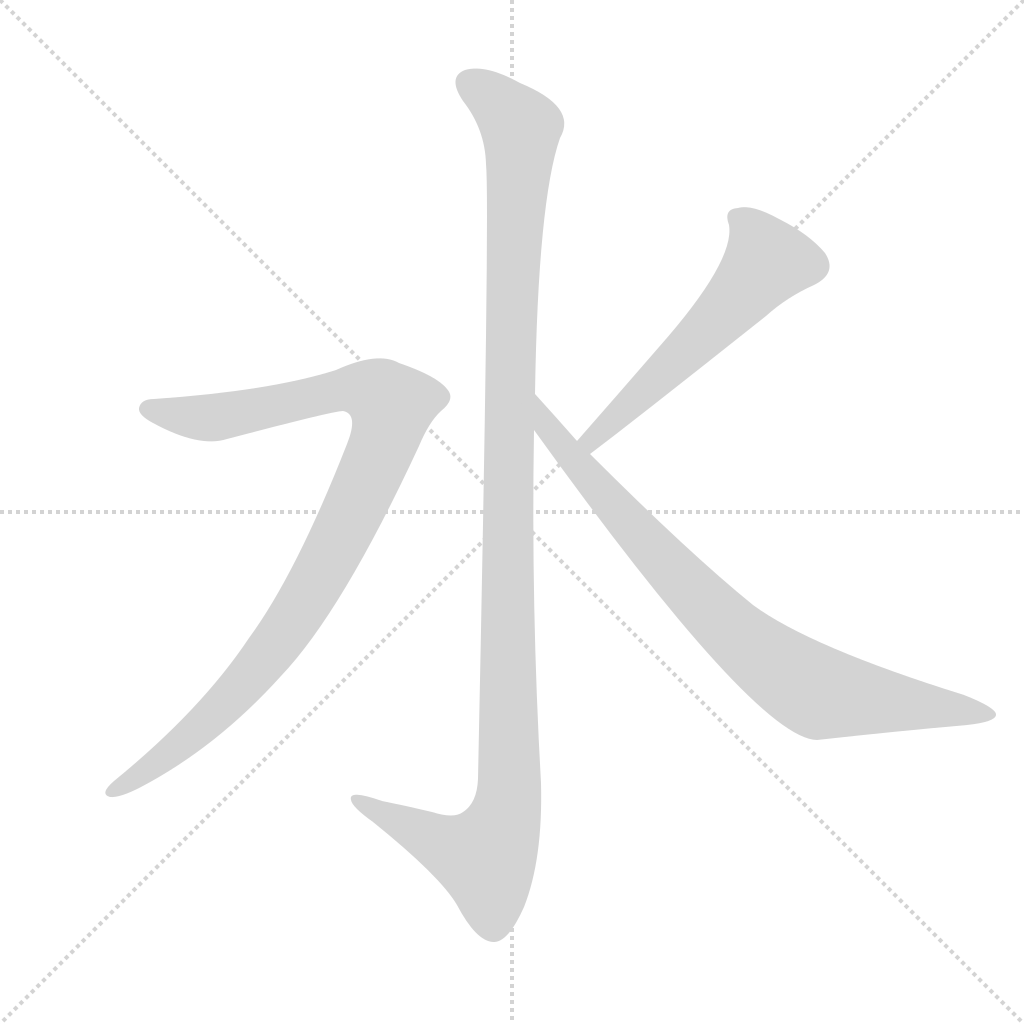
According to the Explaining Graphs and Analyzing Characters (Shuowen Jiezi), it is interpreted as standard (zhǔn). It represents the behavior of the north, and the form resembles numerous flowing streams, containing a faint presence of yang energy.
Xu Xuan states: Numerous curved strokes combine to form the character for water. It is the most yielding, yet it can overcome the hard, thus the internal strokes are unified.
Explaining Names (Shiming) interprets it as: Water means standard, as it allows objects to be leveled.
White Tiger Hall Discourses (Baihu Tong) states: The position of water is in the north. The north belongs to yin energy, located beneath the yellow springs, responsible for nourishing all things. The meaning of water is to moisten.
Book of Documents (Shangshu), Chapter on the Great Plan (Hongfan), records the Five Elements, and the first is water.
It is also said: The characteristic of water is to moisten and flow downward.
Correct Meaning (Zhengyi) states: Heaven produces water first, and Earth enables it to take form at six. Among the physical entities of the Five Elements, water is the most subtle and ranks first. Fire is gradually distinct and ranks second. Wood has a substantial form and ranks third. Metal has a firm nature and ranks fourth. Earth is vast in texture and ranks fifth.
Classic of Changes (Yijing), Qian Hexagram, states: Water flows toward moist places.
The Discussion of the Hexagrams (Shuogua) states: The Kan hexagram represents water.
Guanzi, Water and Earth Chapter, states: Water is the blood and energy of the earth, flowing like veins.
Huainanzi, Treatise on Celestial Patterns (Tianwen Xun), states: Accumulated cold yin energy forms water.
It is also one of the six beverages.
Rites of Zhou (Zhouli), Officers of Heaven, records: The Beverage Master manages the supply of the six beverages for the king: water, thin gruel, sweet fermented liquor, cooled drink, medicinal decoction, and thick fermented gruel.
Also, Book of Rites (Liji), Pattern of Jade (Yuzao), records five beverages: superior water, thin gruel, wine, sweet fermented liquor, and thick fermented gruel.
The commentary says: Superior water is water used as the highest grade, with the others following in order.
Also, Book of Rites (Liji), Summary of the Rules of Propriety (Quli), states: For all rituals in the ancestral temples, water is referred to as clear cleansing.
There is also bright water (míngshuǐ), which is used for offerings.
Rites of Zhou (Zhouli), Officers of Autumn, records: The Official of Solar Mirrors (Sǐxuǎnshì) manages the use of a solar igniter to obtain bright fire from the sun, and a bronze mirror to obtain bright water from the moon, to supply clean sacrificial offerings, bright candles, and bright water for rituals.
The commentary says: The mirror is a type of reflection tool used for obtaining water. People of the world call it Fangzhu.
It is also an official title.
Zuo Tradition (Zuozhuan), Seventeenth Year of Duke Zhao, records: The Gonggong clan recorded events using water, so they established the office of water commander and named officials after water.
Also, History of the Former Han (Qian Hanshu), Treatises on Laws and Calendars, records the five sounds; the yu note corresponds to water.
There is also Tianshui, a commandery name established by Emperor Wu of Han.
There is also Zhongshui, a county name belonging to Zhuo Commandery. Ying Shao says: It is because it is located between the Yi River and the Kou River. See History of the Former Han (Qian Hanshu), Treatise on Geography.
There is also Heishui, a country name, which is the Mohe people.
There is also dew water, known as upper pool water.
Records of the Grand Historian (Shiji), Biography of Bian Que, records: Drinking this water from the upper pool.
The commentary says: Upper pool water refers to water that has not yet reached the ground, likely dew or water from bamboo and trees, used for compounding medicine.
It is also a surname.
Also, in the Rhyme Supplement (Yunbu), it is voiced with the sound of zhuì.
Liu Zhen, Ode to the Capital of Lu (Lu Du Fu), states: Duckweed floats on the waves raised by the water god, while lotuses grow beside the small islands in the water. The bright red flowers shine brilliantly, and the clear light reflects on the water's edge.
It is also voiced with the sound of huǐ.
Li Bai, Poem on Touring Danyang Lake in Gaochun, states: The turtle plays on the lotus leaves, and the bird rests among the reed blossoms. The young girl rows a light boat, and her singing drifts along with the flowing water.
Also, the Rhyme Supplement (Yunbu) contains the theory that it is pronounced zhǔn. It cites the White Tiger Hall Discourses (Baihu Tong) saying, "The word for water means standard." Note: Standard is the meaning of water, not its pronunciation. This likely stems from a mistake in Zheng Xuan's commentary on the Rites of Zhou (Zhouli), Record of Tradesman (Kaogong Ji), where the character for standard was read as water. This pronunciation is not adopted here.