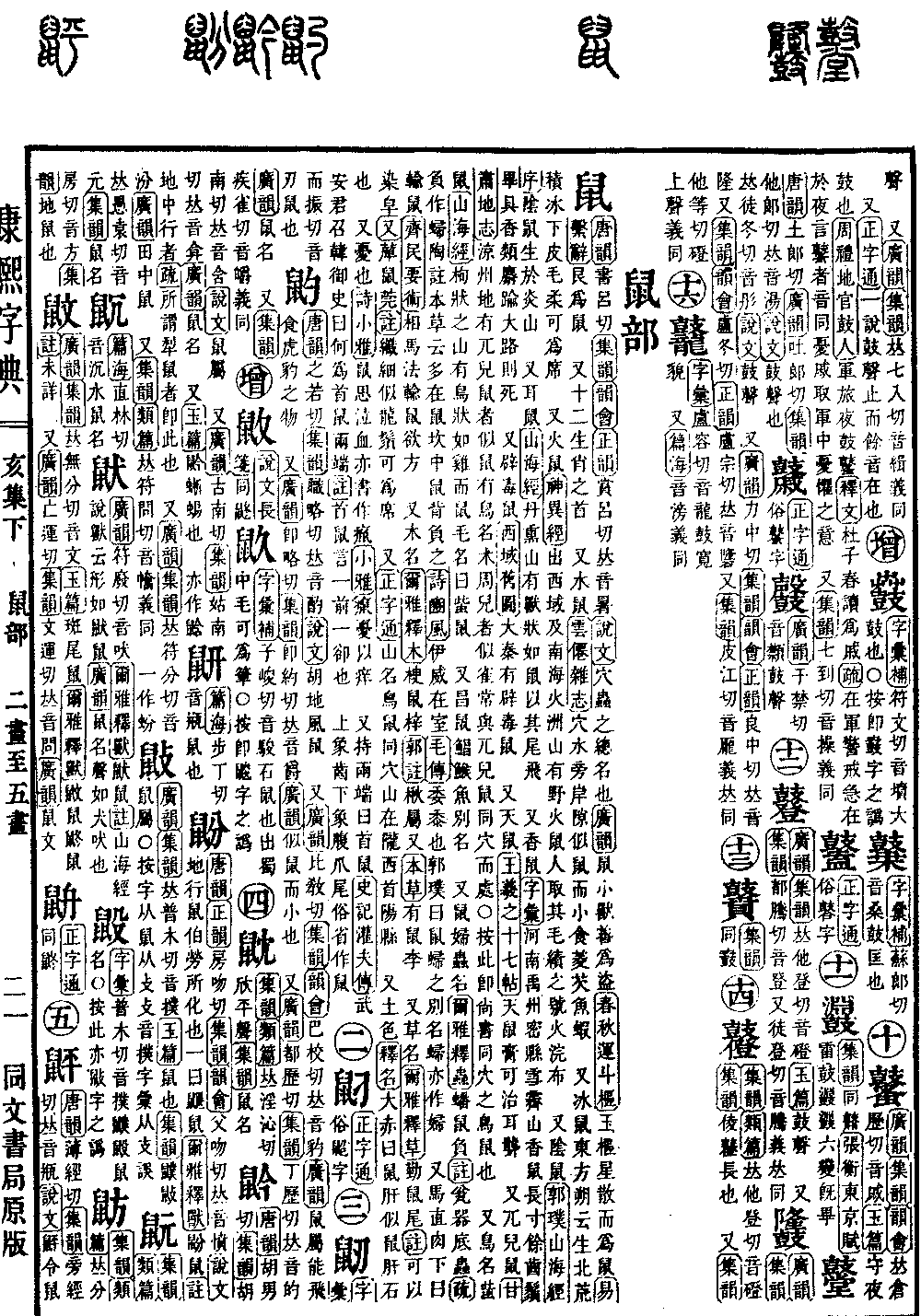
Hai Collection, Lower Volume
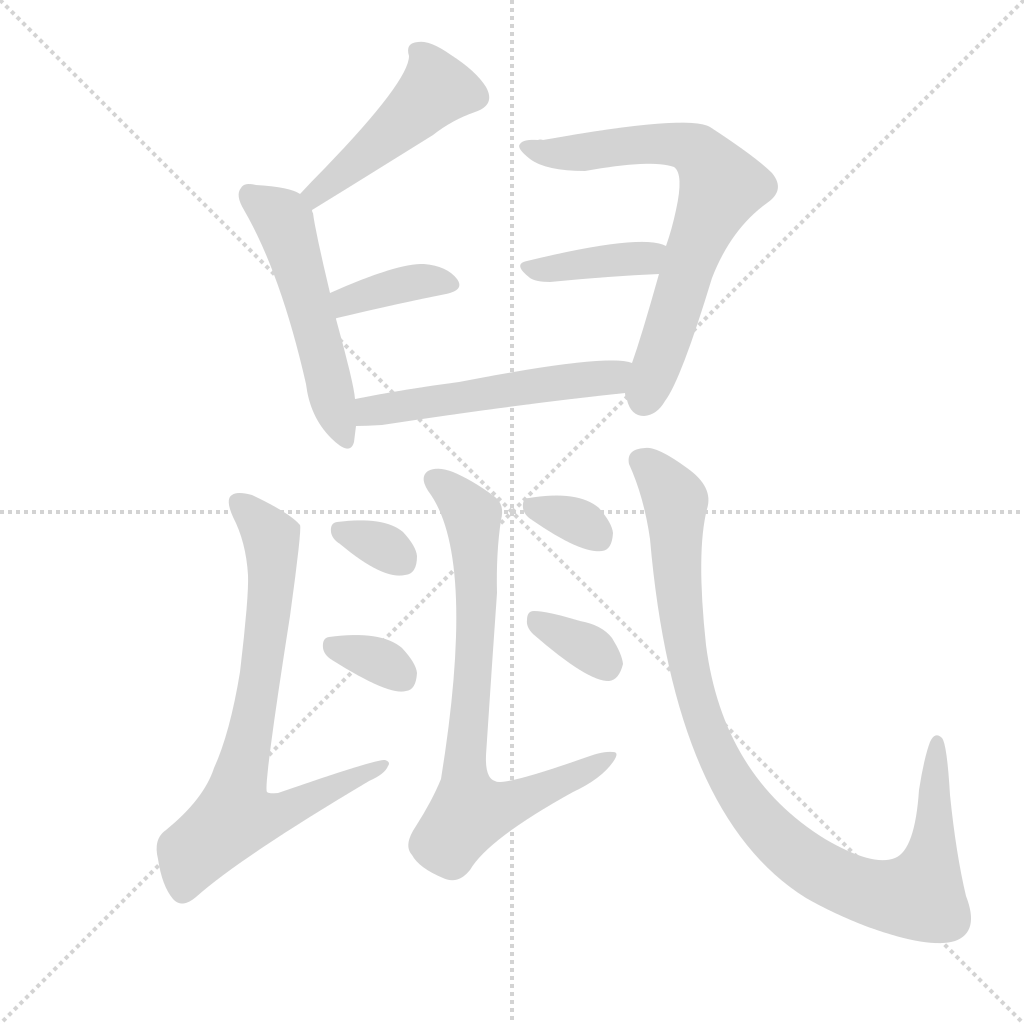
Radical: Rat (shǔ)
Kangxi Strokes: 13
Page 1527, Entry 14
Pronounced shǔ.
From Explaining Graphs and Analyzing Characters (Shuowen Jiezi): A general term for burrowing insects.
From Broad Rhymes (Guangyun): The rat is a small animal that is adept at stealing.
From Spring and Autumn Annals: Chart of the Pivot of Destiny (Chunqiu Yundoushu): The Jade Pivot star scattered and became rats.
From Book of Changes (Yijing), Appended Remarks (Xici): The trigram Gen represents the rat.
Also, the first of the twelve zodiac animals.
Also, the water rat. From Miscellaneous Records of Cloud Immortals (Yunxian Zaji): It lives in crevices along riverbanks, resembles a rat but is smaller, and eats water chestnuts, euryale seeds, fish, and shrimp.
Also, the ice rat. Dongfang Shuo said: It lives beneath the accumulated ice of the northern wilderness; its fur is soft and can be made into mats.
Also, the fire rat. From Classic of Gods and Marvels (Shenyingjing): Found in the fire mountains of the Western Regions and the South Sea. People collect its fur and spin it; it is called fire-washed cloth.
Also, the yin rat. From Guo Pu's Preface to Classic of Mountains and Seas (Shanhaijing): The yin rat is born in the flaming mountains.
Also, the ear rat. From Classic of Mountains and Seas (Shanhaijing): On Danxun Mountain there is a beast shaped like a rat that flies using its tail.
Also, the fragrant rat. From Collection of Characters (Zihui): Found in Xueji Mountain, Yu County, Henan; it is over an inch long with complete teeth and whiskers. It is fragrant like musk, and it dies if it crosses a main road.
Also, the poison-repelling rat. From Old Maps of the Western Regions (Xiyu Jiutu): Da Qin has the poison-repelling rat.
Also, the sky rat. From Wang Xizhi's Seventeen Models of Calligraphy (Shiqi Tie): The fat of the sky rat can cure deafness.
Also, the wu'er rat. From Gansu Geographical Records (Gansu Dizhi): In Liangzhou, there is an animal called the wu'er rat that resembles a rat; there is also a bird called the muzhou'er that resembles a sparrow and lives in the same burrow as the wu'er rat. Note: This is the bird and rat that share a burrow as mentioned in the Book of Documents (Shangshu).
Also, a bird name. Shu: From Classic of Mountains and Seas (Shanhaijing): On Xunshan Mountain there is a bird shaped like a chicken but with rat hair, named shu.
Also, changshu, another name for the silver pomfret fish.
Also, the shufu (woodlouse), an insect name. From Er Ya, Explaining Insects: Pan is called shufu. Annotation: An insect found at the bottom of earthen jars. Commentary: The character fu is written as the character for 'load'. Tao's Annotation to the Materia Medica (Bencao) states: They are often found in rat burrows, carried on the backs of rats. From Book of Odes (Shijing), Odes of Bin: The iwei is in the room. Mao's Commentary: It is the shu (millet) insect. Guo Pu said: Another name for the rat. The character is also written as the character for 'woman'.
Also, the area below the flesh of the horse's straight line is called shushu. From Essential Techniques for the Common People (Qimin Yaoshu): In the method of judging horses, the shushu should be square.
Also, a tree name. From Er Ya, Explaining Trees: The yu, shu, and zi trees. Guo's Annotation: A type of catalpa.
Also, from Materia Medica (Bencao), there is the shuli (rat plum).
Also, a grass name. From Er Ya, Explaining Grasses: The qiong is called shuwei (rat tail). Annotation: It can be used to dye black. Also: Shuguan. Annotation: Slender like dragon whiskers, it can be used to make mats.
Also, from Investigation of Characters (Zizhitong): A mountain name. The bird-rat co-burrowing mountain is located in Shouyang County, Longxi.
Also, a soil color. From Explaining Names (Shiming): Red soil is called shu-liver, because it resembles the color of a rat's liver.
Also, to worry. From Book of Odes (Shijing), Lesser Odes of Kingdom (Xiaoya): I worry and weep blood. Also written as the character for 'zhu'. From Lesser Odes of Kingdom: Zhu-worry leads to itchiness.
Also, to hold both ends is called shoushu. From Records of the Grand Historian (Shiji), Biography of Guan Fu: Lord Wu'an summoned Han the Censor and said: Why are you being shoushu (irresolute/wavering) at both ends? Annotation: Shoushu means one part goes forward while another retreats.
The top part represents teeth, the bottom part represents the belly, claws, and tail. Popularly simplified as the character for 'shu'. The character for yu in the original carving of the word for yu (tree) was an error. Verification: From Explaining Names, 'great red' is corrected to 'earth red', and 'rat liver stone' is corrected to 'rat liver color'.