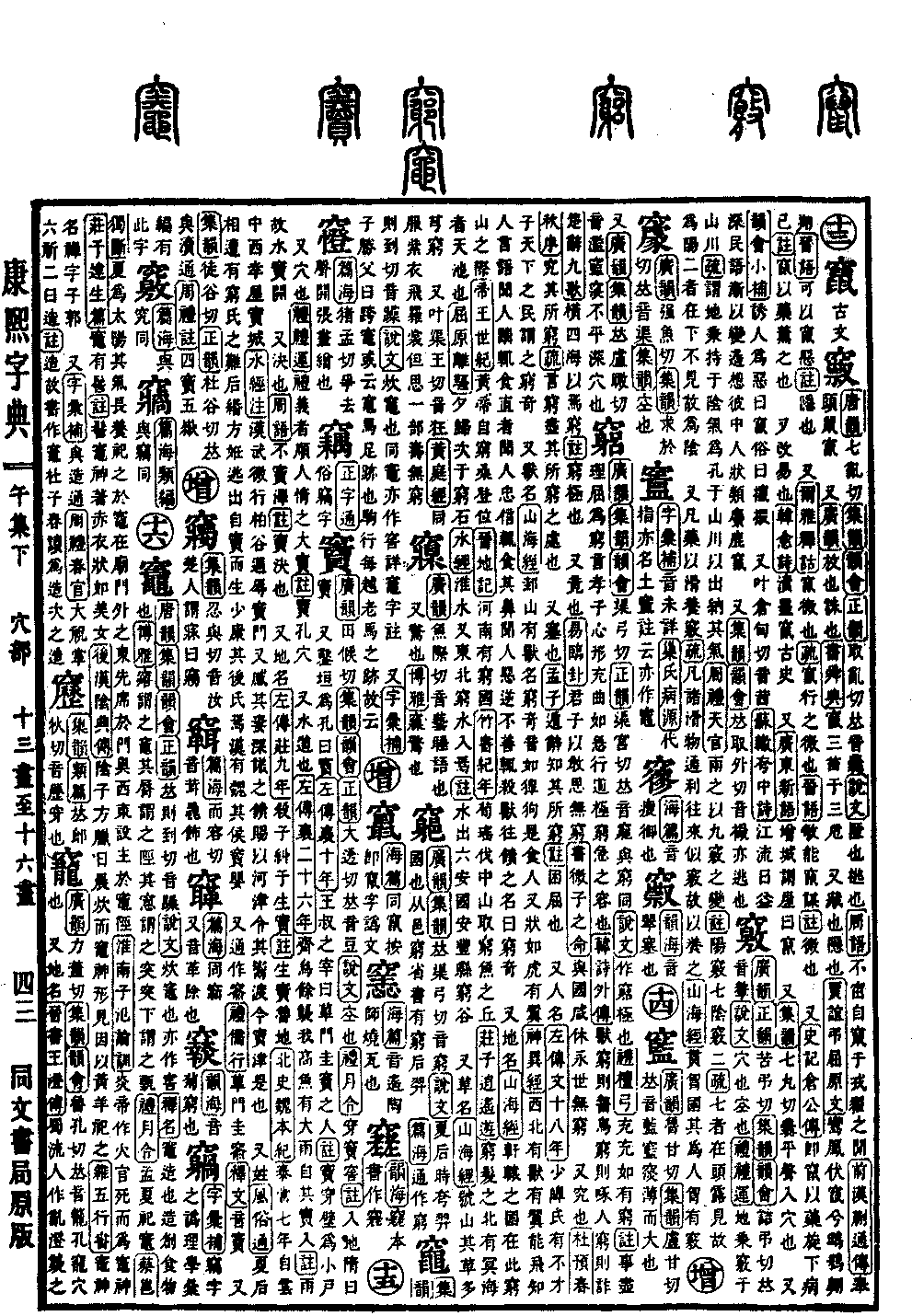
Wu Collection, Lower Volume
Radical: Cave (xué)
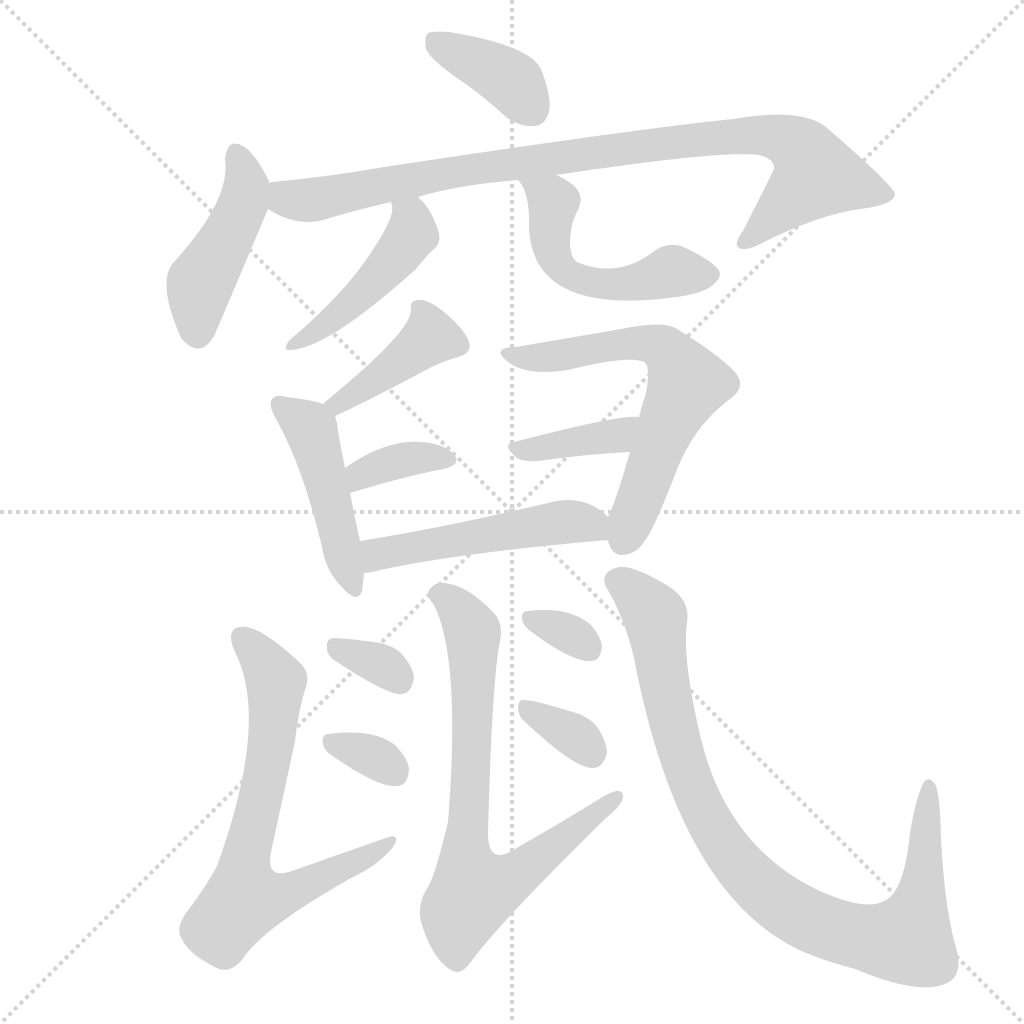
Cuan (竄)
Kangxi Strokes: 18
Page 869, Entry 01
Ancient form. Pronounced cuan (falling tone).
According to the Explaining Graphs and Analyzing Characters (Shuowen Jiezi), it means to hide or to flee.
In the Discourses of the States (Guoyu): Bu Zhu fled and hid himself among the Rong and Di tribes.
In the Biography of Kuai Tong in the History of the Former Han (Qian Han Shu): He fled like a rat clutching its head.
Also, meaning to banish or to execute, as found in the Canon of Shun in the Book of Documents (Shujing): Banish the Three Miao tribes to the Sanwei region.
Also, meaning to conceal or to hide. In Jia Yi’s Lament for Qu Yuan: The phoenix hides itself while the owls soar.
In the Discourses of the States (Guoyu): One can hide wickedness. Note: This means to conceal.
Also, in the Erya, a dictionary of the third century BC, it states that to hide means to be slight or subtle. The commentary explains this as the subtle movements of hiding.
In the Discourses of the States (Guoyu): One must be quick to hide one’s strategies. Note: This means subtle.
Also, in the Biography of Cang Gong in the Records of the Grand Historian (Shiji): He then treated it with medicine, and the illness was soon purged. Note: Here, it means to fumigate with medicine.
Also, meaning to alter or revise. In a poem by Han Yu: Staining the ink to revise the ancient histories.
Also, in the New Account of Guangdong (Guangdong Xinyu): In Zengcheng, a house is called a cuan.
Also, pronounced cuan (level tone). Meaning to enter a cave.
Also, in the Supplementary Additions to the Rhyme Treasury (Yunhui Xiaobu): To entice someone to do evil is called cuan. Popularly referred to as cuanduo.
Also, rhymes with the sound qian. In a poem by Su Zhe: The river flows and becomes deeper daily, the speech of the people gradually changes. Looking toward the people there, their appearance is like that of startled deer fleeing.
Also, pronounced cuo. Also meaning to flee.