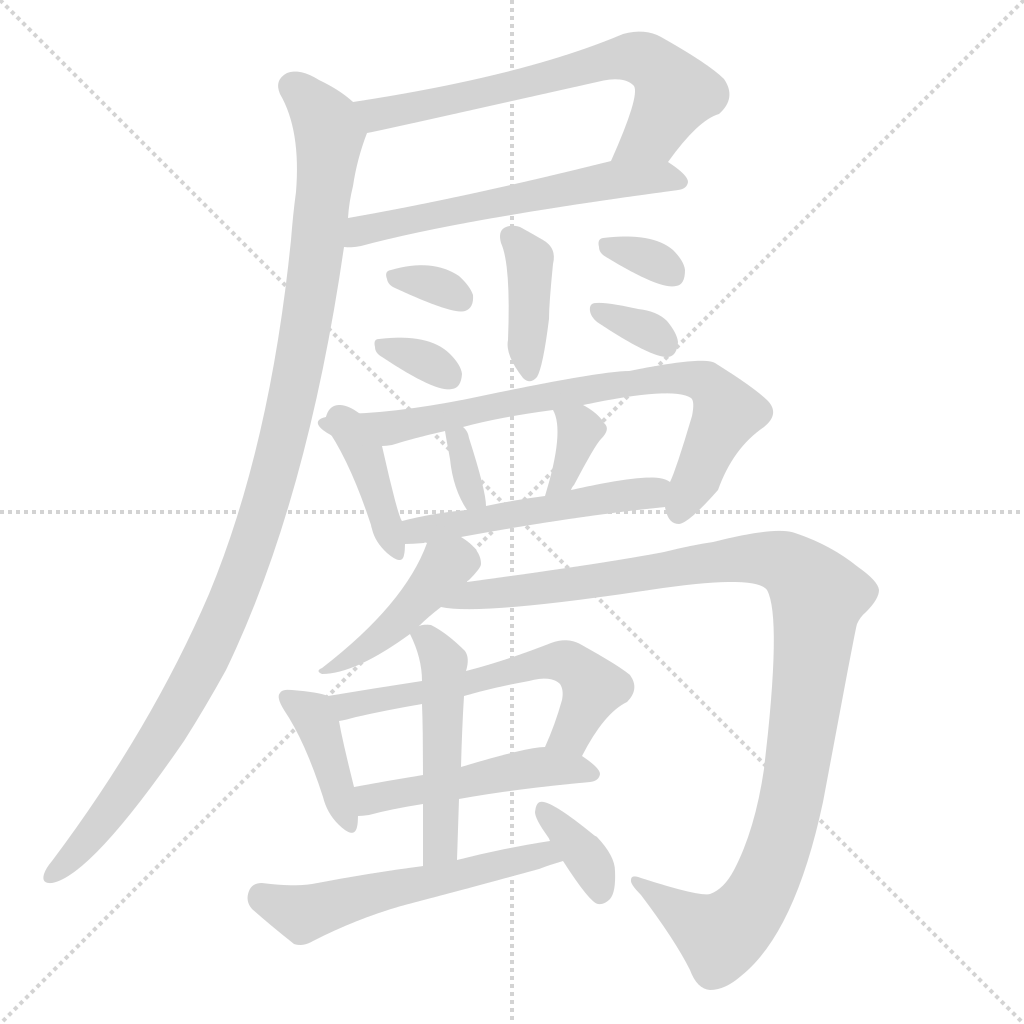
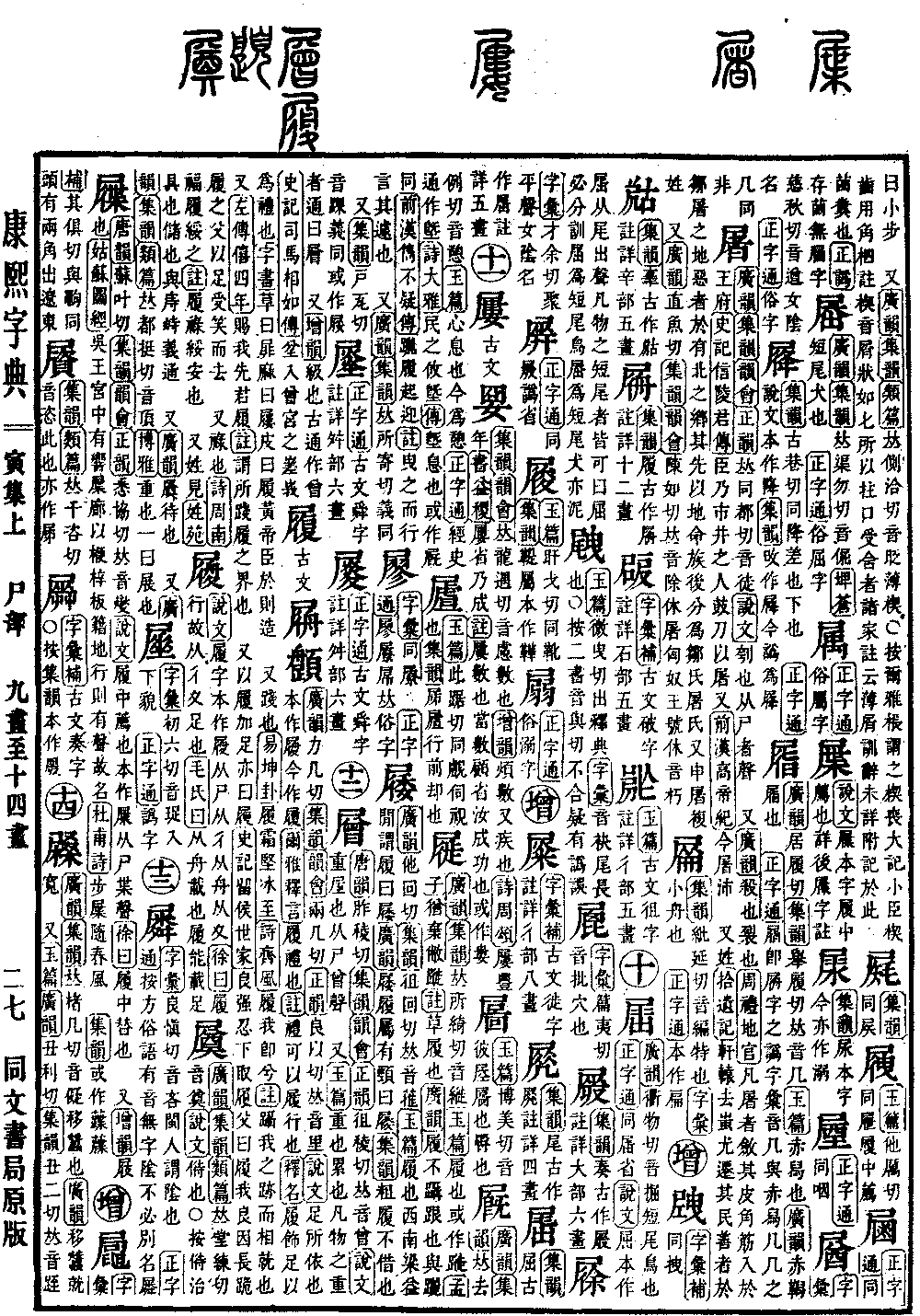
Yin Collection, Upper Volume
Radical: Corpse (shī)
Kangxi Strokes: 21
Page 303, Entry 01
Pronounced zhu (rising tone)
According to the Explanations of Graphs and Analysis of Characters (Shuowen Jiezi), it means to connect. It is formed from the radical for tail, with the character shu acting as the phonetic component. Xu Shen says: To be connected, like a tail attached to a body, hence it is formed from the radical for tail.
According to the Extensive Dictionary of Characters (Guangyun), it means to gather or to assemble.
Rites of Zhou (Zhouli), Section on District Chiefs (Zhouzhang): On a lucky day of the first lunar month, each shall assemble the people of their district to read the state laws. Commentary: To assemble means to gather.
Mencius (Mengzi): Thereupon, he assembled the village elders and informed them.
It also means to entrust.
Zuo Commentary (Zuo Zhuan), Third Year of Duke Yin: Duke Mu of Song was critically ill; he summoned the Grand Marshal Kongfu and entrusted Duke Shang to him.
Records of the Grand Historian (Shiji), Biography of the Marquis of Liu: Among the generals of the King of Han, only Han Xin is capable of being entrusted with great affairs and handling matters independently.
It also refers to a respectful appearance.
Book of Rites (Liji), Section on Rites and Vessels (Liqi): A look of great reverence manifesting loyalty. Commentary: This refers to a respectful appearance.
It also means continuous or connected.
Records of the Grand Historian (Shiji), Biography of Lord Xinling: The carriages and horses of the envoys from Lord Pingyuan arrived in the State of Wei in an endless stream.
Also, from Discourses of Jin (Jinyu): One will surely incur resentment. Commentary: Here, it means to bind or tie together.
It also means to satisfy or to be sufficient.
Zuo Commentary (Zuo Zhuan), Twenty-eighth Year of Duke Zhao: I only wish, with the mind of a petty man, to serve the heart of a superior man, being satisfied and knowing when to stop. Commentary: Here, it means enough; it implies that if a petty man knows when he is satisfied, a superior man should likewise do so.
Also, Zuo Commentary (Zuo Zhuan), Twenty-third Year of Duke Xi: He held a whip and a bow in his left hand, and hung his quiver and bow case on his person to circle around you. Commentary: This refers to attaching or wearing.
Rites of Zhou (Zhouli), Winter Officials, Record of the Artificer (Kaogongji): The method for inspecting a carriage is to ensure its structure is sturdy and tightly attached while the surface area touching the ground remains small. Commentary: This means to be firmly attached.
It also means to show compassion or to provide relief.
Book of Documents (Shangshu), Zi Cai: To the extent of showing respect for the widowed and orphaned, and to the extent of providing relief to the wives and concubines. Commentary: Here, it means to inquire after and show compassion. Wives refers to wives and concubines.
It also refers to the number of scales on armor.
History of the Former Han (Qian Hanshu), Treatise on Law: The warriors of the State of Wei wore armor of three layers. Commentary by Ru Chun: One layer for the torso, one for the thigh covering, and one for the leg wrappings; there are three in total, all connected.
Pronounced shu
Classic of Poetry (Shijing), Lesser Odes (Xiao Ya), Constant Affection (Chang Di): Commentary by Zheng Xuan: Here, it refers to the ordered sequence of ancestral temples according to their rank (zhao and mu).
Also, as noted in the Supplement to the Rhymes (Zengyun), it means to be subordinate or to be under the jurisdiction of; it refers to subordinate officials or a staff.
Book of Rites (Liji), Royal Regulations (Wangzhi): Beyond one thousand miles, regional lords were established, with five states forming one subordinate group, each with a leader.
Book of Documents (Shangshu), Offices of Zhou (Zhouguan): Each leading their own subordinate officials to provide guidance to the officials of the Nine Provinces.
It also refers to the same clan or lineage.
Records of the Grand Historian (Shiji), Biography of Tian Dan: Tian Dan was a distant relative of the Tian clan of Qi.
It also means category or peer.
Records of the Grand Historian (Shiji), Biography of the Marquis of Liu: Now, Your Majesty has risen from the common people and relied on these men to gain the world, yet those you have enfeoffed are all old friends like Xiao He and Cao Can.
It also means to follow or to accompany.
Records of the Grand Historian (Shiji), Annals of Xiang Yu: When Xiang Yu crossed the Huai River, only about one hundred cavalrymen were able to follow him.
Also, History of the Former Han (Qian Hanshu), Biography of Jia Yi: Skilled at writing literary compositions. Commentary by Yan Shigu: Here, it means to connect and compile.
Also, Zuo Commentary (Zuo Zhuan), Second Year of Duke Cheng: Han Jue said: Your humble servant is unfortunate to have been caught in the ranks of the army. Commentary: Here, it means to happen to be or to be currently in a situation.
Also, Book of Documents (Shangshu), Tribute of Yu (Yu Gong): The Jing River connects to the bend of the Wei River. Commentary: It means to reach. Ma Rong says it means to enter.
Pronounced zhu (rising tone)
It means to pour.
Book of Etiquette and Ceremonial (Yili), Marriage Rites of Gentlemen (Shi Hun Li): Scoop the dark wine three times and pour it into the vessel. Commentary: Here, it means to pour.
Also, Discourses of Jin (Jinyu): If I take the lead, I fear the eyes and ears of the people of the state will all be focused on me. Commentary: It means to fix one's gaze upon.
Also, Qu Yuan, Encountering Sorrow (Lisao): I bid Wangshu to serve as my vanguard in the front, and bid Feilian to run and follow in the rear.
Also, rhyming with shu (falling tone).
Classic of Poetry (Shijing), Lesser Odes (Xiao Ya): If a gentleman has a strategy, the petty man will come to attach himself. (This rhymes with the character fu).
Also, rhyming with zhu (falling tone).
Ban Gu, Western Capital Rhapsody (Xidu Fu): Ascend the tomb path and cross the western wall, connecting to the Jianzhang Palace and linking to the outer auxiliary buildings. (This rhymes with the character ge and the character jue).
Essential Information on Characters (Zhengzitong): The common form written with the character for entrust is incorrect.