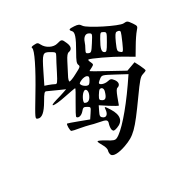
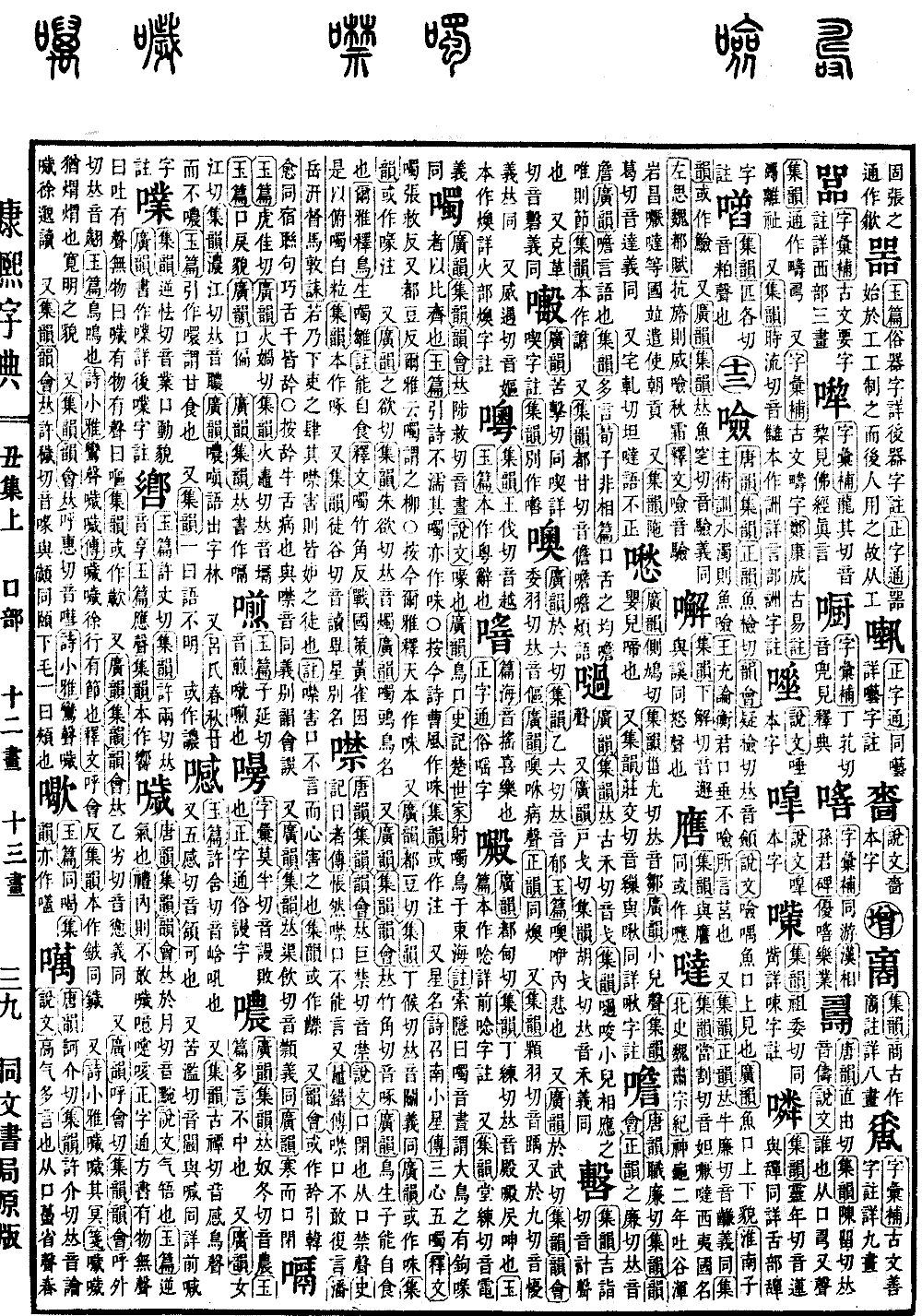
Chou Collection, Upper Volume
Radical: Mouth (kǒu)
Kangxi Strokes: 16
Page 209, Entry 29
Pronounced zhou (falling tone).
In the Shuowen Jiezi (Shuowen), it means a beak.
In the Guangyun, it refers to a bird's beak.
In the Records of the Grand Historian (Shiji), Chu Shijia, it is written: shoot the beak-bird in the Eastern Sea.
The commentary notes: The Suoyin states the pronunciation is zhou, referring to a large bird with a hooked beak, used here to compare to the State of Qi.
The Yupian cites the Book of Odes (Shijing): do not wet its beak. Also written as zhu. Note that in the current version of the Book of Odes, Cao Feng, it is written as zhu.
The Jiyun notes it is sometimes written as zhu.
Also, it is a star name.
In the Mao Commentary (Zhuan) on the Book of Odes (Shijing), Xiaonan, it says: three hearts and five beaks.
The Shiwen commentary indicates the pronunciation is zhou (falling tone) and also dou (falling tone). The Erya says the beak is called willow. Note that in the current version of the Erya, Shitian, it is written as zhu.
Also, pronounced dou (falling tone). The meaning is the same.
In the Guangyun, it is sometimes written as zhu.
In the Jiyun, it is sometimes written as hui or zhu.
Also, pronounced zhu (entering tone).
In the Guangyun, it is the name of a bird.
Also, pronounced zhuo (entering tone).
In the Guangyun, it refers to when a bird gives birth to offspring that are able to feed themselves.
In the Erya, Shiniao, it is written: birth of a feeding chick.
The commentary notes: able to feed itself.
The Shiwen commentary indicates the pronunciation is zhuo (entering tone).
In the Strategies of the Warring States (Zhan Guo Ce), the yellow sparrow, because of this, bows down to peck (zhuo) at white grains.
The Jiyun notes the original form is zhuo.
Also, pronounced du (entering tone). Another name for the Net star.