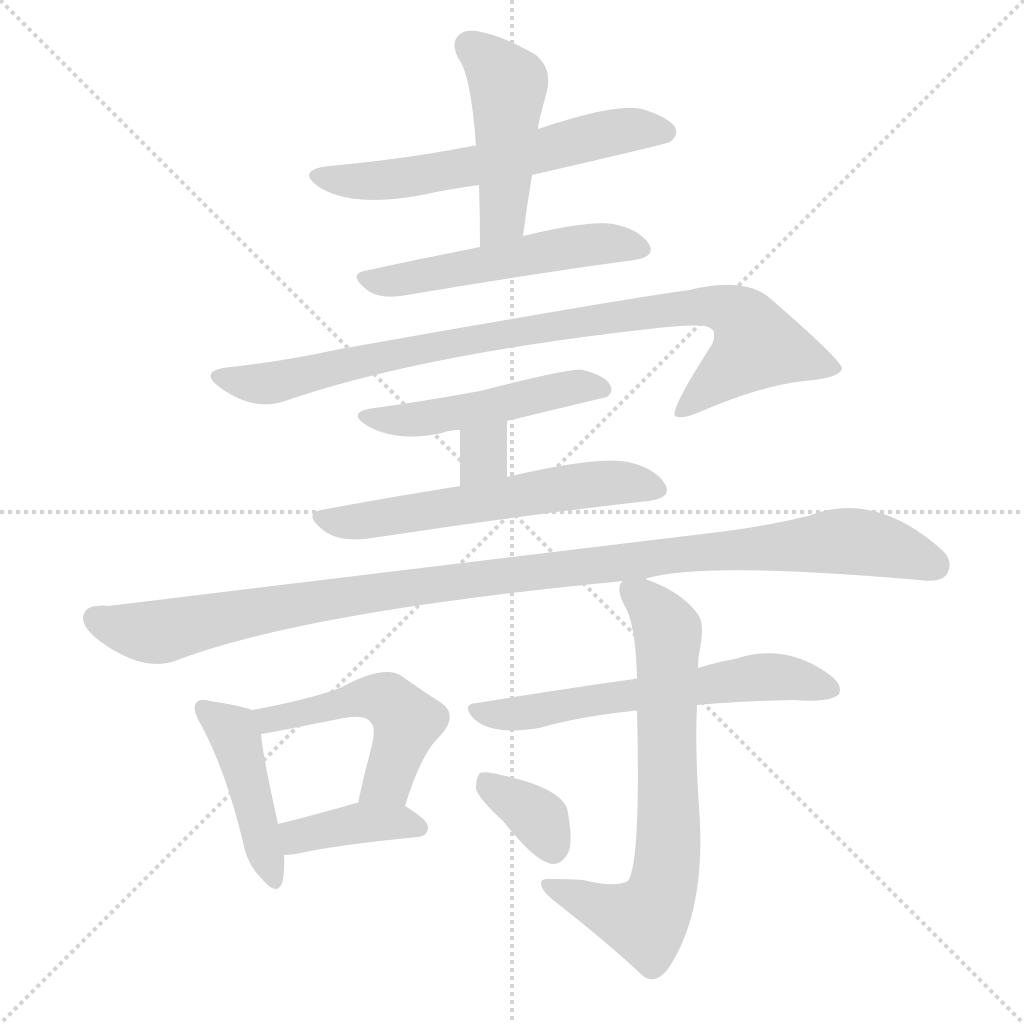
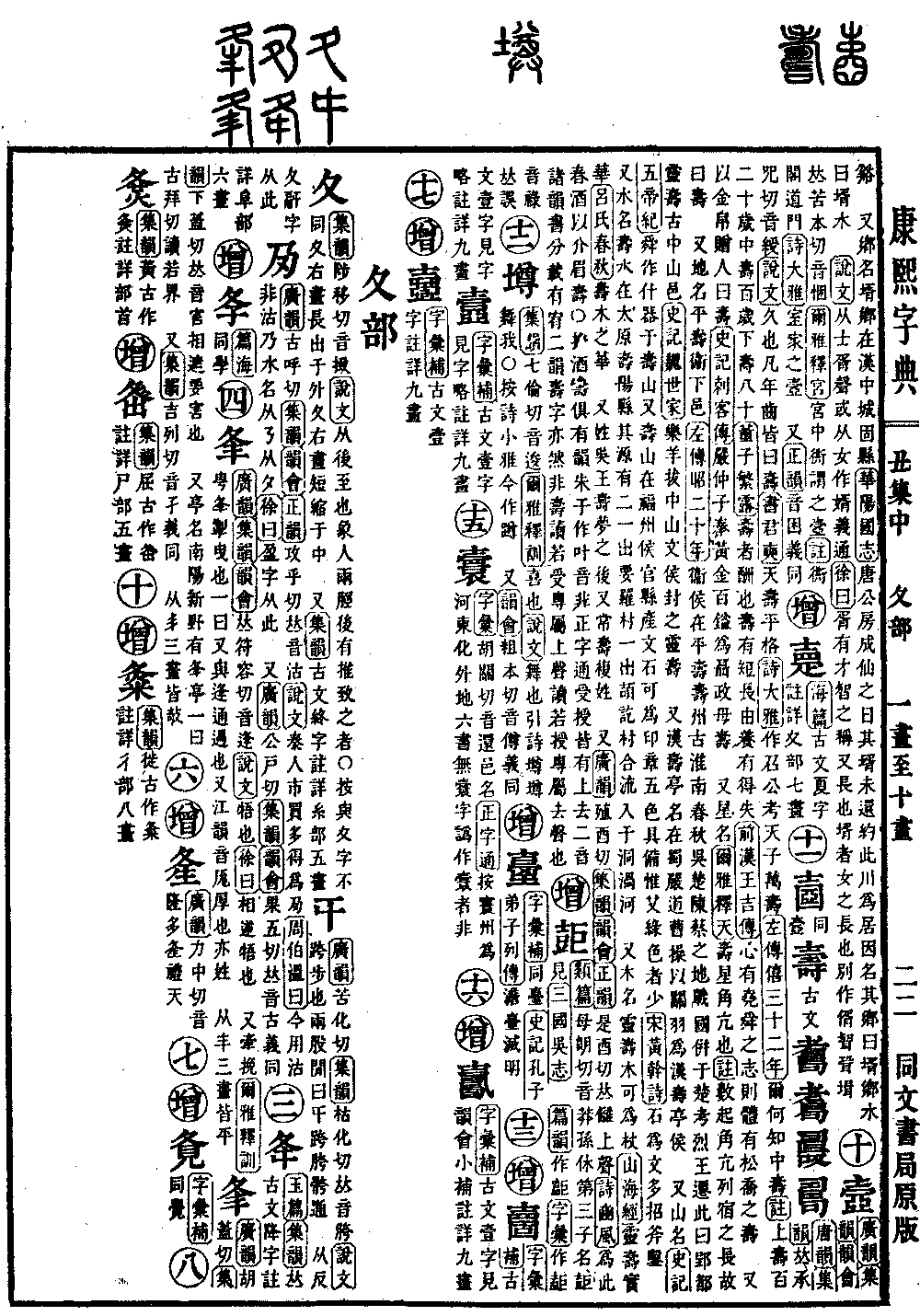
Chou Collection, Middle Volume. Radical: Scholar (shì). Kangxi Strokes: 14. Page 244, Entry 04.
Ancient script. According to the Tang Rhymes (Tangyun) and the Collected Rhymes (Jiyun), the pronunciation is shòu. According to the Analytical Dictionary of Characters (Shuowen), it means long-lasting. All references to years are called shòu. In the Book of Documents (Shangshu), chapter Jun Shi: Heaven granted longevity to the upright. In the Book of Odes (Shijing), Great Odes: Making sacrifices to the Duke of Zhao, the Son of Heaven shall have ten thousand years of longevity. In the Zuo Tradition (Zuo Zhuan), 32nd year of Duke Xi: What do you know of middle longevity? The commentary states: The highest longevity is 120 years, middle longevity is 100 years, and lowest longevity is 80 years. In Master Dong's Luxuriant Dew (Chunqiu Fanlu): Longevity is a form of recompense. The length of one's lifespan depends on whether one's preservation of life is skillful or lacking. In the History of the Former Han (Qian Hanshu), Biography of Wang Ji: If one holds the aspirations of Yao and Shun in their heart, then their body shall enjoy the longevity of Chi Songzi and Wang Ziqiao.
It is also used for gifts of gold, silver, silk, and fabrics given to others for their birthday. In the Records of the Grand Historian (Shiji), Biography of Assassins: Yan Zhongzi presented one hundred yi of gold to Nie Zheng to celebrate his mother's birthday.
It is also the name of a star. In the Literary Expositor (Erya), Interpretation of Heaven: The Longevity Star refers to the Horn (Jiao) and Neck (Kang) lunar mansions. The commentary states: The order of the constellations begins with the Horn and Neck mansions; they are the leaders of all constellations, hence they are called longevity.
It is also a place name. Pingshou was a border town of the State of Wei. In the Zuo Tradition (Zuo Zhuan), 20th year of Duke Zhao: The Marquis of Wei was at Pingshou. Shou Prefecture was ancient Huainan; during the Spring and Autumn period, it was the territory of the states of Wu, Chu, and Cai. During the Warring States period, it was annexed by Chu, and King Kaolie moved his capital there, naming it Yingdu. Lingshou was a city of the ancient State of Zhongshan. In the Records of the Grand Historian (Shiji), House of Wei: Yue Yang conquered Zhongshan, and Marquis Wen of Wei enfeoffed him at Lingshou. Hanshou was a pavilion, located in Yandao in the Shu region. Cao Cao enfeoffed Guan Yu as the Marquis of Hanshou Pavilion.
It is also a mountain name. In the Records of the Grand Historian (Shiji), Annals of the Five Emperors: Shun made daily utensils at Shou Mountain. There is also a Shou Mountain in Houguan County, Fuzhou, which produces patterned stone that can be carved into seals. It comes in five colors, though the mugwort-green variety is rare. In a poem by Huang Gan of the Song dynasty: The stone attracts the chisel because of its many veins.
It is also a river name. Shou River is in Shouyang County, Taiyuan. It has two sources, one originating at Yaoluo Village and the other at Xieqi Village, which converge and flow into the Dongwo River.
It is also a tree name. Lingshou wood can be used to make walking sticks. In the Classic of Mountains and Seas (Shanhaijing): The Lingshou tree flowers and bears fruit. In the Master Lu's Spring and Autumn Annals (Lu Shi Chunqiu): The shòu tree flowers.
It is also a surname. It descends from King Shou Meng of Wu. There is also Changshou, which is a double-character surname.
Also, according to the Guangyun, pronunciation is shǒu; according to Jiyun, Yunhui, and Zhengyun, pronunciation is shǒu, similar to the rising tone of chou. In the Book of Odes (Shijing), Odes of Bin: Preparing this spring wine, to assist in eyebrow-longevity. Note: Both wine and longevity rhyme here; Zhu Xi considered this a forced rhyme, but that is incorrect. The Zhengzitong states that both shòu (to receive) and shòu (to grant) have both rising and departing tone pronunciations, and various rhyme dictionaries record them under the respective rhyme categories. The character shòu is the same; it is not the case that it is exclusively rising tone when read as receive or exclusively departing tone when read as grant.