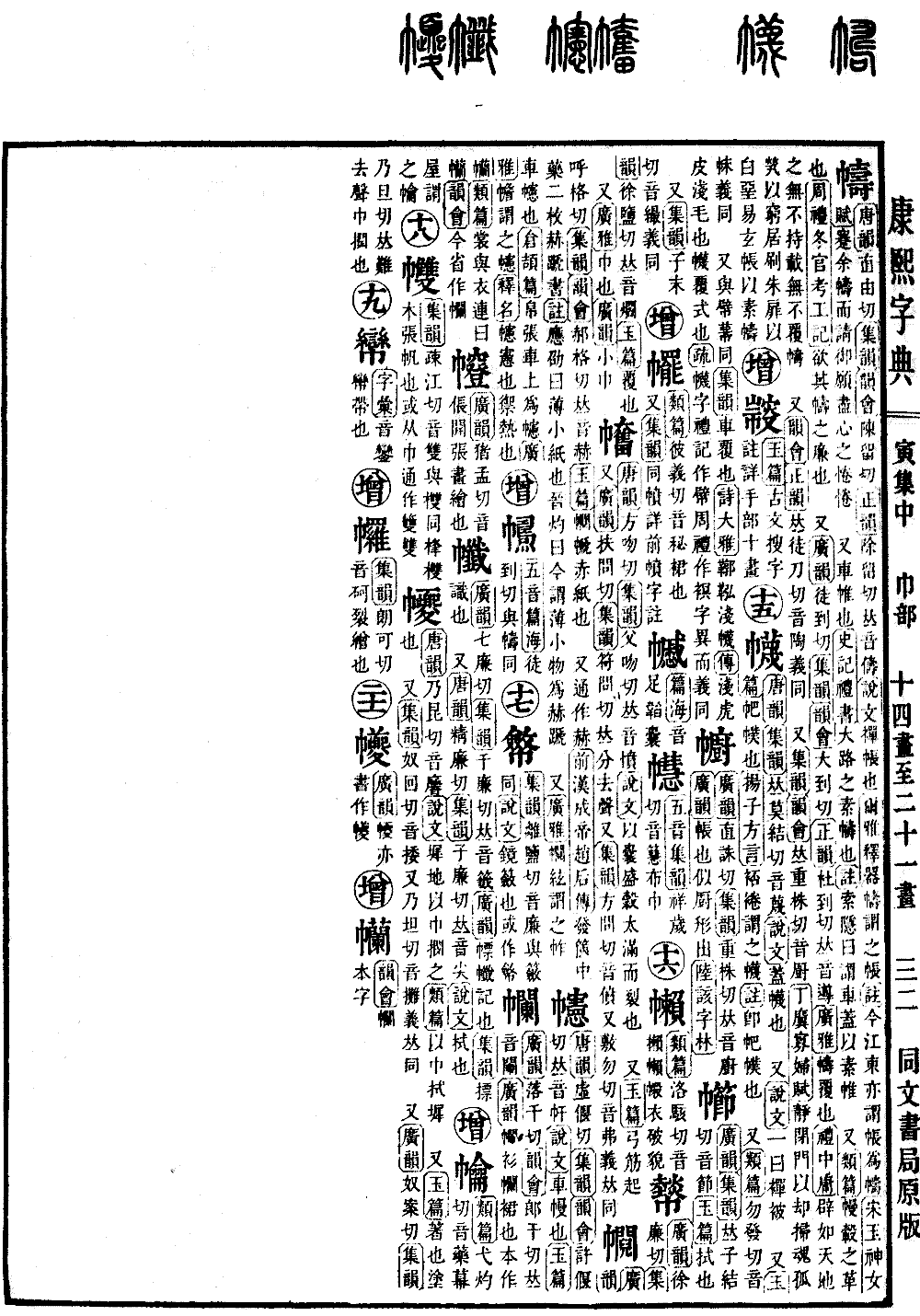
Yin Collection, Middle Volume
Radical: Turban (jīn)
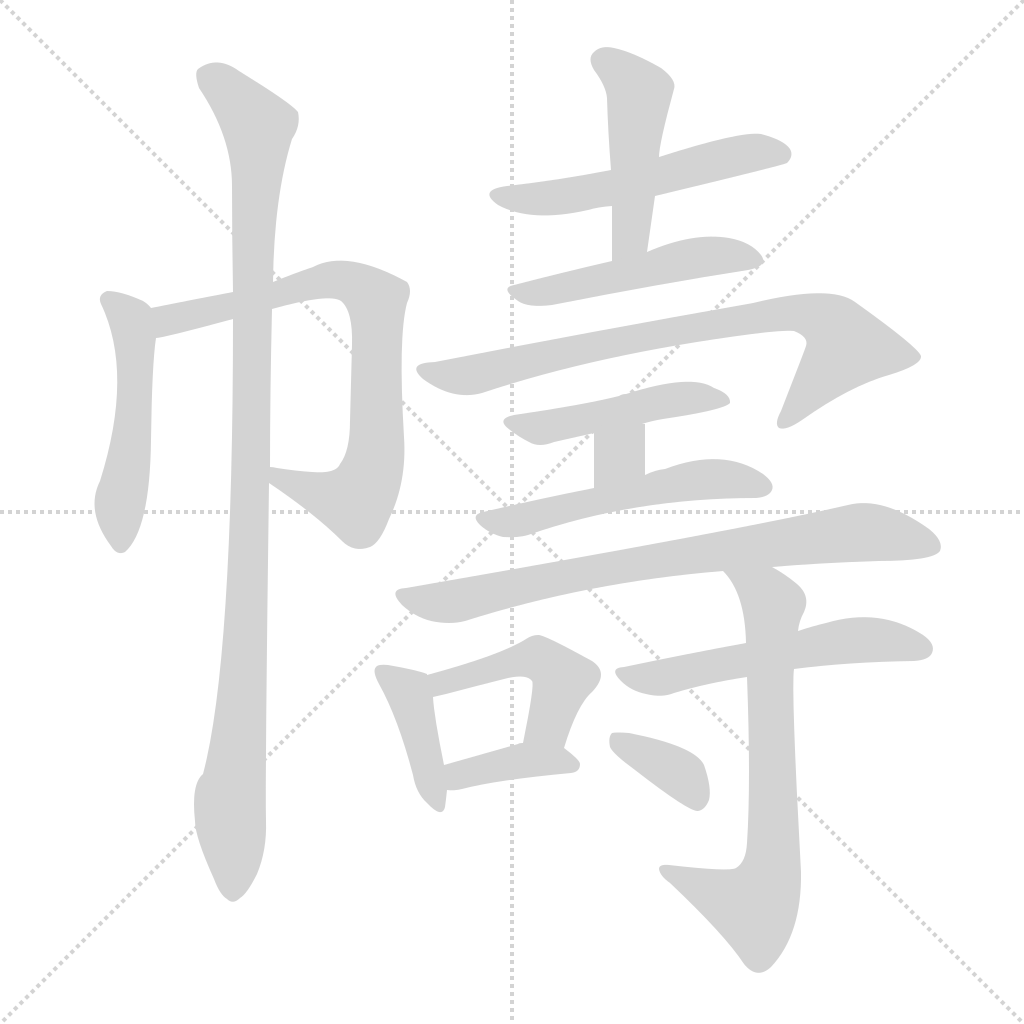
幬
Kangxi strokes: 17
Page 338, Entry 01
Pronounced chou.
Shuowen Jiezi (Dictionary of Explanations and Analysis of Characters): A single-layered curtain or tent.
Erya (Approaching Elegance), section on Explanations of Teachings (Shixun): A curtain is called a chou.
Commentary: In the present Jiangdong region, people also call a curtain a chou.
Song Yu, Rhapsody on the Goddess (Shennü Fu): Drawing back my curtains to request service, I wish to offer a sincere and earnest heart.
Also refers to the curtains on a carriage.
Records of the Grand Historian (Shiji), Treatise on Rites (Lishu): Large carriages use plain-colored carriage curtains.
Commentary: The Suoyin (Search for Hidden Meanings) states: This refers to the carriage canopy using a plain-colored curtain.
Also, according to the Leipian (Classified Dictionary): Leather that wraps around the carriage hub.
Rites of Zhou (Zhouli), Winter Officials, Record of Trades (Kaogongji): Hoping it is wrapped so that the corners are distinct.
Pronounced dao.
Guangya (Broad Refinement): Chou means to cover or overspread.
Book of Rites (Liji), Doctrine of the Mean (Zhongyong): It is as if there is nothing in heaven and earth that is not carried, and nothing that is not covered.
Pronounced tao.
The meaning is the same.
Pronounced chu.
Ding, Rhapsody on the Widow (Guafu Fu): Quietly closing the door to stop receiving guests, the spirit dwells in lonely confinement. Whitewashing the vermilion gates, changing the embroidered curtains for plain-colored ones.
Textual research:
In Erya, section on Explanations of Vessels (Shiqi), it says a chou is called a curtain. According to the original book, this has been corrected from Explanations of Vessels to Explanations of Teachings.