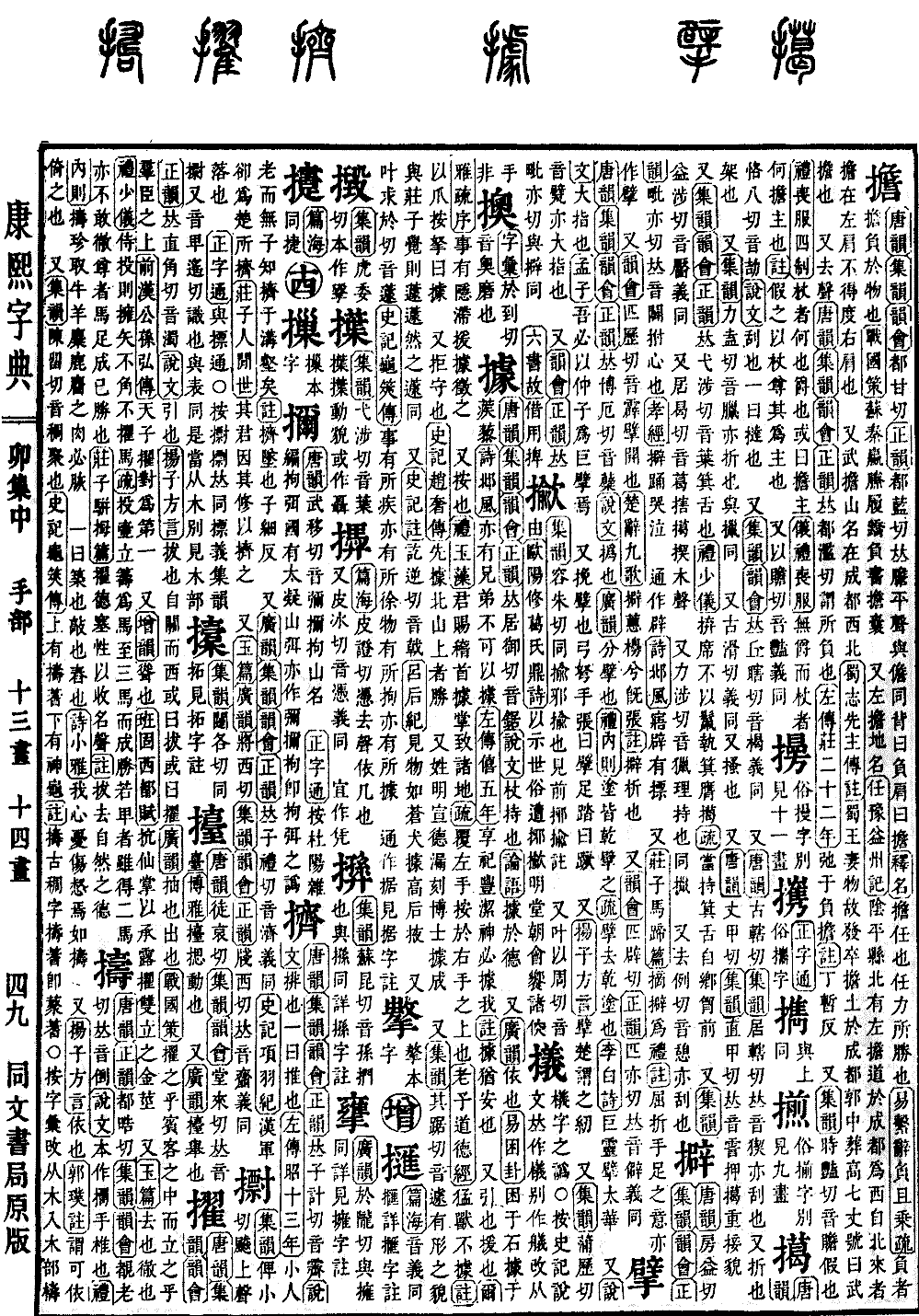
Mao Collection, Middle Volume
Radical: Hand (shǒu)
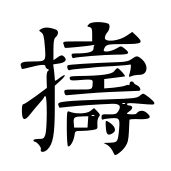
Entry: 擣
Kangxi strokes: 18
Page 459, Entry 28
Pronounced dǎo.
According to the Shuowen Jiezi (Explanation of Graphs and Analysis of Characters), it is the original form of the character. It means to push and strike with the hand.
In the Book of Rites (Liji), it is written: when preparing delicacies, one must use the tenderloin of beef, mutton, elk, deer, or muntjac. Another interpretation defines it as to build, to pound, or to hull.
In the Book of Odes (Shijing), it is written: my heart is sorrowful, my anxieties are as if I am being pounded by a pestle.
Also, in the Fangyan (Regional Dialects) by Yangzi, it means to rely or to depend upon. Guo Pu notes: it refers to something that can be relied or leaned upon.
Also, according to the Jiyun (Collected Rhymes), it is pronounced chóu. It means to gather or to crowd together.
In the Records of the Grand Historian (Shiji), it is written: above there are dense milfoil plants, and below there are divine tortoises. The commentary notes: this 擣 is the ancient form of the character for dense (chóu). 擣蓍 refers to dense or clustered milfoil.
The Zihui (Compendium of Characters) erroneously changed this to a form with the wood radical, classifying it under the character táu. This commentary is incorrect.
Sometimes also written in a variant form (dǎo). Also written in a variant form (dáo). Commonly written in a variant form.