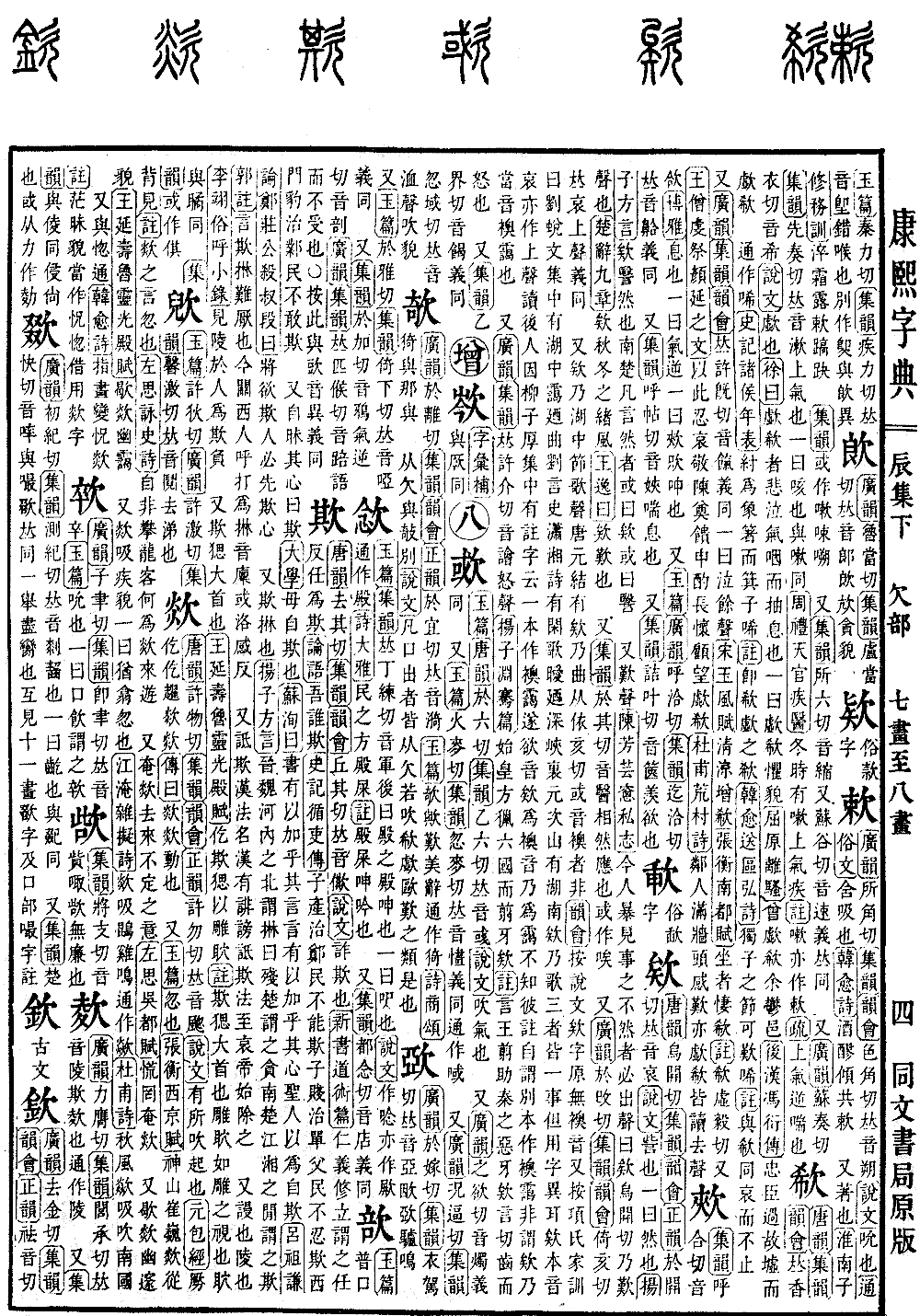
Chen Collection, Lower Volume
Radical: Lack (qiàn)
Page 568, Entry 21
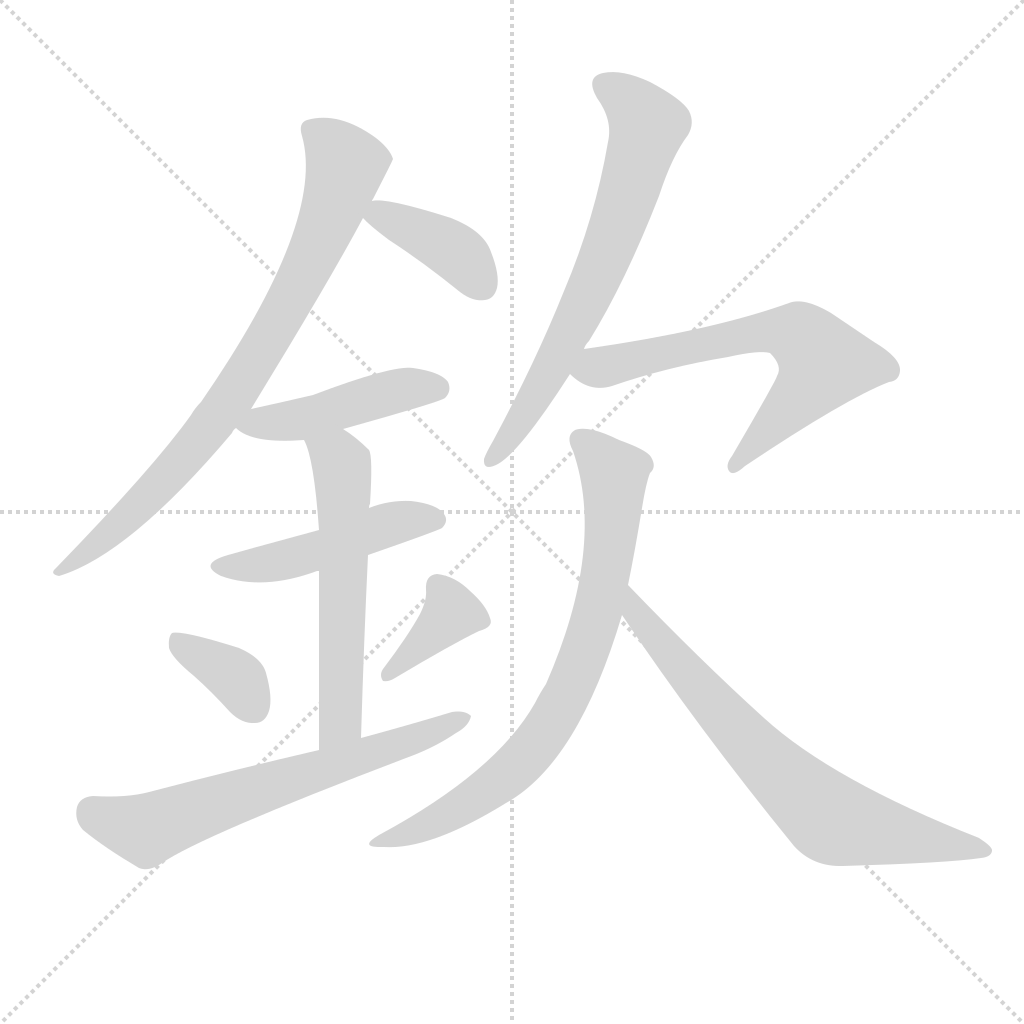
Ancient form. Pronounced qin.
In the Explanation of Characters (Shuowen Jiezi), it denotes the appearance of one lacking something. Another meaning is to respect.
In the Book of Documents (Shangshu), Chapter Canon of Yao (Yao dian): To be respectful, wise, accomplished, and thoughtful, maintaining serenity.
Also in the Taijia chapter: Respect your stopping point.
In the Collection of Proper Characters (Zhengzitong): Today, imperial pronouncements are called imperial commands; envoys are called imperial orders; colloquially, one says imperial envoy. All take the meaning of respect.
Also qin qin, the meaning of longing or looking forward to.
In the Book of Odes (Shijing), Chapter Odes of Qin (Qin feng): My worried heart is qin qin.
In the Mao Commentary: Longing for it, the heart is qin qin.
Also, the rhythmic sound of bells.
In the Book of Odes (Shijing), Chapter Minor Odes (Xiao ya): The sounding of bells is qin qin.
Also a posthumous title.
In the Bamboo Annals (Zhushu jinian): To have all forms of dignity and decorum fully prepared is called qin.
Also a prefecture name. Also a river name.
In the Dictionary of Rhymes (Yunhui): During the Liang dynasty it was Anzhou; during the Sui dynasty it was renamed Qinzhou, taking the name from the Qin River.
In the Records of the World (Guangyuji): It belongs to Lianzhou Prefecture in Guangdong. The prefecture has the Qin River and the Longmen River.
Also a mountain name.
In the Classic of Mountains and Seas (Shanhaijing): Mount Qin has much gold and jade but no stone; the Shi River originates there.
Also Qinkou.
In the Book of Han (Hanshu), Treatise on Geography: In Wu'an County of Weijun, Mount Qinkou is where the Baiqu River originates.
Also Qinyuan, both are bird names. Found in the Classic of Mountains and Seas (Shanhaijing).
Also a surname.
In the Heshi Xingyuan: They are people of Wu. During the Song dynasty, there was Qin Dezai, who called himself the Old Man of Shouyan.
Also pronounced in the departing tone: to press.
In Li Yi's Records of Colloquial Terms (Suhu xiaolu): To press is called qin. Qin, departing tone.
In Wang Ju's Classic of Archery (Shejing): Press the body slightly curved, and fix the gaze on the target.
Also: When drawing the bow and releasing the arrow, one must press the body and hold the bow handle outward, clearly recognizing the mark.
Also pronounced yin. The same as to groan (yin). To moan.
In the Classic of Mountains and Seas (Shanhaijing): Mount Gang has many spirits, and their sound is like qin.
Guo Pu's commentary: Qin is also a phonetic loan for the character to groan (yin).
Note: In the Treatise of the Han Dynasty (Hanshu), it says: Internal is called reverence, external is called respect (qin). Also Zheng Kangcheng says: To respect affairs and be frugal in usage is called respect (qin). Respect (qin) originally refers to both internal and external; it cannot be solely attributed to the external. Since respecting affairs and being frugal does not fully capture the meaning of respect (qin), it is not included in the primary definitions but appended here.