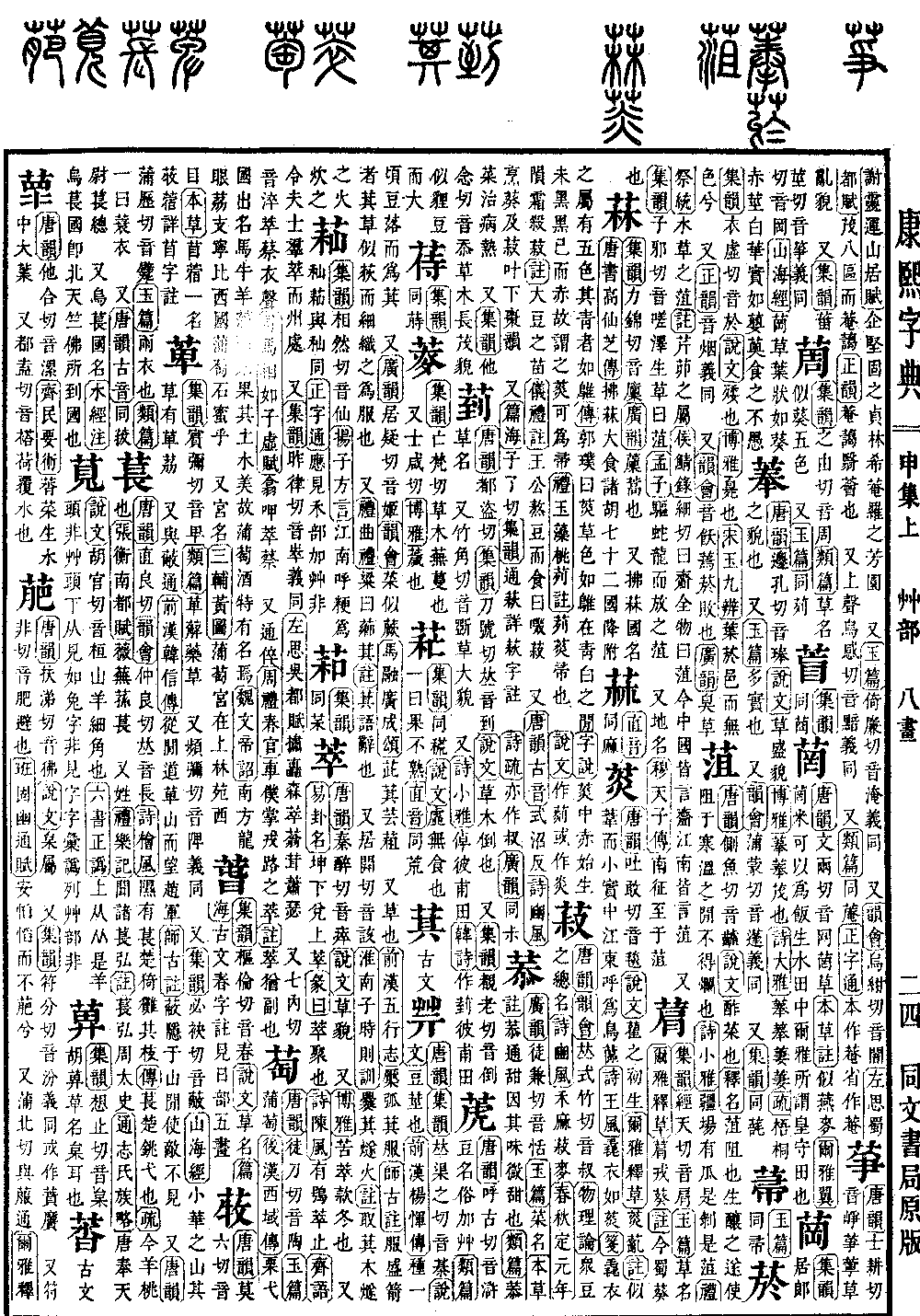
Shen Collection, Upper Volume
Radical: Grass (cǎo)
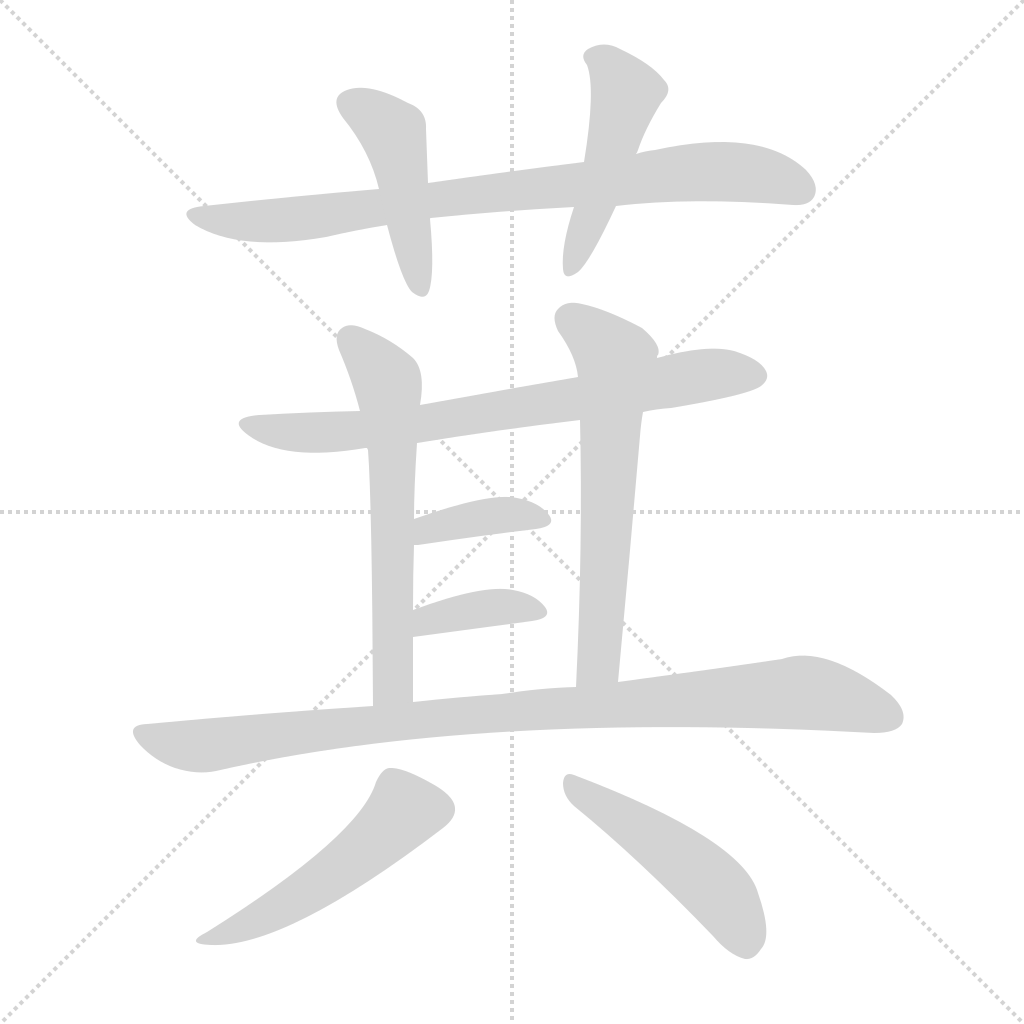
Character: Qi
Kangxi strokes: 14
Page 1040, Entry 21
Ancient form: From Tang Rhymes (Tangyun) and Collected Rhymes (Jiyun), it is pronounced qi.
According to the Explaining Graphs and Analyzing Characters (Shuowen Jiezi), it refers to the stalks of beans. In the Biography of Yang Yun from the Book of Han (Hanshu), it states: Plant a qing of beans, they wither and become stalks (qi).
Also, according to the Extensive Rhymes (Guangyun), it is pronounced ji. According to the Rhyme Compendium (Yunhui), it is a vegetable resembling a fern. In Ma Rong’s Eulogy of Guangcheng (Guangcheng Song), it mentions zi, qi, yun, and ju.
It also refers to a type of grass. In the Treatise on the Five Elements from the Book of Han (Hanshu), it mentions the mulberry bow and qi quiver. The commentary by Shigu notes: A quiver is something to hold arrows; qi grass resembles reeds but is finer, and it is woven to make such quivers.
Also, in the Book of Rites (Liji), specifically the Summary of the Rules of Proprietary Behavior (Quli), it mentions that millet is called xiangqi. The commentary states: Qi is a particle used in speech.
Also, pronounced gai. In the Training for the Seasons from the Huainanzi, it mentions cooking with qi wood to kindle fire. The commentary states: One takes the wood of the qi tree to create fire and use it to cook.