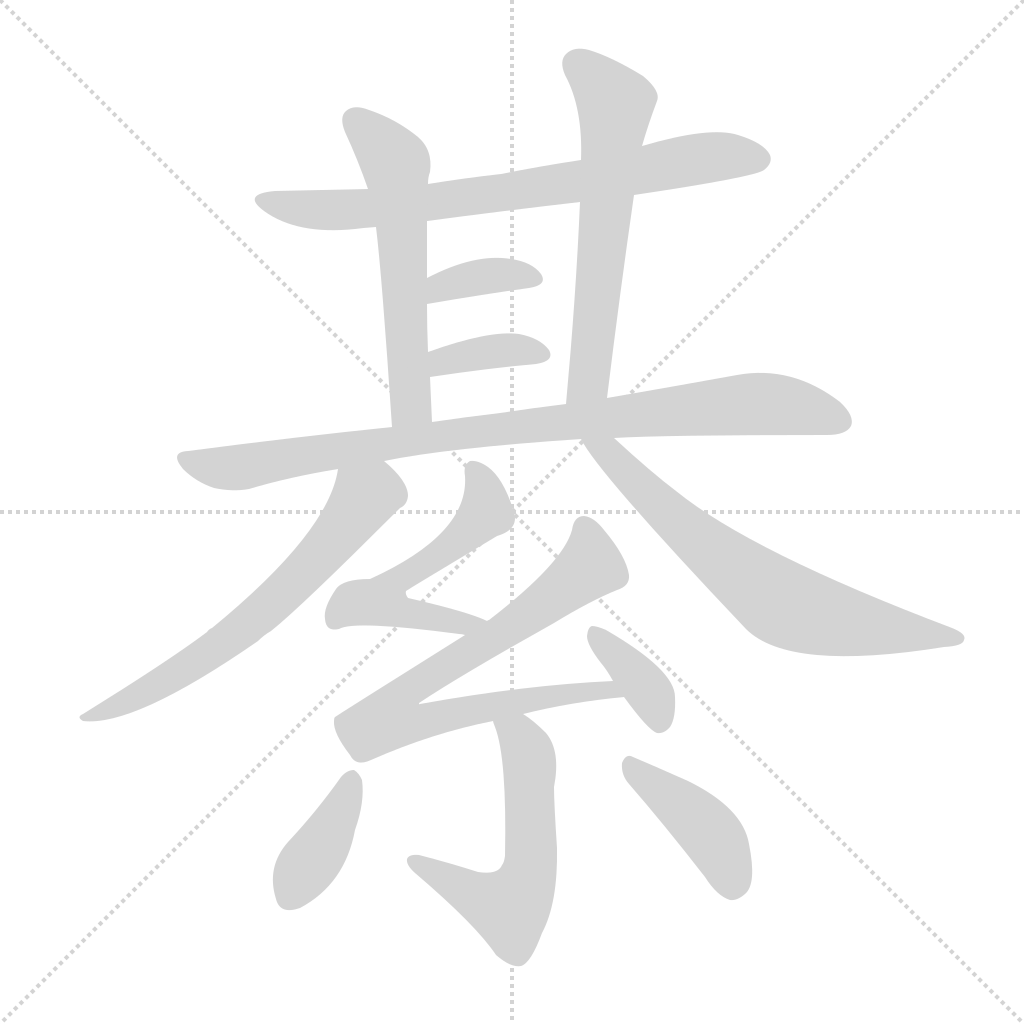
Wei Collection, Middle Volume
Radical: Silk (mì)
Kangxi Strokes: 14
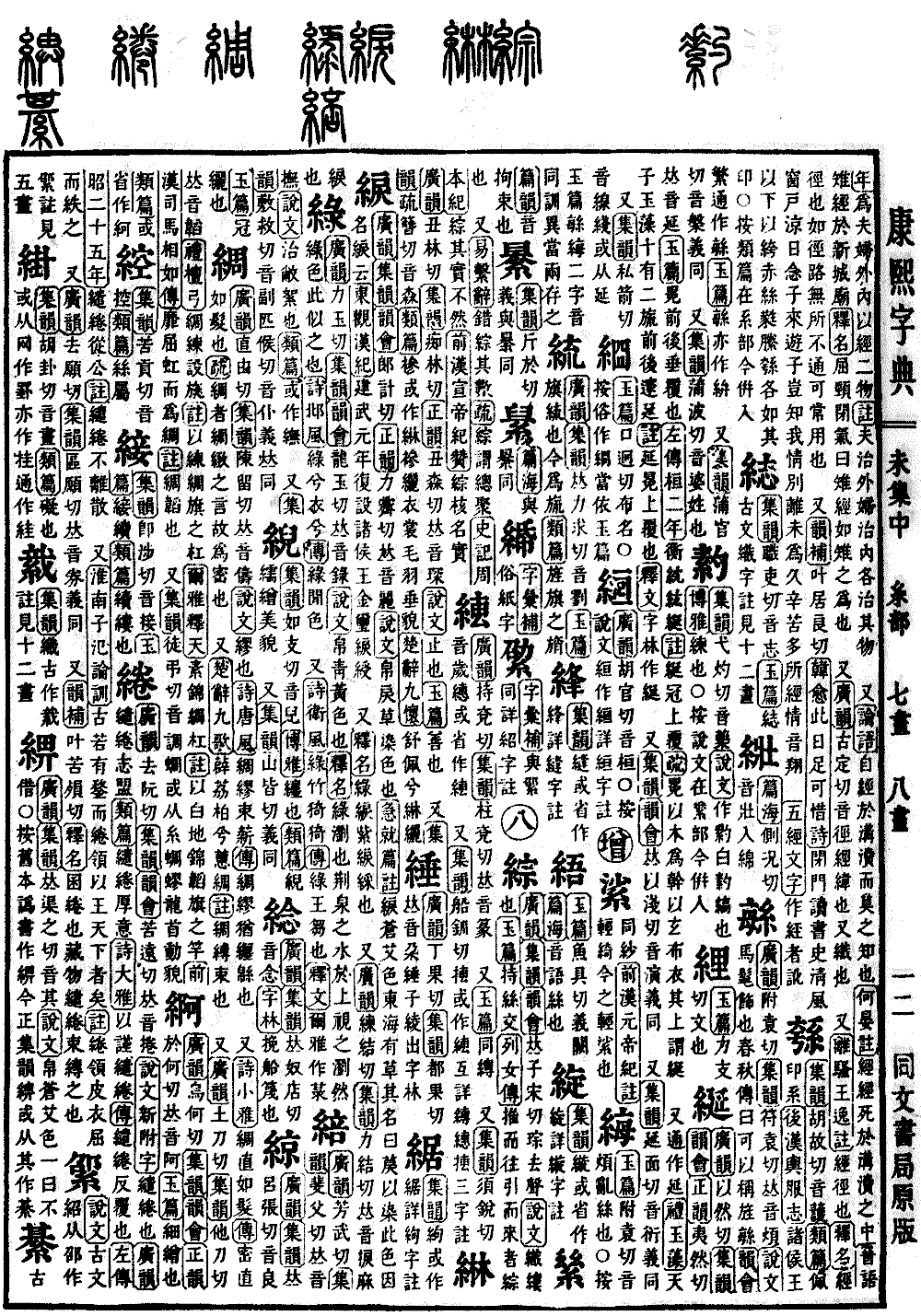
Page 926, Entry 41
Ancient text. According to the Broad Rhymes (Guangyun) and Collected Rhymes (Jiyun), and the Rhyme Collection (Yunhui), it is the same as the character for a silk headband. The Analytical Dictionary of Characters (Shuowen) states that the character for a silk headband is sometimes written with the component for that. Extensive Refinement (Boya) states that this character refers to colored patterns. The Book of Documents (Shangshu), in the chapter on The Testamentary Charge (Guming), mentions four men wearing caps with this character. The commentary says it refers to deer-skin caps with patterns of this type. The sub-commentary of Zheng Kangcheng says that a bluish-black color is called this. Wang Su says it refers to a reddish-black color. Furthermore, in the Book of Odes (Shijing), in the Odes of Zheng, there is a reference to white robes and caps of this color. The commentary states that the cap of this color is an article of clothing for unmarried women. The Analytical Dictionary of Characters, citing the Book of Odes, writes it with the silk radical and notes it as clothing worn by unmarried women. According to the Book of Etiquette and Ceremonial (Yili), in the chapter on Rites for the Funeral of an Officer (Shi Sangli), it refers to the ties on footwear. The annotation says that this is a shoe tie, used to secure the footwear. Furthermore, in the Xunzi, in the chapter on Kings and Hegemons, it says that if one is extremely great, one will rule, and if one is extremely small, one will perish. It also says that the eyes desire colors of the extreme, and the ears desire sounds of the extreme. The annotation states that this character means extreme or ultimate. It is sometimes written as another character, which is a scribal error. It is also a surname. According to the He Surname Registry in the Broad Rhymes, it is a surname of people from Yixing. According to the Collected Rhymes, it is pronounced ji (falling tone), with the same meaning. The original character was written with a different component, not the one that appears here.