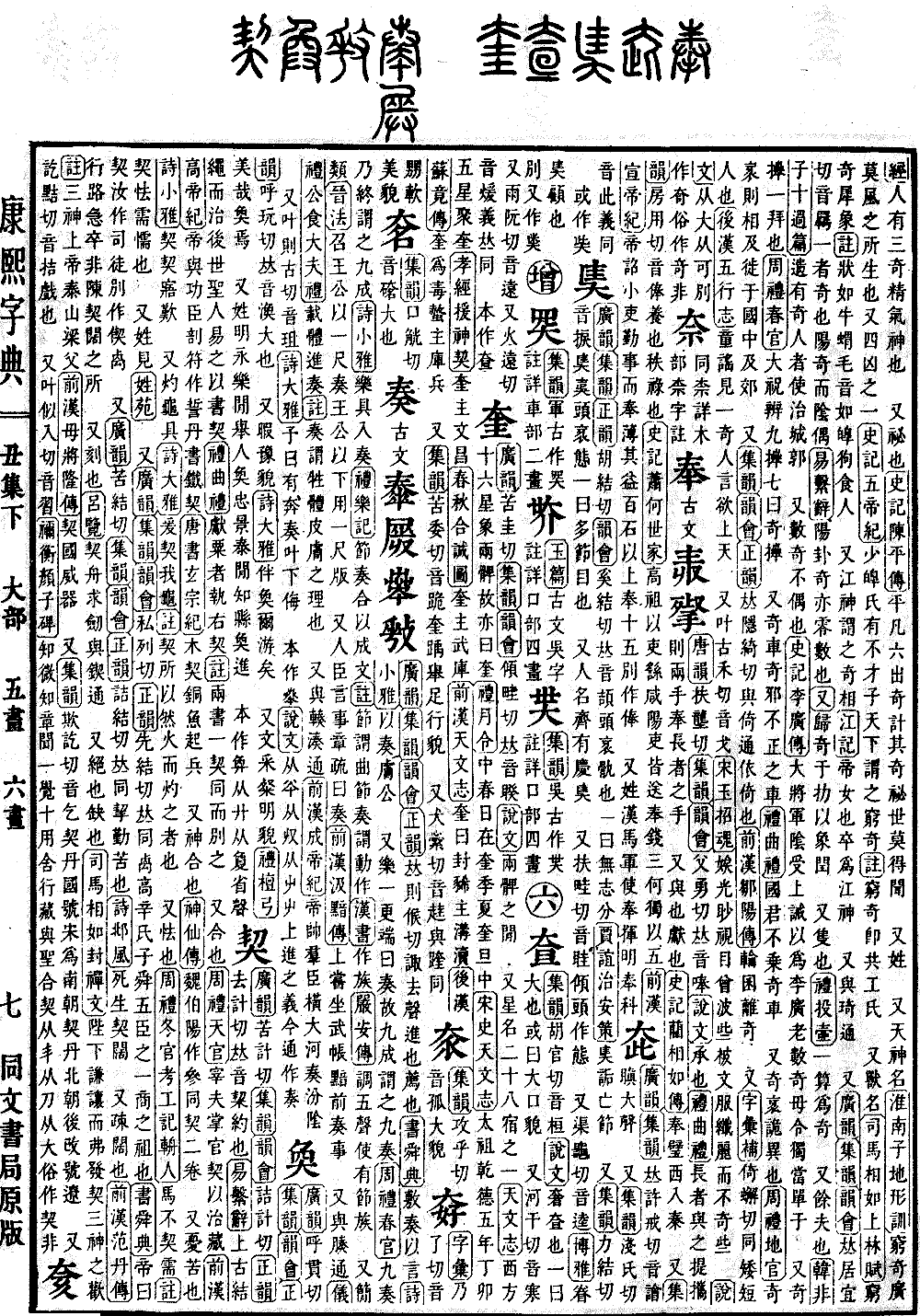
Chou Collection, Lower Volume
Radical: Big (dà)
Page 251, Entry 21
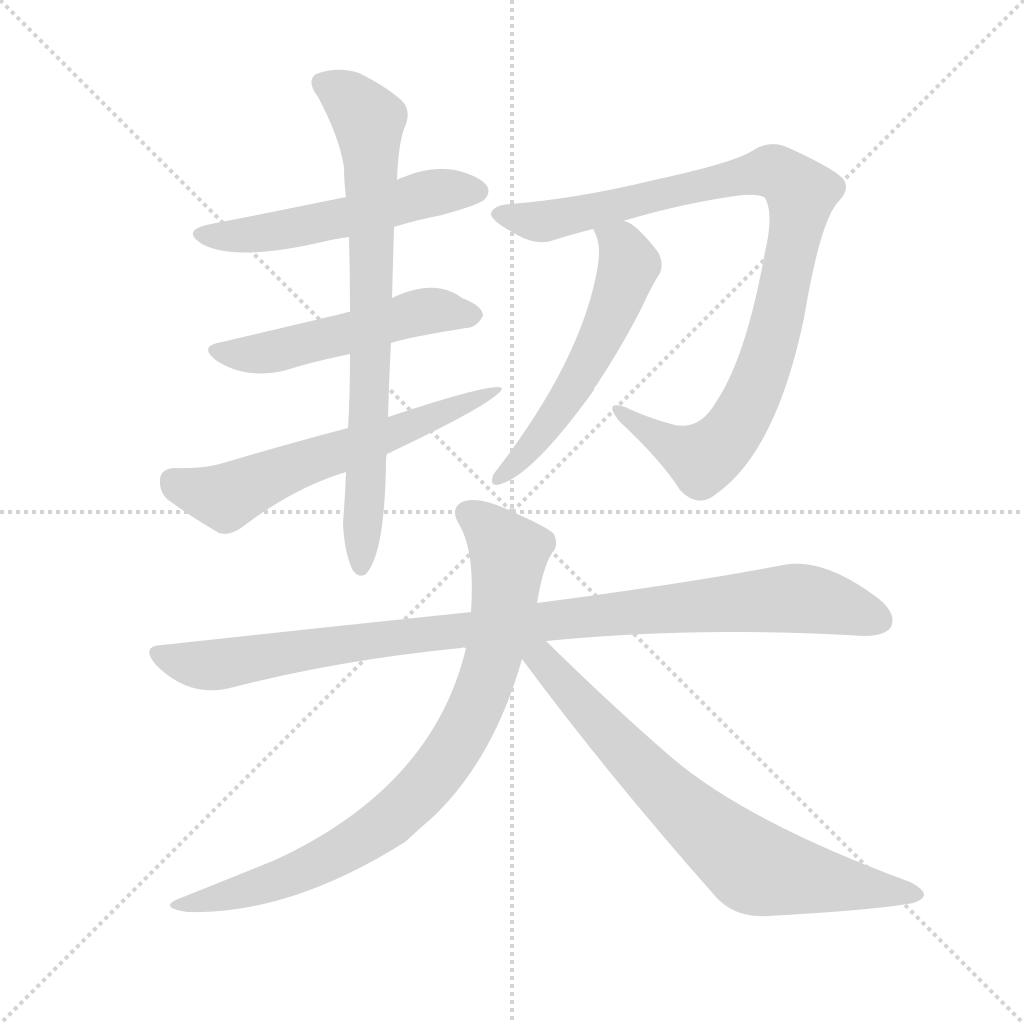
According to the Extensive Rhymes (Guangyun), the Collected Rhymes (Jiyun), the Rhyme Compendium (Yunhui), and the Correct Rhymes (Zhengyun), the character is pronounced qi (falling tone), same as the sound of qie. To agree or covenant. Book of Changes (Yijing), Appended Remarks: In high antiquity, they used knotted ropes to govern; in later ages, sages replaced this with writing and tallies. Book of Rites (Liji), Songs of Propriety (Quli): Those who offer grain hold the right-hand tally. Commentary: The two parties each hold one piece of the tally, matching them to verify the identity. Also, to join. Rites of Zhou (Zhouli), Offices of Heaven (Tianguan): The grand steward manages the official tallies to regulate the treasury. History of the Former Han (Qianhan), Annals of Emperor Gao: The Emperor and his meritorious officials split tallies and made oaths, with red writing on iron tallies. History of the Tang (Tangshu), Annals of the Imperial Clan: With wooden tallies and bronze fish, they raised an army. Also, a spiritual union. Biographies of Divine Immortals (Shenxian Zhuan): Wei Boyang wrote the Triplex Unity (Cantongqi) in two volumes. Also, to be anxious or distressed. Book of Odes (Shijing), Lesser Odes (Xiaoya): Anxiously I wake and sigh. Also, a tool for scorching tortoise shells. Book of Odes (Shijing), Greater Odes (Daya): There I scorched my tortoise shell. Commentary: The tally is that which is used to ignite fire and scorch it. Also, to be timid. Rites of Zhou (Zhouli), Winter Offices (Dongguan Kaogongji), Wheelwrights: The horse is neither timid nor hesitant. Commentary: Tally means timid, hesitant means cowardly. Also, a surname. Found in the Garden of Surnames (Xingyuan). Also, according to the Extensive Rhymes (Guangyun), the Collected Rhymes (Jiyun), the Rhyme Compendium (Yunhui), and the Correct Rhymes (Zhengyun), it is pronounced xie (entering tone). The son of the Gaoxin clan, one of the five ministers of Emperor Shun, the ancestor of the Shang dynasty. Book of Documents (Shangshu), Canon of Shun (Shundian): The Emperor said: Xie, you shall serve as Minister of Instruction. Alternatively written as xie. Also, according to the Extensive Rhymes (Guangyun), the Collected Rhymes (Jiyun), the Rhyme Compendium (Yunhui), and the Correct Rhymes (Zhengyun), it is pronounced qie (entering tone). The same as the character for to hold or to lift, meaning diligent toil or hardship. Book of Odes (Shijing), Odes of Bei (Beifeng): In life and death, through hardship and separation. Also, distance or separation. History of the Former Han (Qianhan), Biography of Fan Dan: For those traveling on the road, it is not a place for separation. Also, to engrave. Lu's Spring and Autumn Annals (Lüshi Chunqiu): Engraving the boat to search for the sword. Interchangeable with the character for to carve. Also, to cut off or to be deficient. Sima Xiangru, Rhapsody on the Feng and Shan Sacrifices (Fengshan Wen): Your Majesty is humble and does not disclose it, cutting off the joy of the three gods. Commentary: The three gods are the Supreme Emperor, Mount Tai, and Mount Liangfu. History of the Former Han (Qianhan), Biography of Wujiang Long: Destroying the prestige and implements of the state. Also, according to the Collected Rhymes (Jiyun), it is pronounced qi (entering tone). Khitan, a national name. The Song was the Southern Dynasty, the Khitan the Northern Dynasty; later the name was changed to Liao. Also, pronounced jie (entering tone). To play. Also, rhyming with the sound xi (entering tone). Ni Heng, Praise of Master Yan: Knowing the subtle and knowing the manifest, hearing one and realizing ten, whether to act or withdraw, in agreement with the sage. Formed from the radical for grain (jie) and the radical for knife (dao) and the radical for big (dà). The popular form is incorrect.