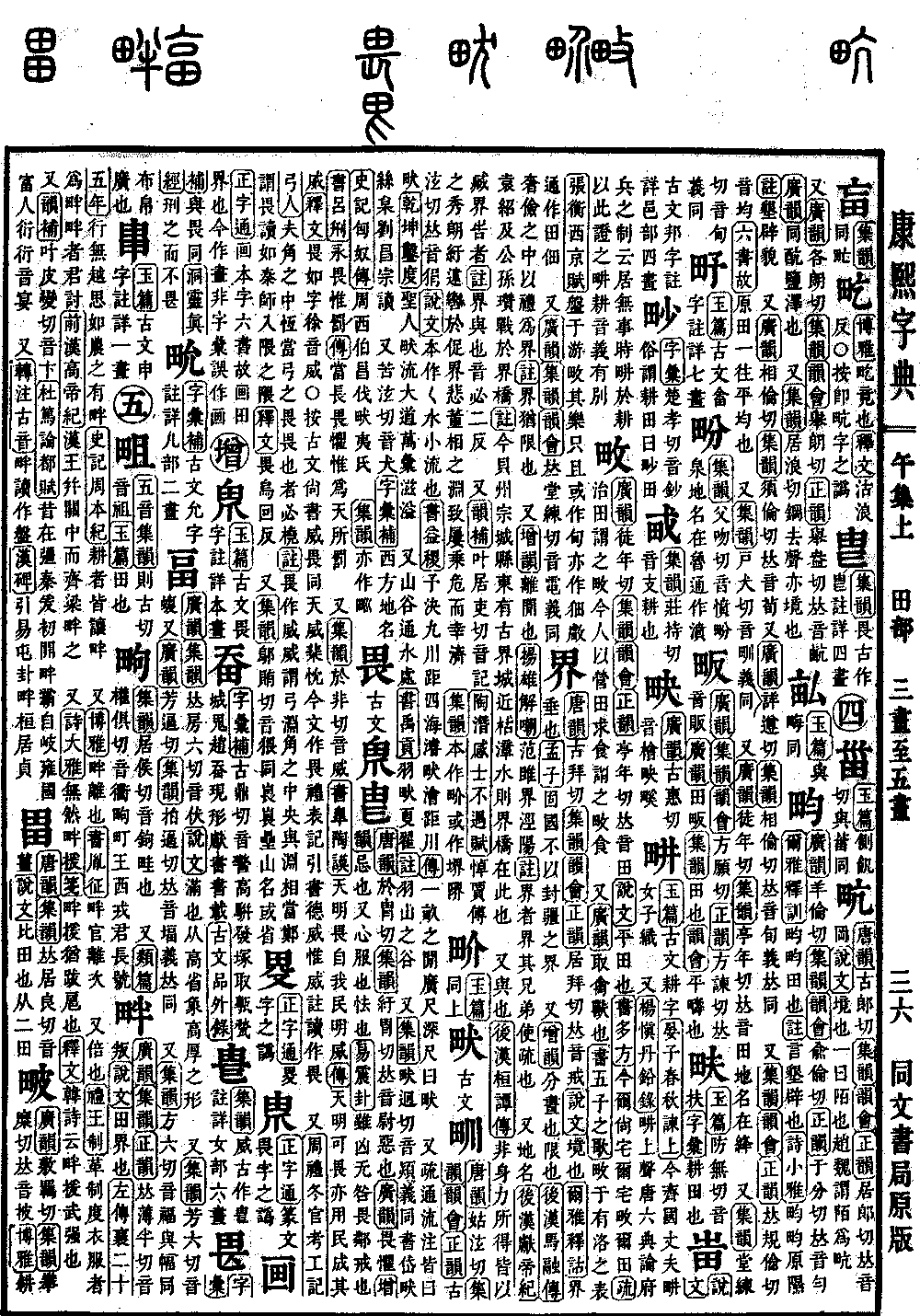
Wu Collection, Upper Volume
Radical: Field (tián)
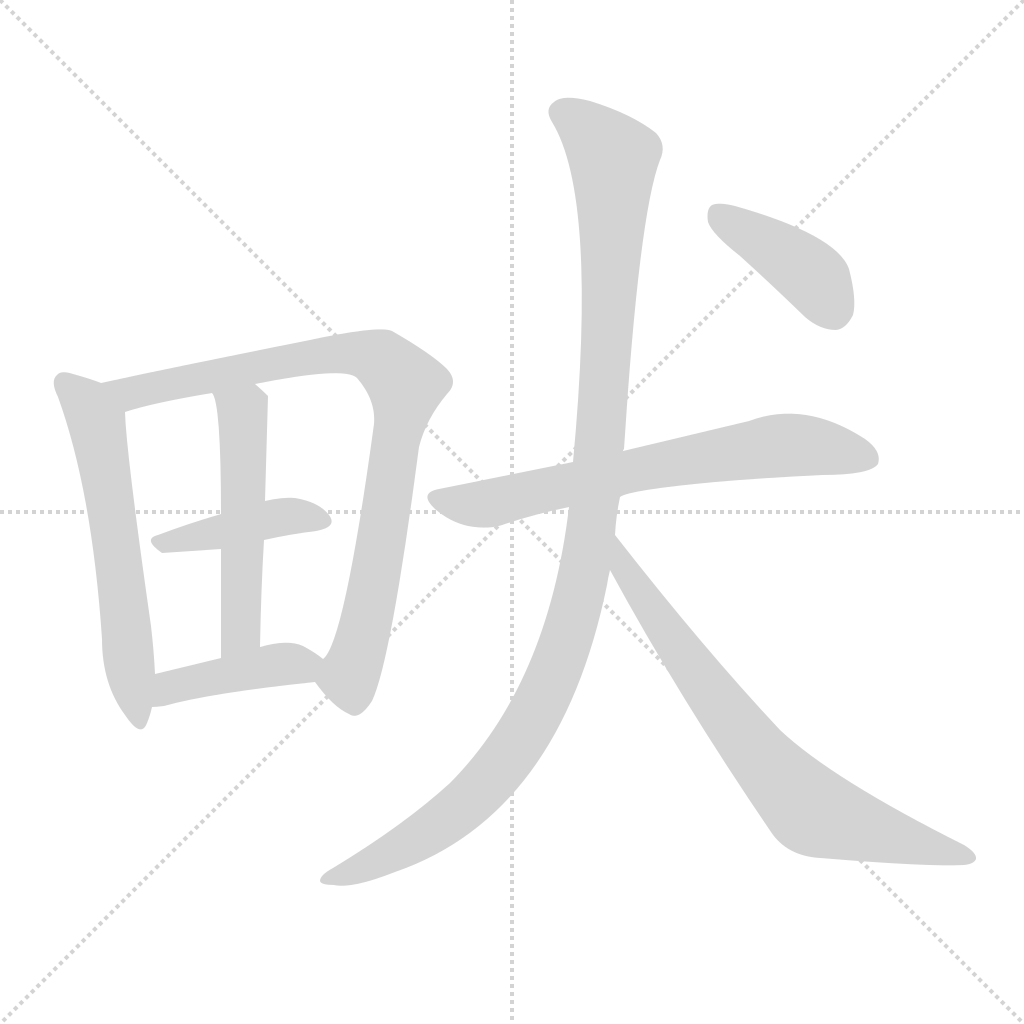
Entry: Quan
Kangxi stroke count: 9
Page 760, Entry 20
Ancient form: Quan (variant)
Tang Dynasty Rhyme Dictionary (Tangyun): Pronounced juan (rising tone)
Collected Rhymes (Jiyun), Rhyme Compendium (Yunhui), Correct Rhymes (Zhengyun): Pronounced juan (rising tone)
Explanation of Simple and Compound Characters (Shuowen): Originally written as a character meaning a small water flow.
Book of Documents (Shujing): I channeled the nine rivers and reached the four seas, dredging the irrigation ditches and canals to connect them to the rivers.
Commentary: A ditch one foot wide and one foot deep between fields is called a quan. Also, all forms of dredging and channeling water are called quan.
Qiankun Zaodu: The sage channels the great path, allowing all things to flourish and overflow.
Also refers to a place in a mountain valley where water flows.
Book of Documents (Shujing): The valley of Mount Yu, where the summer pheasants dwell.
Commentary: The valley of Mount Yu.
Collected Rhymes (Jiyun): Pronounced jiong (rising tone). Meaning is the same. Used in the phrase regarding silk and hemp from the valley of Mount Dai, as read by Liu Changzong.
Also pronounced quan (rising tone).
Supplement to the Dictionary (Zihui Bu): A place name in the west.
Records of the Grand Historian (Shiji): King Wen of Zhou attacked the Quan barbarian tribe.
Collected Rhymes (Jiyun): Also written in a variant form.