Hai Collection, Upper Volume
Radical: Carriage (mǎ)
Qian
Kangxi strokes: 20
Page 1442, Entry 01
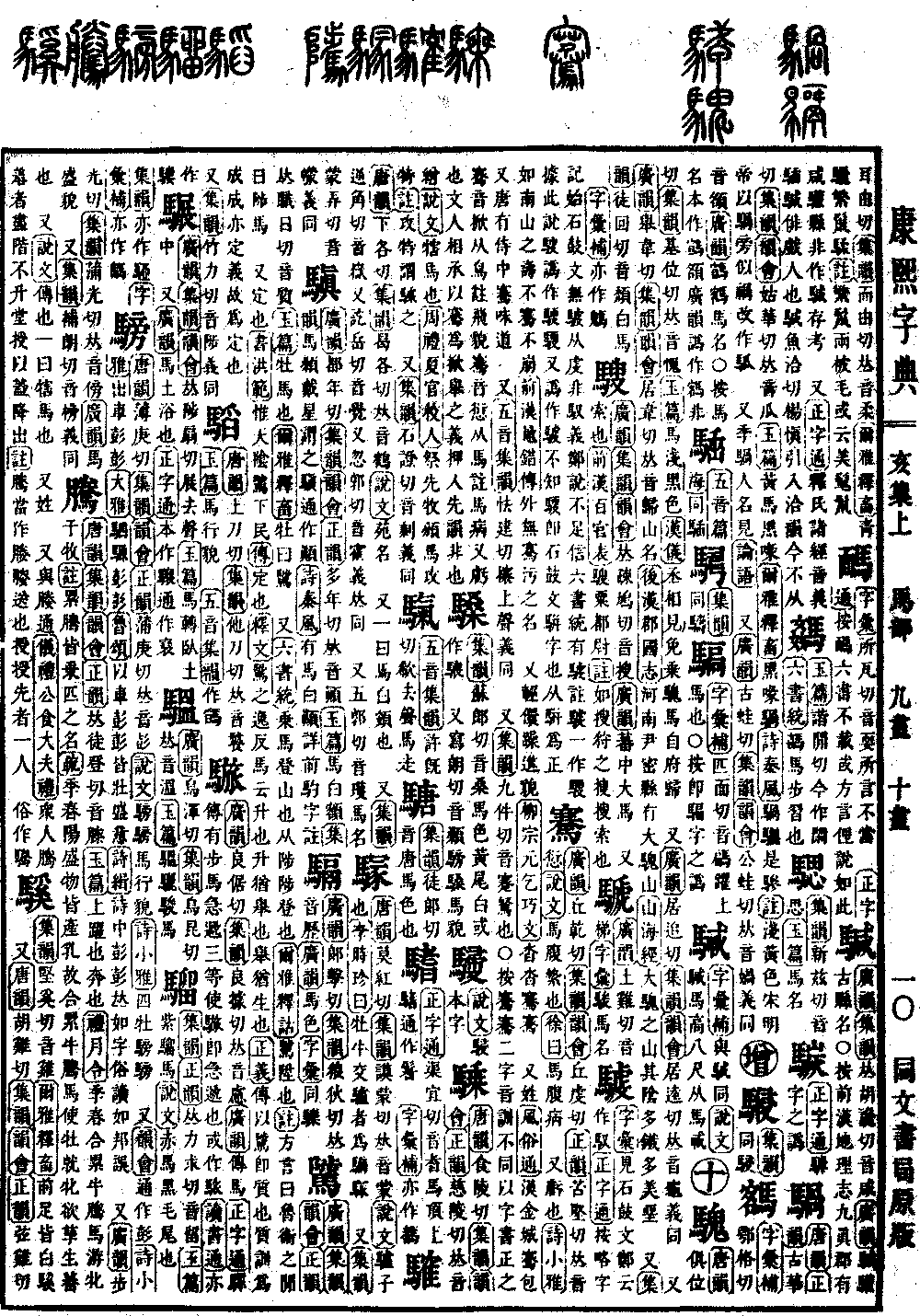
Guangyun (Guangyun): Pronounced qian. Jiyun (Jiyun) and Yunhui (Yunhui): Pronounced qian. Zhengyun (Zhengyun): Pronounced ku jian, pronounced qian.
According to the Shuowen Jiezi (Shuowen), it refers to a horse restrained at the belly. Xu says it refers to an ailment of a horse's belly. It also means to be deficient.
Book of Odes (Shijing), Lesser Odes: As long-lived as the Southern Mountain, neither failing nor collapsing.
History of the Former Han (Qian Hanshu), Biography of Chao Cuo: Externally, there was no reputation of deficiency or disgrace.
It also refers to the appearance of being light, frivolous, and impetuous.
Liu Zongyuan, Qiqiao Wen: Hurrying and impetuous.
It is also a surname.
Fengsu Tong (General Customs): During the Han dynasty, there was Qian Bao from Jincheng.
Also, during the Tang dynasty, there was a Chancellor named Qian Weidao.
According to the Wuyin Jiyun (Wuyin Jiyun), pronounced qie jian, in the departing tone, the meaning is the same.
According to the Jiyun (Jiyun), pronounced jiu jian, pronounced jian, it refers to a weary or inferior horse.
Note: The characters xian and qian have different pronunciations and meanings. Based on dictionaries, xian is pronounced xian, radical bird, meaning the appearance of flying. Qian is pronounced qian, radical horse, meaning a horse's ailment, and also means to be deficient. Writers have traditionally used qian to mean to lift or raise, rhyming with the xian sound, but this is incorrect.