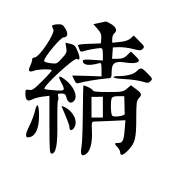
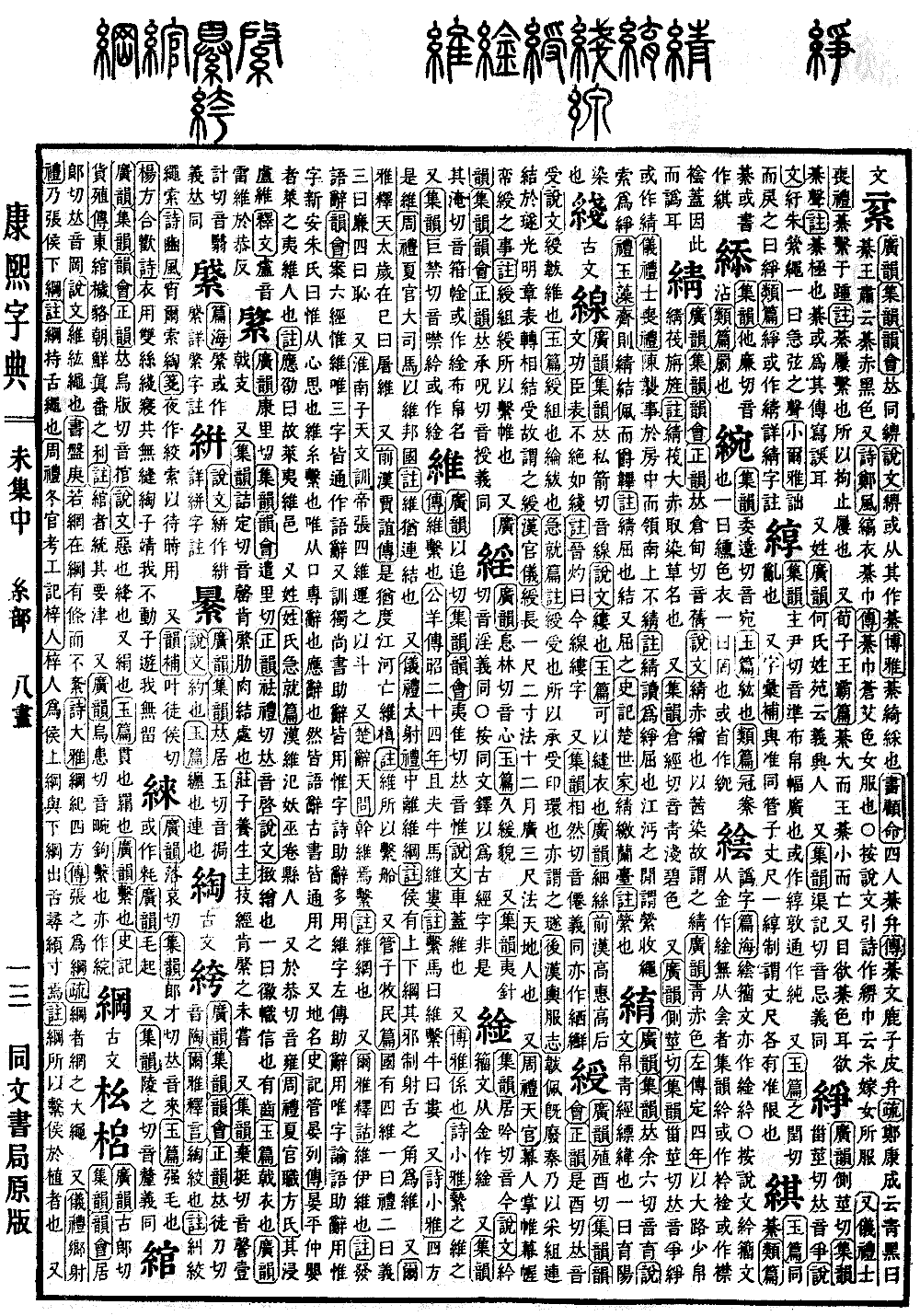
Wei Collection, Middle Volume
Radical: Silk (mì)
Kangxi Strokes: 14
Page 927, Entry 08
Broad Rimes (Guangyun), Collected Rimes (Jiyun), Rime Collection (Yunhui), Correct Rimes (Zhengyun): Pronounced qian (falling tone).
In the Explanation of Graphs (Shuowen): Qian is red silk. Because it is dyed with madder, it is called qian.
Broad Rimes (Guangyun): A bluish-red color.
Zuo Tradition (Zuozhuan), Year 4 of Duke Ding: Used the grand carriage, the small silks, the qian and fa, and the banners. Commentary: Qian-fa is a deep red, named after the dyeing plant.
Collected Rimes (Jiyun): Pronounced qing. A light green color.
Broad Rimes (Guangyun), Collected Rimes (Jiyun): Pronounced zheng. Sometimes written in a variant form (zheng).
Ceremonial Rites (Yili), Rites for the Burial of an Officer: Arrange the garments for the deceased in the side chamber, with the collars facing west, the southern ends uppermost, and do not tie them (qian). Commentary: Qian is read as zheng, meaning to bend. In the regions of the Yangtze and Mian rivers, to coil and store ropes is called zheng.
Book of Rites (Liji), Jade Pattern: When fasting, one shall coil (qian) and knot the pendant and wear the sparrow-colored apron. Commentary: Qian means to bend; the knot is further bent.
Records of the Grand Historian (Shiji), House of Chu: Coiled (qian) the cords at the Orchid Terrace. Commentary: Means to wind.
Textual research: In Ceremonial Rites, regarding the phrase "Arrange the garments for the deceased in the side chamber, and the collars facing south, the southern ends uppermost, and do not tie them (qian)," the original text has been corrected to read "with the collars facing west."