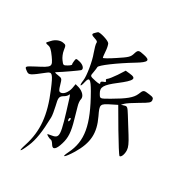
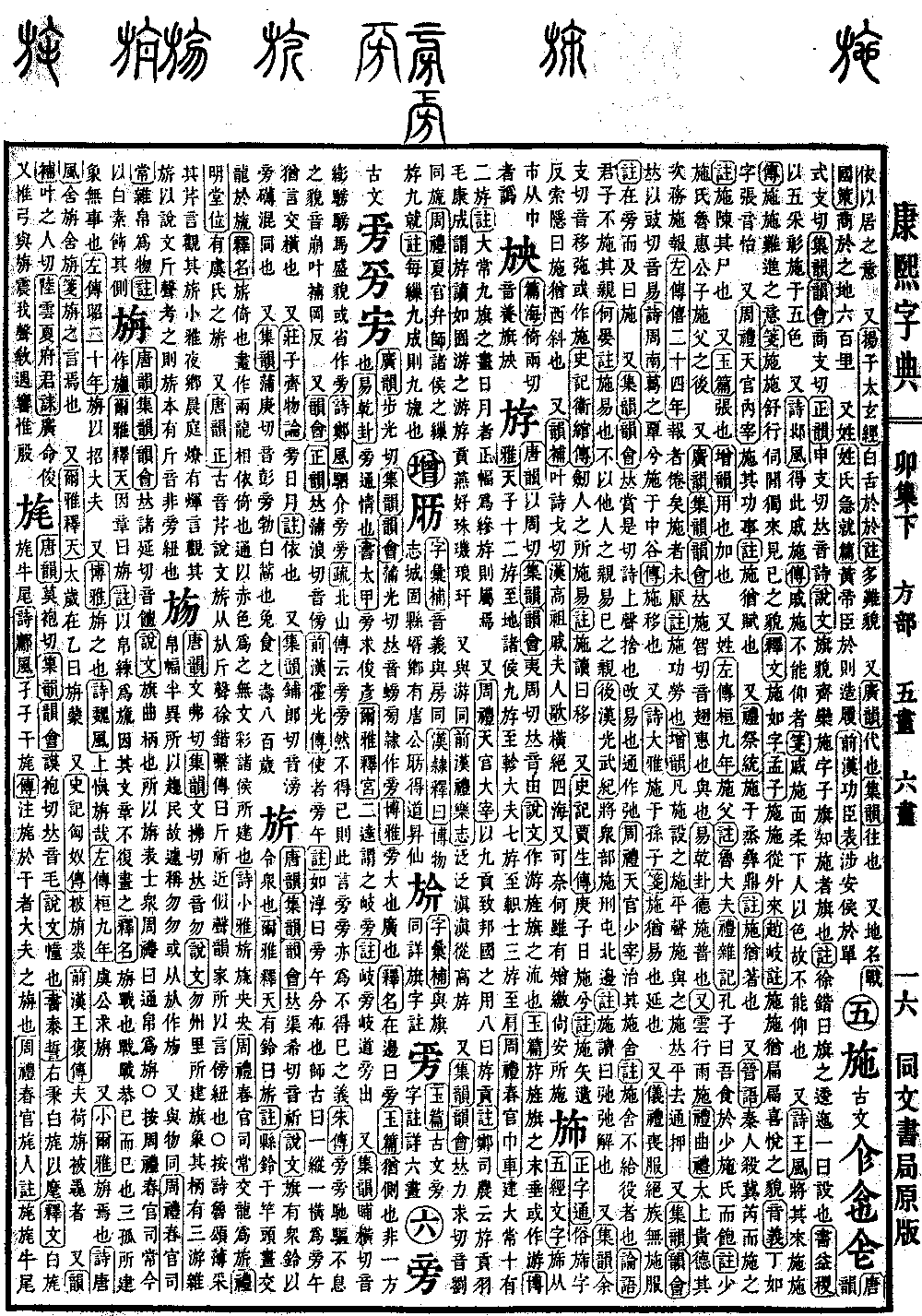
Mao Collection, Lower Volume
Radical: Square (fāng)
Kangxi Strokes: 10
Page 482, Entry 15
Pronounced qí.
Shuowen Jiezi (Shuowen): A banner with many bells used to command the masses.
Erya, Interpretation of the Heavens (Erya, Shitian): That which has bells is called a qi.
Commentary: Bells are hung at the top of the pole, and intersecting dragons are painted on the streamers.
Interpretation of Names (Shiming): Qi means to lean or rely on. It is painted with two dragons leaning against each other. It is generally red in color, without intricate patterns. It is what feudal lords set up.
Book of Odes (Shijing), Lesser Odes of the Kingdom (Xiaoya): The qi and zhao banners are bright and shining.
Rites of Zhou (Zhouli), Spring Offices, Administrator of Standards (Sichang): Intersecting dragons serve as the qi.
Book of Rites (Liji), The Hall of Distinction (Mingtangwei): The qi of the Yu Dynasty.
Additionally, according to Tangyun Zheng, the ancient pronunciation was qín. The Shuowen states that the character qi is formed from the character for square, with the sound of the character jīn. Xu Kai, in his continuous commentary, states that jīn and qí are similar in sound, which is why phonologists refer to them as cognate side-initials. However, examining the Odes of Lu from the Book of Odes, it says, gather the water celery (qín), and then gaze at the qi banner. In the Lesser Odes, it says, at night toward dawn, the courtyard torches glow, and one gazes at the qi banner. Based on the phonetic indicator jīn in the Shuowen, the character qi originally carried the sound of jīn and is not a case of cognate side-initials.