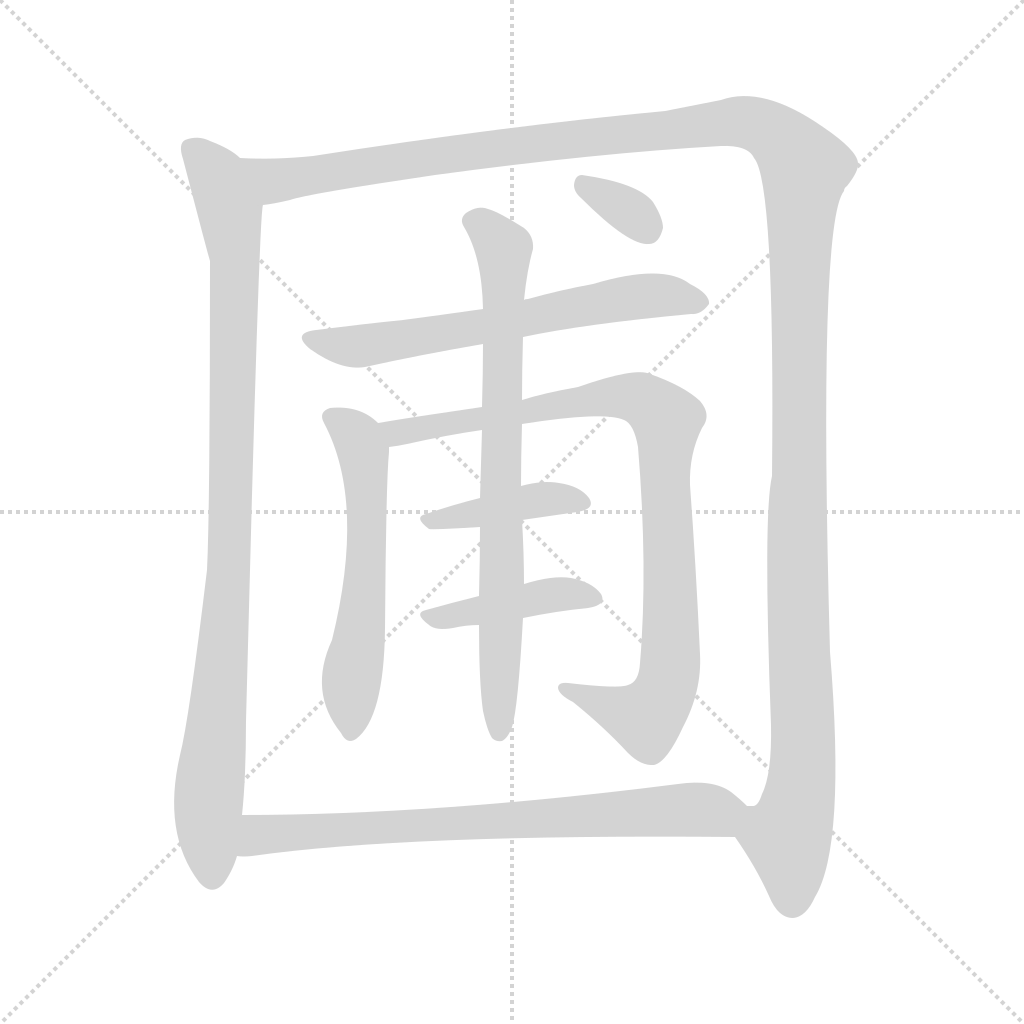
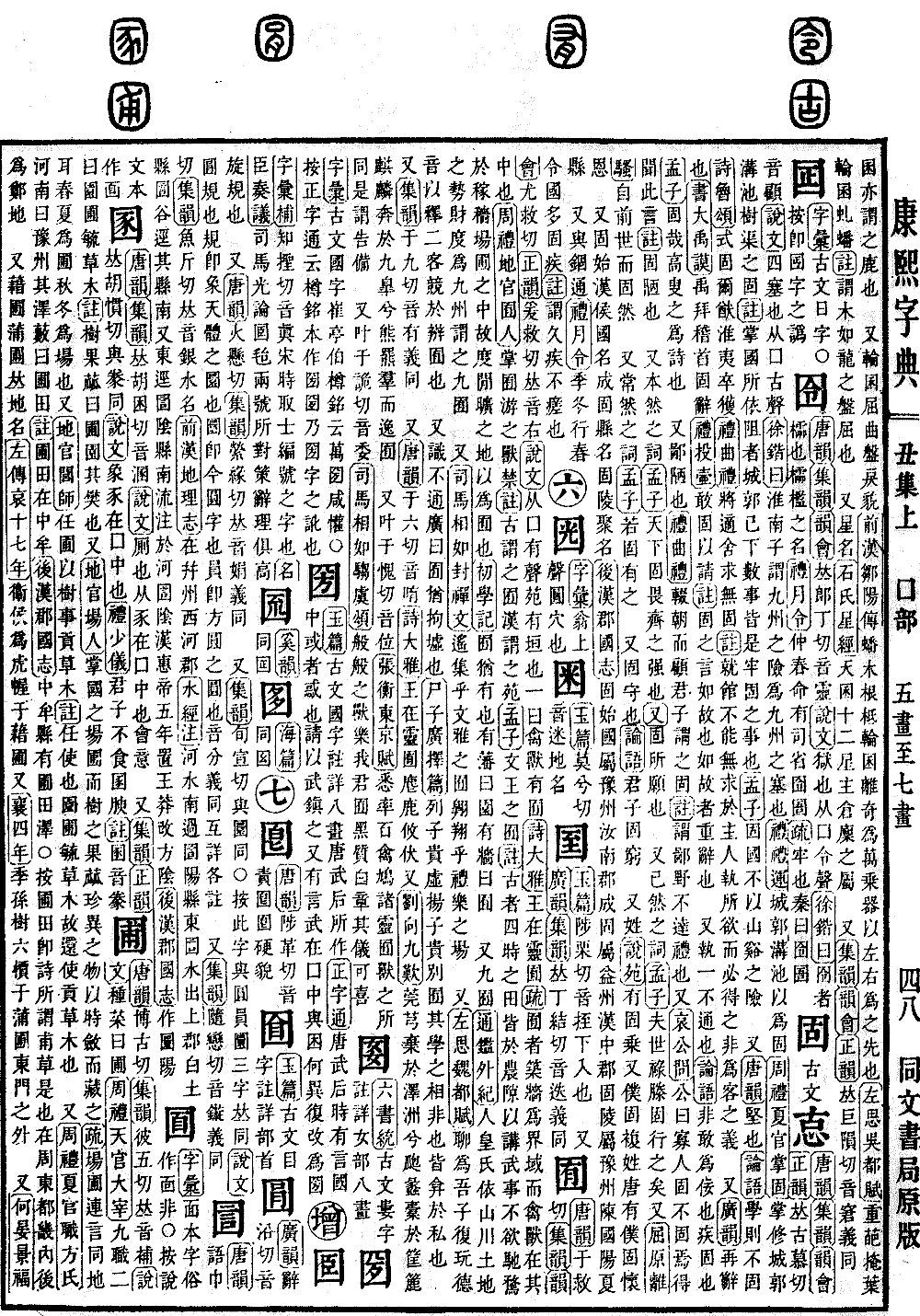
Chou Collection, Upper Volume
Radical: Enclosure (wéi)
Kangxi Strokes: 10
Page 218, Entry 21
Pronounced bu (third tone).
Explaining Characters and Writing (Shuowen Jiezi): A place for growing vegetables is called a pu.
Rites of Zhou (Zhouli), Offices of Heaven, Grand Administrator: There are nine types of occupations; the second is garden and pu, for the cultivation of plants and trees. Commentary: Growing melons and fruits is called a pu; garden refers to its fence.
Also, Rites of Zhou, Offices of Earth, Master of Grounds: Oversees the state fields and pu, planting fruits and precious items, harvesting and storing them according to the season. Commentary: The terms field and pu used together refer to the same plot of land. In spring and summer, it is used as a pu; in autumn and winter, it is used as a field.
Also, Rites of Zhou, Offices of Earth, Neighborhood Master: Appoints those who manage gardens and pu, requiring them to contribute plants and trees according to agricultural affairs. Commentary: Appointment means to employ. Gardens and pu cultivate plants and trees, so they are required to contribute them.
Also, Rites of Zhou, Offices of Summer, Officials of Territorial Divisions: The area south of the Yellow River is called Yuzhou; its lakes and marshes are called Putian. Commentary: Putian is in Zhongmou. Book of the Later Han (Hou Hanshu), Treatise on Administrative Geography: Zhongmou County contains the Putian Marsh. Note: Putian is what is referred to as the grasses of pu in the Book of Odes (Shijing); it was within the capital region of the Eastern Zhou dynasty and later belonged to the State of Zheng.
There are also Jiepu and Papu, which are place names. Zuo Tradition (Zuozhuan), 17th Year of Duke Ai: The Marquis of Wei built a tiger tent at Jiepu.
Also, 4th Year of Duke Xiang: Jisun planted six catalpa trees outside the east gate of Papu.
Also, He Yan, Rhapsody on Jingfu Hall (Jingfu Dian Fu): Palaces such as Yongning, Anchang, and Linpu were constructed. Commentary: These are all names of palaces.
There is also Xianpu, which is the name of a mountain. Songs of Chu (Chuci), Questions to Heaven (Tianwen): Where are the roots of Xianpu on Mount Kunlun?
Also, Yang Xiong, Rhapsody on Ganquan Palace (Ganquan Fu): It matches the Xianpu where the Celestial Emperor dwells, symbolizing the majesty of the Great Unity deity. Commentary: Xianpu is on Mount Kunlun, the place where the Celestial Emperor resides. It is also written in the variant form tuan.
Biography of King Mu (Mu Tianzi Zhuan): Inscribed deeds upon the tuan to inform future generations.
Yu Xin, Rhapsody on Horse Archery (Ma She Fu): In front of the tuan garden of the King of Zhou, the eight fine steeds were still yoked.
Pronounced bu (fourth tone).
Qu Yuan, Encountering Sorrow (Lisao): I departed from Cangwu in the morning; by evening I arrived at Xuanpu. I wished to linger briefly before the gates of the spirits, but the sun was hurriedly about to set.
Collected Rhymes (Jiyun): Sometimes simplified as pu. It is also written in other variant forms.