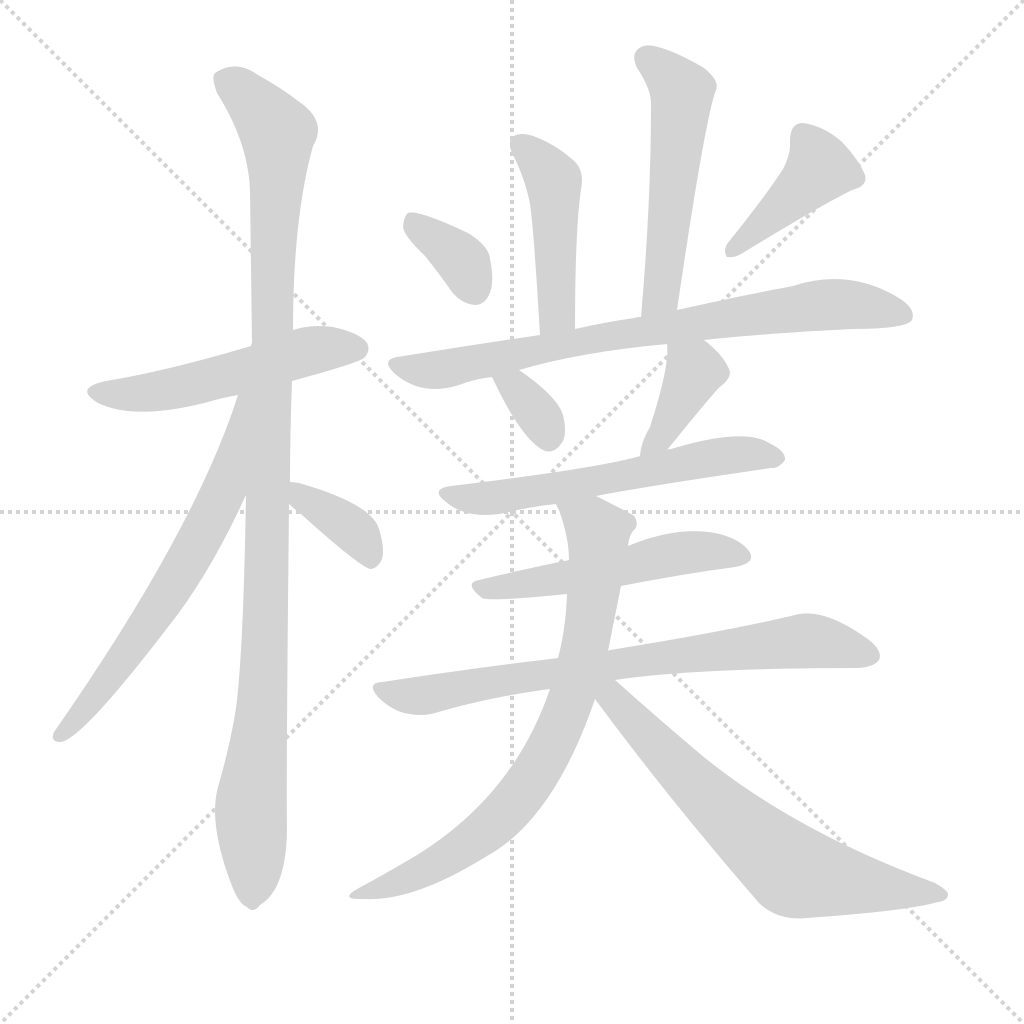
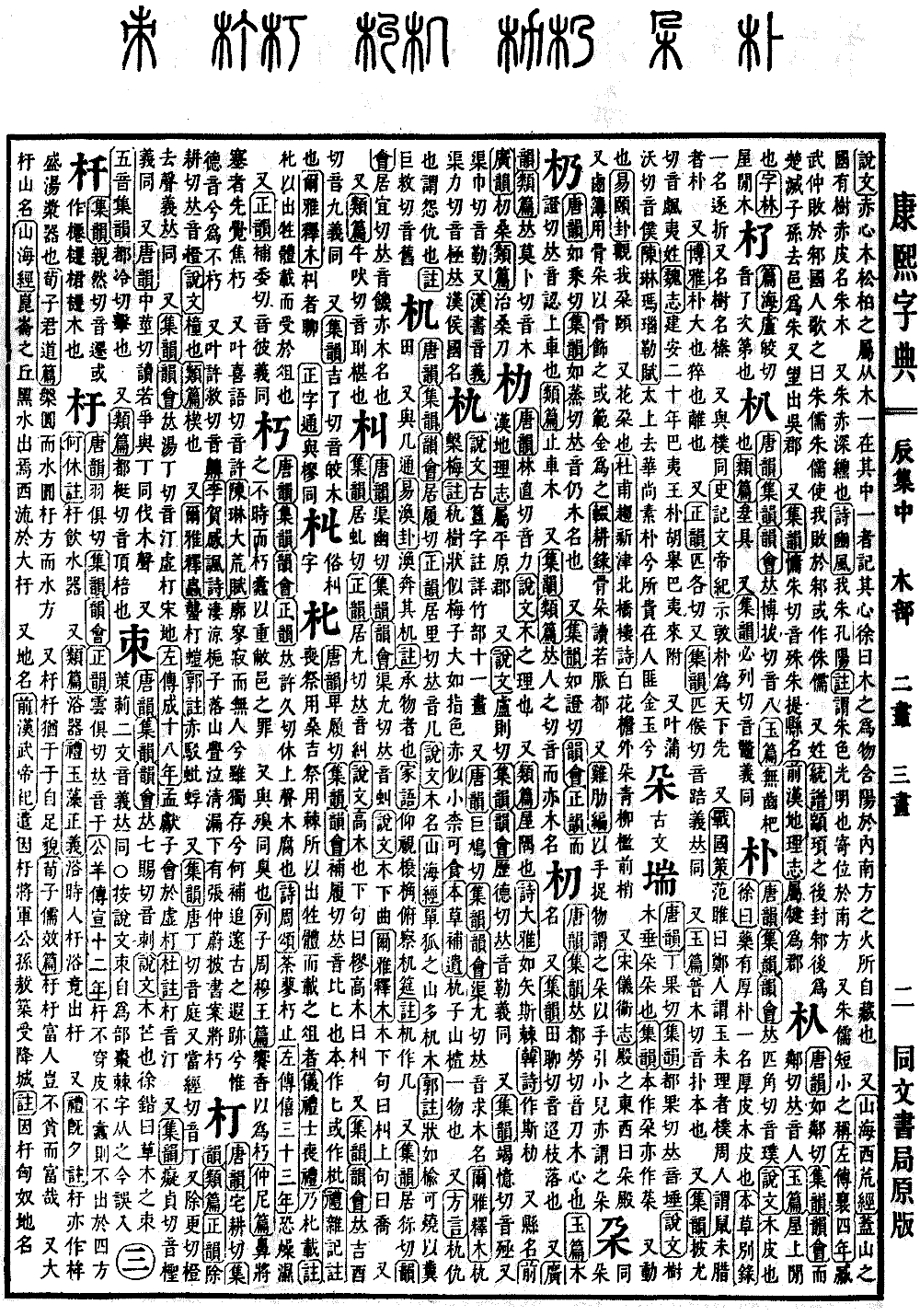
Chen Collection, Middle Volume, Radical: Tree (mù)
PO, 16 strokes, Page 510
Pronounced pu (entering tone) according to Tang Yun, Jiyun, Yunhui, and Zhengyun.
Shuowen writes it as "檏". Refers to unprocessed wood.
Xu notes: Earthen bricks are called "坏", and unprocessed wood is called "檏".
Book of Documents (Shu), Chapter Zicai: "Having diligently planed and worked the raw wood, it awaits red lacquer."
Also, any unfinished object can be called "樸".
Erya, Chapter Shiqi: "Working wood is called '剫', carving jade is called '雕'."
Guo's commentary: These are all names for processing raw materials (to make them into objects).
Also refers to essence and simplicity.
Book of Rites (Li), Chapter Jiaotesheng: "Riding in an unadorned carriage honors simplicity."
Pronounced bu (entering tone) according to Jiyun, Yunhui, and Zhengyun.
Book of Odes (Shijing), Chapter Daya: "Flourishing yù and pǔ trees."
Commentary: "樸" refers to the fú wood.
Jian: "White crabapple trees grow densely together."
Zhou Rituals (Zhou Li), Chapter Dongguan Kaogongji: "Examining the method of a carriage, one must see if its structure is firmly attached, and if the area of the wheel touching the ground is small."
Note: "樸属" means attached firmly.
Pronounced pu (falling tone) according to Jiyun.
Zhang Heng's "Tokyo Fu": "Following frugality and valuing simplicity. Recalling Confucius's self-restraint and return to propriety, and Laozi's contentment."
Also refers to hard wood.
Pronounced pu (entering tone) according to Jiyun. Refers to dense trees.
Pronounced pu (rising tone) according to Guangyun. "樸䍽", a county name.
Former Han Dynasty (Qian Han), Chapter Geography: "Belonging to Wuwei Commandery."
Pronounced pu (falling tone) according to Tang Yun.
Huainanzi, Chapter Jingshen: "Clearly understanding the origin of pure simplicity, following nature, and returning to simplicity."