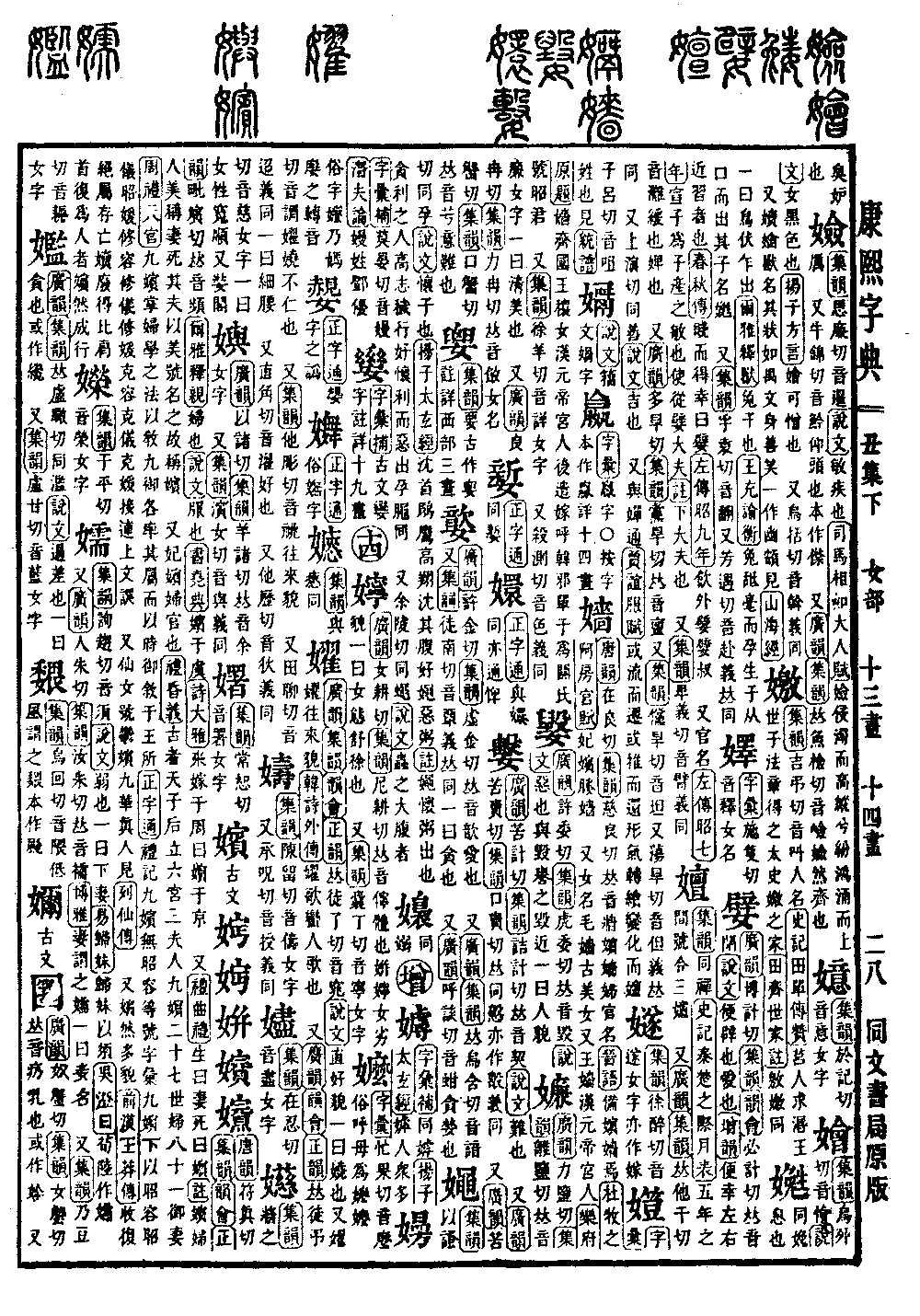
Chou Collection, Lower Volume
Radical: Woman (nǚ)
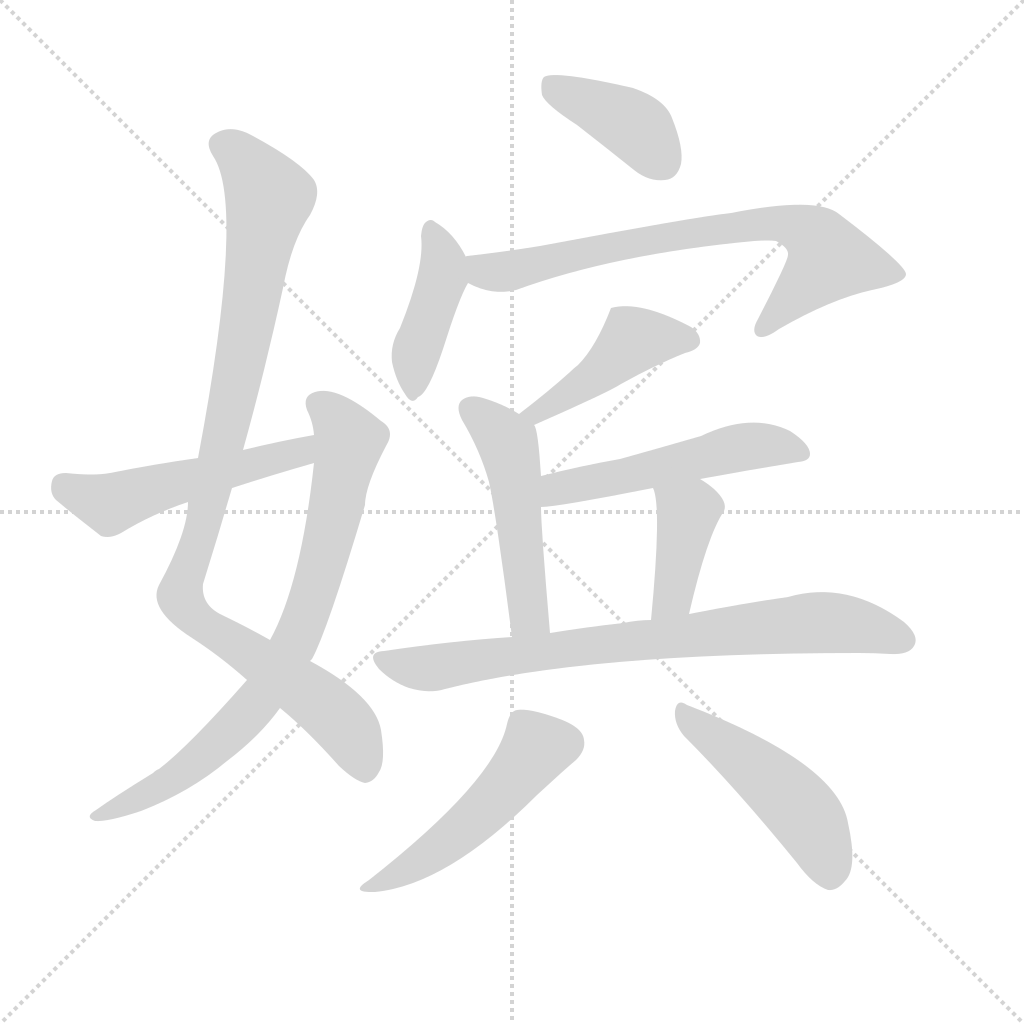
Pin
Kangxi stroke count: 17
Page 272, Entry 02
Ancient form: Pin (pīn)
Pronounced bin
Pronounced bin
According to the Erya: Explaining Kinship (Erya), it means wife. According to the Shuowen Jiezi (Shuowen), it means to serve. In the Book of Documents (Shangshu): "Married into the Yu clan." In the Book of Odes (Shijing): "Came to be wed in Zhou, known as the wife at the capital." Also, according to the Book of Rites (Liji): "Alive, she is called wife; dead, she is called pin." The commentary states that pin is an honorific term for a woman. When a wife dies, her husband honors her with this beautiful title, hence she is called pin. Also, feipin refers to palace officials. According to the Book of Rites: "In antiquity, the Son of Heaven established six palaces, three ladies, nine pin, twenty-seven wives of the gentry, and eighty-one concubines." According to the Rites of Zhou (Zhouli): "The nine pin oversee the methods of female education, instruct the nine concubines, lead their subordinates, and at the appropriate times, attend to the King." According to the Zhengzitong: The nine pin mentioned in the Book of Rites do not include titles such as Zhaorong. The Zihui incorrectly links the nine pin with titles like Zhaorong, Zhaoyi, and Zhaoyuan, which is an error. Also, the name of a celestial maiden, Yu Pin, is one of the Nine Florescent Perfected Ones, see the Biographies of Immortal Immortals (Liexian Zhuan). Also, pinran means appearing in large numbers. According to the History of the Former Han (Hanshu): "Recalling the scattered lineages, restoring those abandoned and lost, standing side by side, those who have returned to humanity appear in long rows."