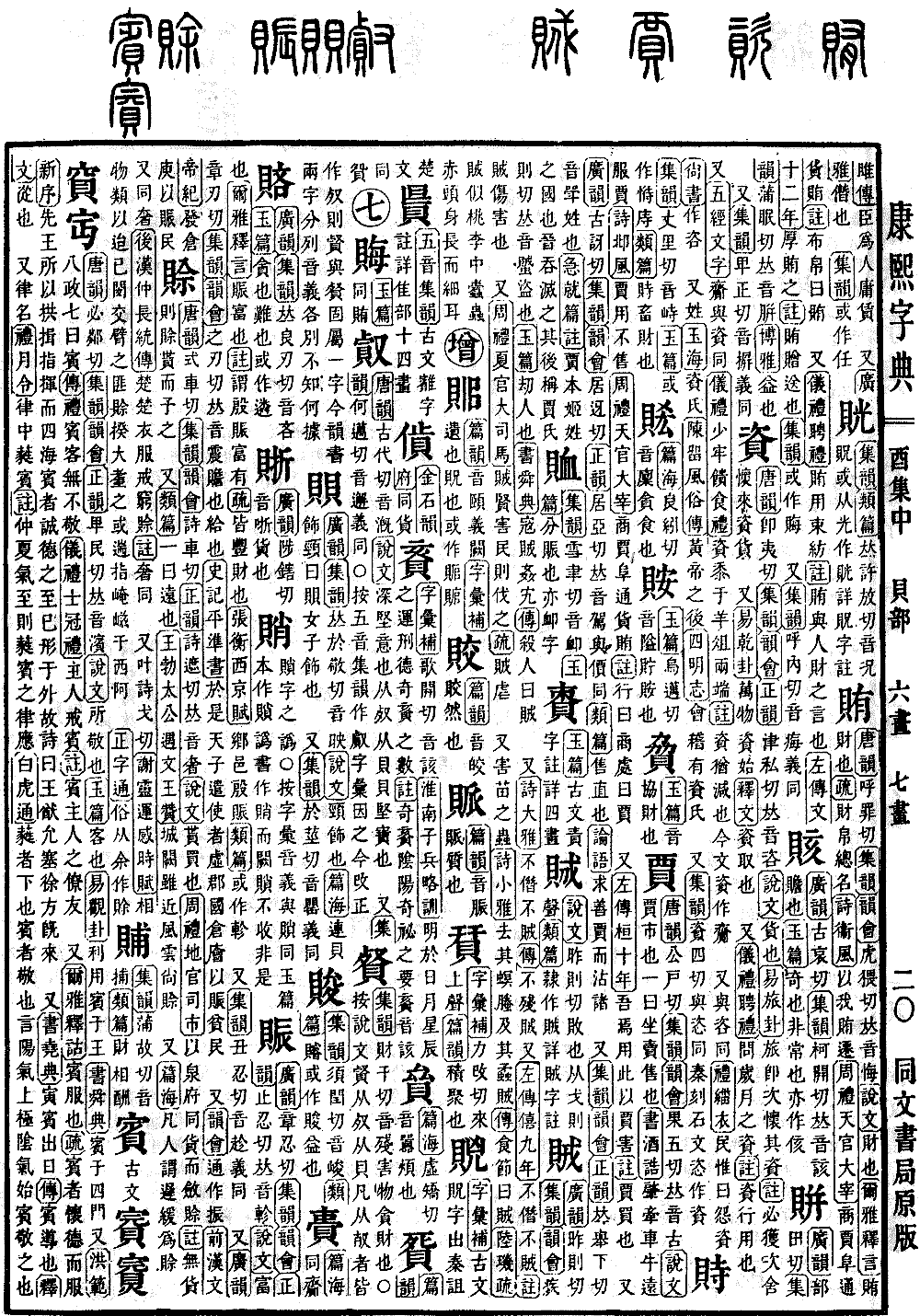
You Collection, Middle Volume
Radical: Cowrie (bèi)
Kangxi Strokes: 14
Page 1208, Entry 01
Ancient script. Pronounced bin.
According to the Explanation of Scripts and Signs (Shuowen Jiezi), it refers to one who is respected.
According to the Jade Chapters (Yupian), it means a guest.
Book of Changes (Yijing), Guan Hexagram: It is advantageous to be a guest of the king.
Book of Documents (Shangshu), Canon of Shun: To receive guests at the four gates.
Also, in the Great Plan (Hongfan): Among the eight policies, the seventh is guest. Commentary: One must treat guests with the utmost respect.
Ceremonial and Ritual (Yili), Master of Ceremonies at the Capping Ritual: The host invites the guest. Commentary: The guest is the colleague and friend of the host.
Also, according to the Progress of Explanations (Er'ya), guest means to submit. Commentary: A guest is one who embraces virtue and submits.
New Narratives (Xinxu): The reason former kings could lead and command, and the four seas submitted, was that their sincere virtue was manifested outwardly. Therefore, the Book of Odes (Shijing) says: The king's policies were truly sound, and the Xu region has already come.
Also, Book of Documents (Shangshu), Canon of Yao: To respectfully guide the rising sun. Commentary: Guest means to guide. Phonetic Gloss: To follow.
Also, a musical pitch name. Book of Rites (Liji), Monthly Ordinances: The pitch corresponds to ruibin. Commentary: When the qi of midsummer arrives, the ruibin pitch responds. White Tiger Hall Discussions (Baihu Tong): Rui means to descend. Bin means to respect, meaning the yang energy has reached its peak, and the yin energy begins to show respect.
Also, Jibin, the name of a kingdom in the Western Regions. Book of the Former Han (Qian Hanshu), Record of the Western Regions: The king of the Jibin kingdom ruled from Xunxian City.
Also, a surname. Jade Sea (Yuhai): The Bin clan; during the Zhou Dynasty, there were Bin Hua and Bin Qi; in the Qi state, there were Bin Xuwu and Bin Meiren.
Also, an official title. Book of Tang (Tangshu), Treatise on Officialdom: Offices for guest management, each with two officials.
Also, Dragon Guest. Things Left Over from Pottery Bottles (Taojia Pingshushi): On Emperor Ming's writing desk, one day a small Daoist as tiny as a fly appeared and shouted "Long live." He said, "I am the essence of ink, the messenger of black pine. Whenever someone with literary talent appears, there are twelve Dragon Guests on the ink." The Emperor considered it divine and bestowed them upon officials in charge of literature.
Also, Wild Guest. Wang's Records (Wangshi Jianwenlu): Wang Renyu owned a monkey, small and clever, named Wild Guest.
Also, pronounced bin (falling tone).
Book of Documents (Shangshu), Numerous Officers: I consider that in the four directions there is nowhere to submit. Phonetic Gloss: Xu reads it as bin. Ma says: It means to reject.
Records of the Grand Historian (Shiji), Biography of Su Qin: The next step is to inevitably prolong the rejection of them. Commentary: The secondary strategy is to long reject and abandon those west of the pass.
Zhuangzi, Xu Wugui: You, sir, live in the forests and mountains, causing me to be rejected. Phonetic Gloss: Bin is sometimes written as rejection, meaning to discard.