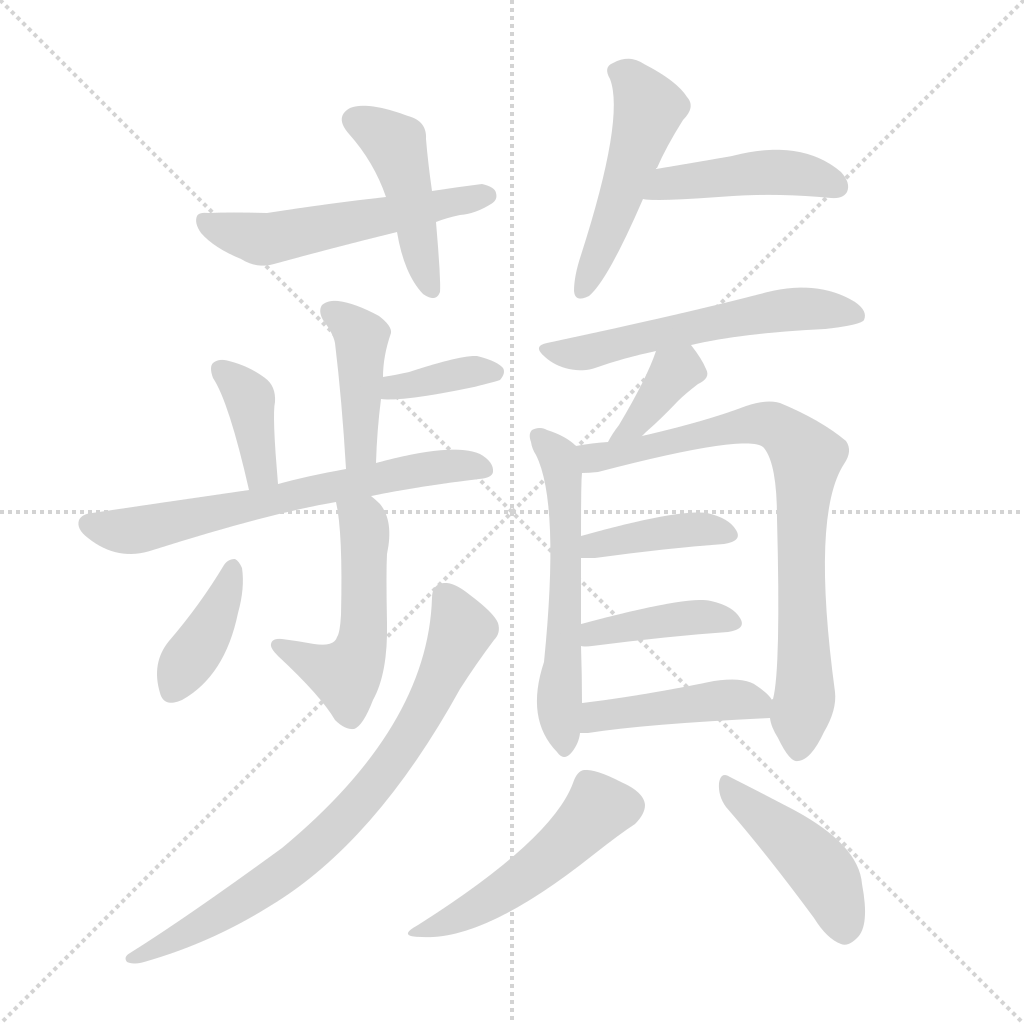
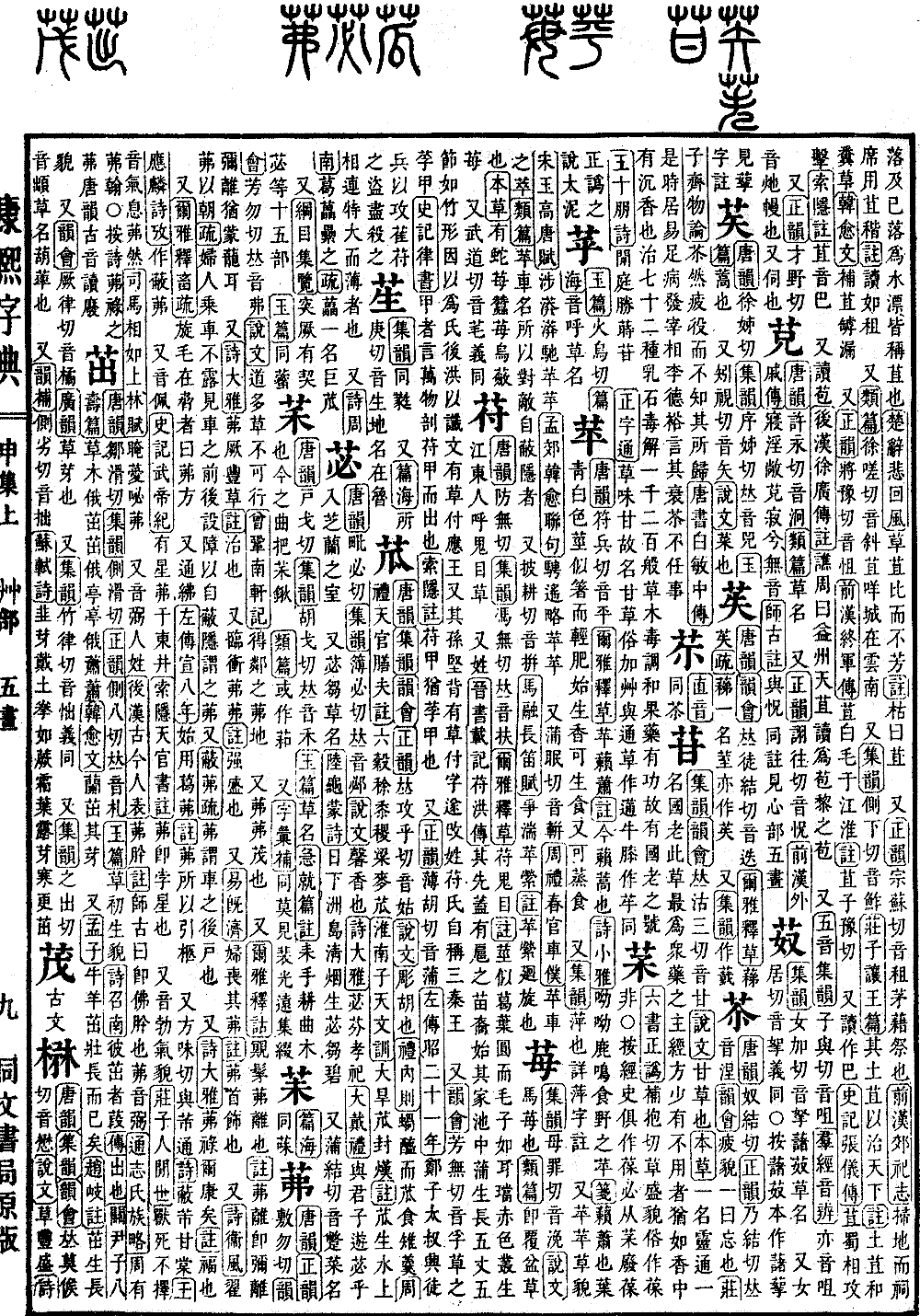
Shen Collection, Upper Volume
Radical: Grass (cǎo)
Ping
Kangxi strokes: 22
Page 1025, Entry 01
Pronounced pin.
Shuowen Jiezi (Shuowen): Originally written as the character for duckweed. It refers to large duckweed.
Erya (Erya), Interpretation of Plants: The ping and ping are the same; the large variety is called ping.
Compendium of Materia Medica (Bencao Jiejie): A plant consisting of four leaves joined together to form one leaf, shaped like the character for field; this is ping.
Book of Odes (Shijing), Shao Nan: To gather ping.
Commentary: In ancient times, those who were about to marry off a daughter would first perform rites in the ancestral hall, using fish as a sacrificial offering, garnished with ping and zao.
Explanation: The word ping shares its sound with the word for guest.
Explication of Text (Shiwen): Han Poetry (Han Shi) says: That which sinks is called ping.
Lüshi Chunqiu (Lüshi Chunqiu): Among fine vegetables, there is the ping of the Kunlun Mountains.
Erya Yi (Erya Yi): Ping resembles the leaves of a locust tree and grows in clusters in shallow water; in the fifth month, it bears white flowers, which is why it is called white ping.
Chu Ci (Chu Ci), Nine Chapters: Ascending the white ping to gaze into the distance.
Textual Research:
Book of Odes (Shijing), Shao Nan: To gather ping. The sub-commentary says, Han Poetry states that which sinks is called ping. Adjusted according to the original text of the Explication of Text.
Lüshi Chunqiu (Lüshi Chunqiu): The fine vegetable of the sea, the ping of the Kunlun Mountains. Note: The original text associates the word sea with the preceding passage, not this one; the word sea has been omitted here.