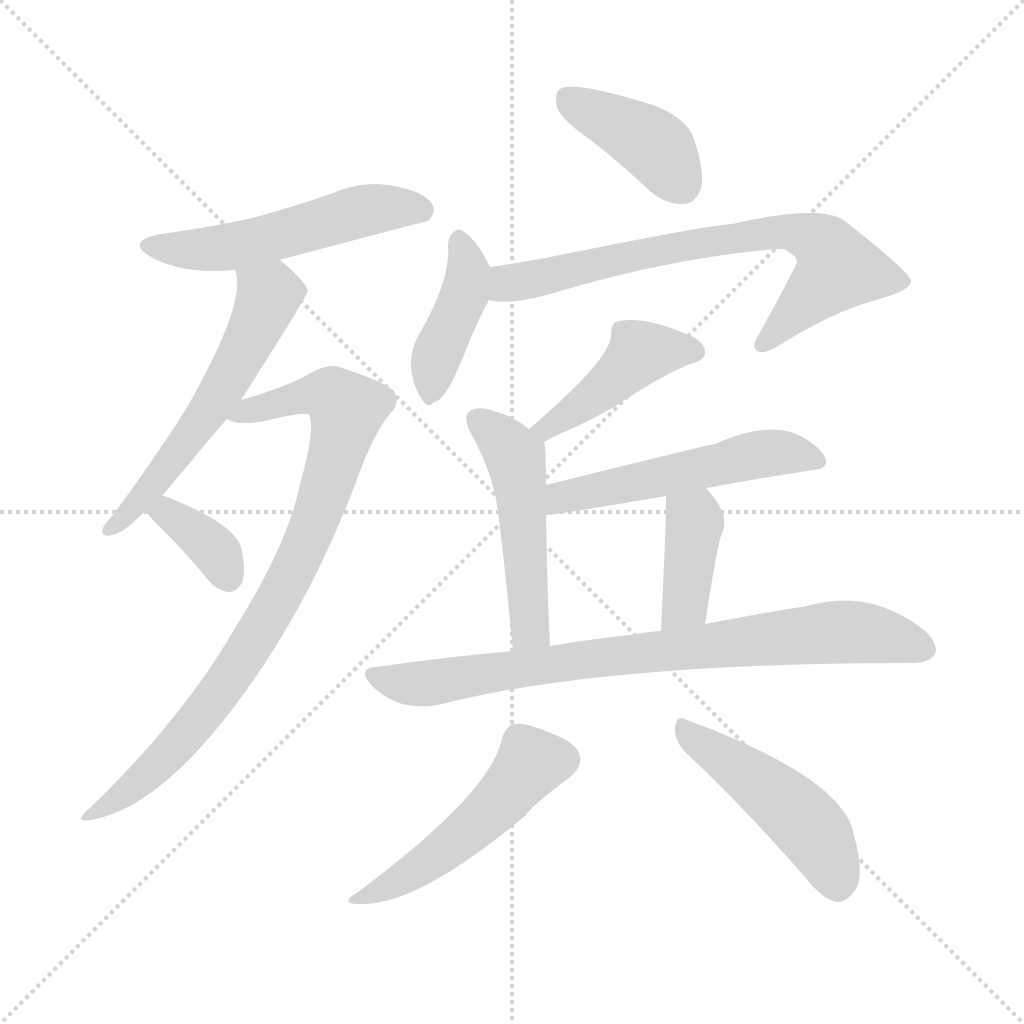
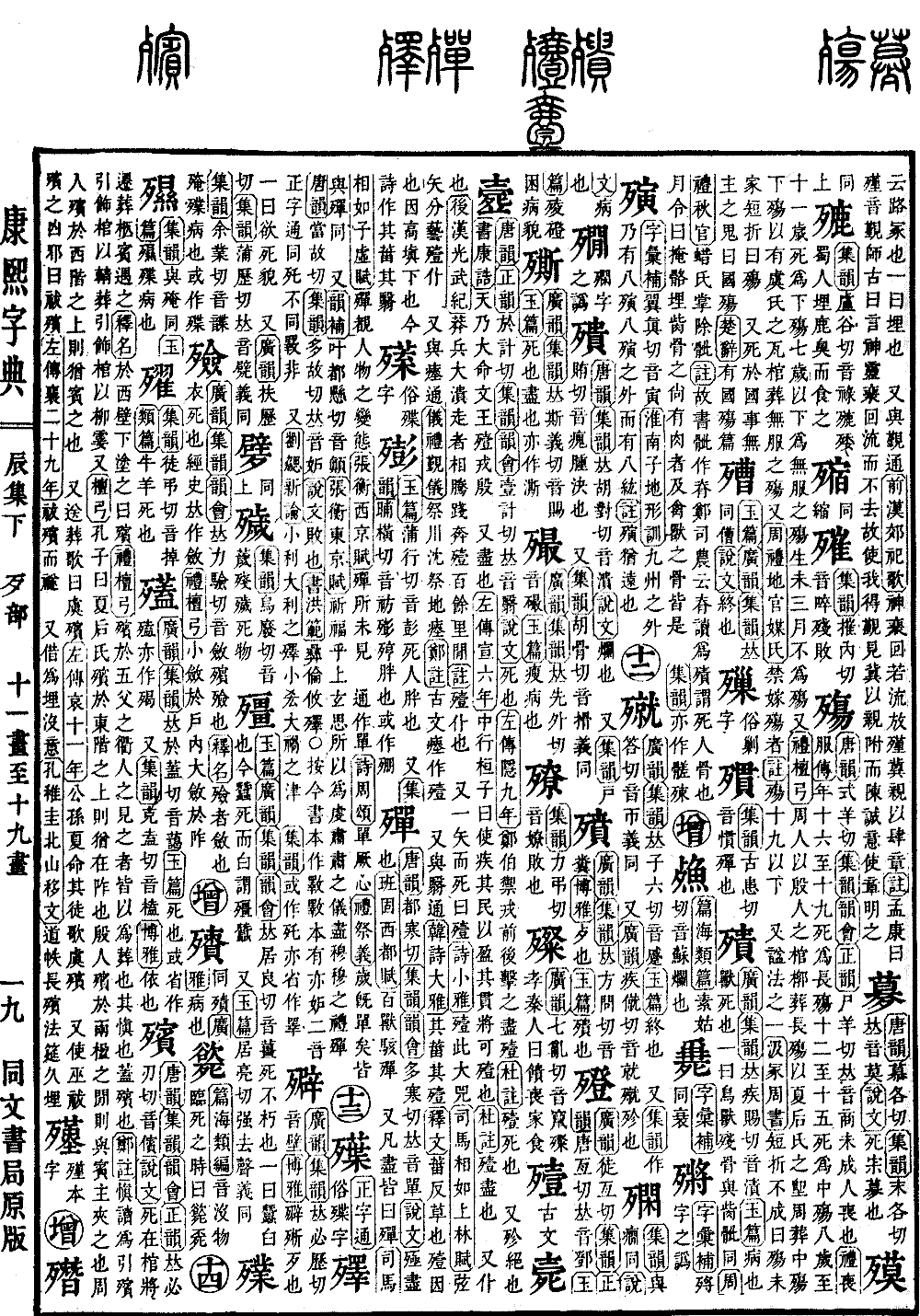
Chen Collection, Lower Volume
Radical: Death (dǎi)
Kangxi Strokes: 18
Page 583, Entry 01
Pronounced bin (falling tone)
Shuowen Jiezi (Shuowen): A coffin containing a deceased person that is awaiting transport for burial; one treats it as a guest.
Shiming (Interpretation of Names): Plastering and decorating the coffin while it is placed along the western wall is called bin.
Book of Rites (Liji): The coffin was parked at the Wufu crossroads; those who saw it thought it was a burial. It was actually the dragging of the coffin, for it was merely being parked. Zheng Xuan annotation: Shen is to be read as drag. When parking the coffin, it is decorated with a carriage cover for pulling; when burying, it is decorated with willow screens for pulling.
Book of Rites (Liji): Confucius said: The Xia dynasty people placed the coffin on the eastern steps, maintaining the position of the host. The Yin dynasty people placed the coffin between the two pillars of the hall, the position between host and guest. The Zhou dynasty people placed the coffin on the western steps, treating it like a guest.
Funeral songs are called Yu Bin.
Zuo Tradition (Zuozhuan): Gongsun Xia ordered his men to sing the Yu Bin.
Also, using shamans to dispel the evil spirits associated with a parked coffin is called fu bin.
Zuo Tradition (Zuozhuan): Dispelling the evil spirits and then offering garments for the encoffining.
Also used in the sense of to bury or to abandon.
Kong Zhigui, Beishan Yiwen: The scriptures of the Daoists have long been buried, and the lecture mats have long been deserted.