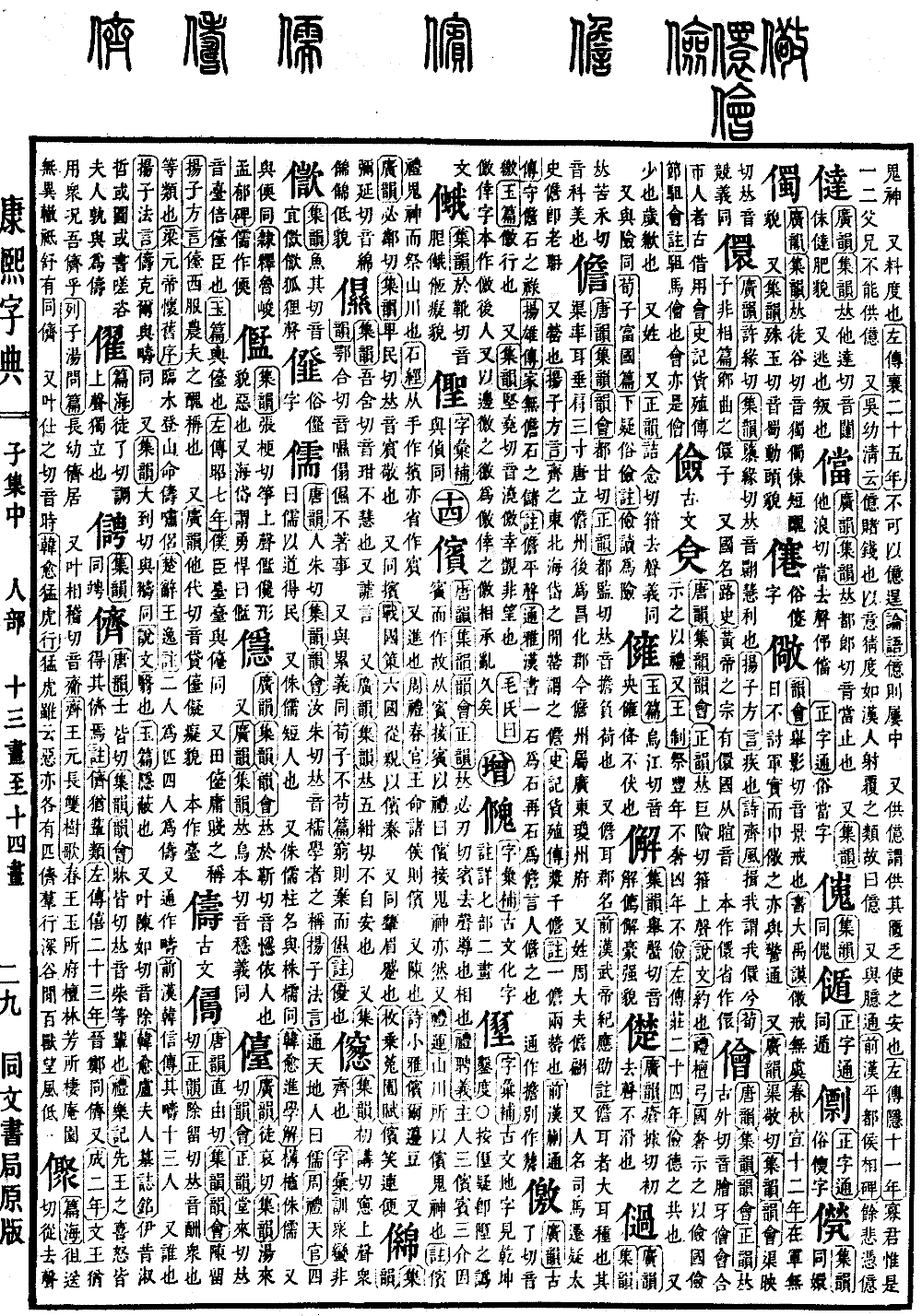
Zi Collection, Middle Volume
Radical: Person (rén)
Bin (儐)
Kangxi strokes: 16
Page 119, Entry 01
Pronounced bìn. To guide and escort guests, to assist in the performance of rituals. Book of Rites (Liji): A minister serves as the primary usher, a high official serves as the intermediary usher, and a minor official serves as the assisting usher. Furthermore, according to ritual etiquette, receiving guests is called bin, and receiving ghosts and spirits is also referred to by this term. Also, Book of Rites (Liji) notes: Mountains and rivers are places used to honor ghosts and spirits. Commentary: To honor and serve ghosts and spirits through ritual, and to offer sacrifices to mountains and rivers. In the Stone Classics (Shijing), it is written with the hand radical (擯), and also abbreviated as (賔). Also, it means to offer or present. Rites of Zhou (Zhouli): When the Son of Heaven issues formal appointments to feudal lords, the ceremony of bin is held. Also, it means to arrange or display. Book of Odes (Shijing): Arrange your sacrificial vessels such as the bamboo and wooden stands.
Also pronounced bín. It means to be respectful. Also equivalent to (擯), meaning to exclude or reject. Strategies of the Warring States (Zhan Guo Ce): The six states formed a vertical alliance to unite and exclude the State of Qin. Also equivalent to (颦), meaning the appearance of knitting one’s brows. Mei Cheng, Rhapsody on the Rabbit Garden (Tuyuan Fu): Knitting brows and smiling artfully, with continuous and varied gestures.
Textual Research: Book of Rites (Liji): The host provides three ushers, and the guest has three assistants; because of the guest this ritual is established, hence the character is based on (宾). According to ritual etiquette, receiving guests is called bin, and receiving ghosts and spirits is also referred to by this term. Note: The original text of Liji does not contain this passage; it appears in the commentary: When a guest meets the host, the host arranges for ushers. The gloss states (擯), though some versions write it as (儐). The subsequent text and commentary are the same. The subsequent text mentioned here refers to the three sentences regarding ministers acting as primary ushers; thus, the (擯) in the classic text is also written as (儐). Based on this, the fourteen characters concerning the host providing three ushers have been amended to read: Ministers act as primary ushers, high officials act as intermediary ushers, and minor officials act as assisting ushers. The subsequent text regarding receiving guests with ritual is called bin, and the same for ghosts and spirits, carries a different meaning; therefore, the character again has been added to distinguish it.