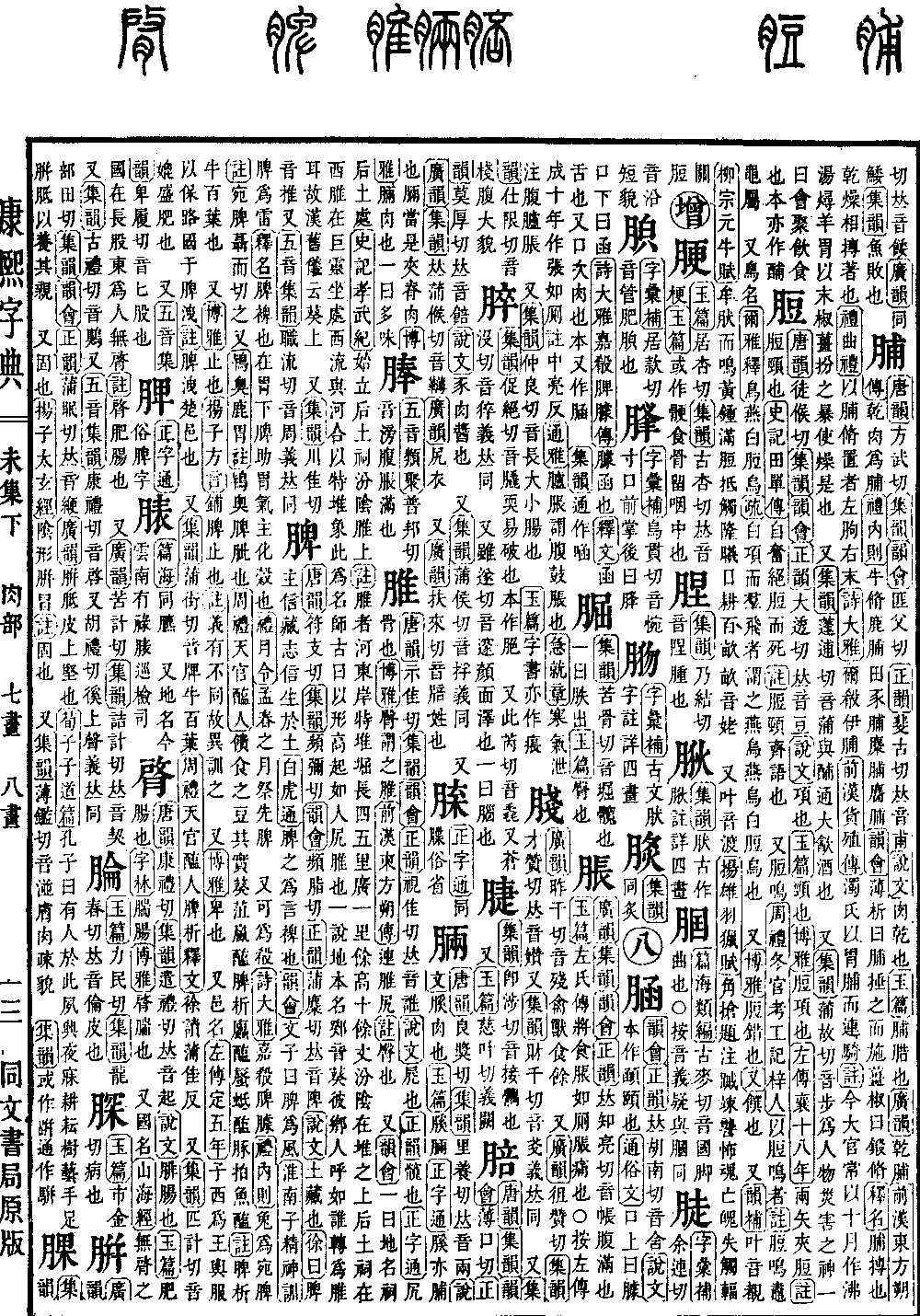
Wei Collection, Lower Volume
Radical: Meat (ròu)
脾
Kangxi Strokes: 14
Page 985, Entry 23
Pronounced pí.
Shuowen Jiezi says: It is the earth organ. Xu says: The spleen manages sincerity and will; sincerity is produced by the virtue of earth. Baihu Tong says: The meaning of spleen is to assist. Yunhui says: Wenzi says: The spleen corresponds to wind. Huainanzi: Jingshen Xun says: The spleen corresponds to thunder. Shiming says: Spleen means to assist. It is located below the stomach. The spleen assists the function of the stomach and is primarily responsible for digesting food. Book of Rites (Liji): In the first month of spring, during sacrifices, the spleen is offered first. It can also be served as a dish. Book of Odes (Shijing): Delicious dishes include the spleen and the palate. Book of Rites (Liji): Rabbit meat is prepared as wanpi. Annotation: Wanpi means cut into thin slices. Also, in the annotation for bao’aoluwe wei: Bao’ao refers to the spleen and the tripe. Zhou Rites (Zhouli): When offering food in vessels during sacrifices, they contain pickles made of mallow and sauce made of snail meat, sauce made of ox omasum and sauce made of large clam meat, sauce made of clam meat and ant eggs, and sauce made of pork ribs and fish. Annotation: Pixi is ox omasum.
Also, Boya says: It means to stop. Yangzi: Fangyan says: Pupi means to stop. Annotation: Because the meanings differ, there are different explanations. Also, Boya says: It means this. Also, it is the name of a place. Zuo Commentary (Zuo Zhuan): Zixi prepared the vehicles and garments of the King of Zhou and established a state at Pixie to protect the road. Annotation: Pixie is a city in the state of Chu.
Also, Jiyun: Pronounced pái. Ox omasum. Zhou Rites (Zhouli): In the commentary on the Pixi entry for the officer in charge of salted foods, Xu Miao reads it as pai.
Also, Jiyun: Pronounced pí. Describes something very fat and strong.
Also, Wuyin Jiyun: Pronounced bǐ. Refers to the thigh.