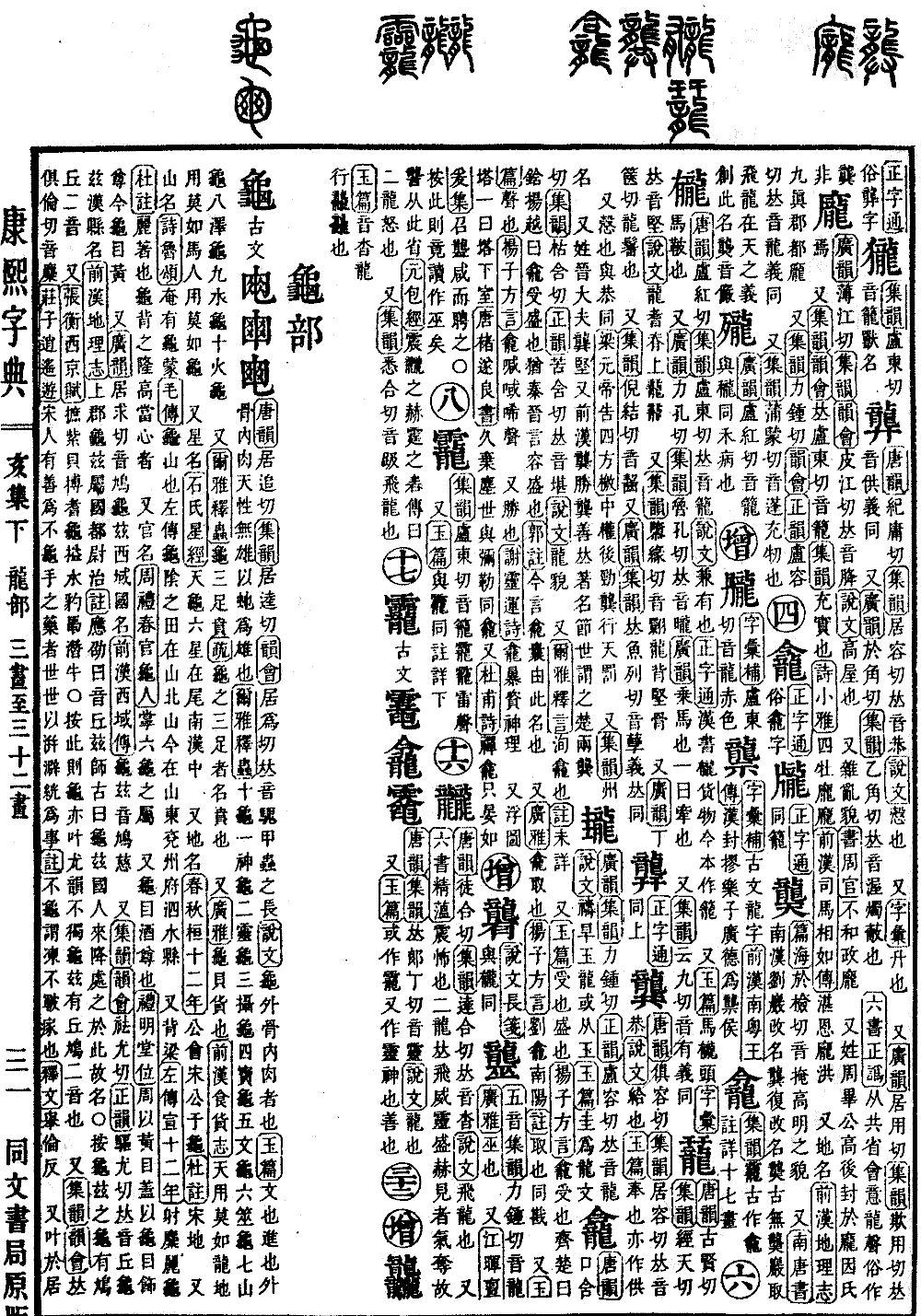
Hai Collection, Lower Volume
Radical: Dragon (lóng)
Page 1537, Entry 19
Guangyun (broad rhymes) records the pronunciation as pang (level tone). Jiyun (collection of rhymes) and Yunhui (compilation of rhymes) both record the pronunciation as pang (level tone). The character is read the same as the character for swollen.
According to Shuowen (explanation of characters), it refers to a tall and large house. It also denotes a messy or chaotic appearance.
In the Book of Documents (Shujing), specifically the Zhou Guan, it is noted that if government affairs are not in harmony, they will become chaotic.
It is also a surname. A descendant of Duke Gao of Bi in the Zhou Dynasty was enfeoffed at the place called Pang, and thus the surname Pang was adopted.
Jiyun and Yunhui also record the pronunciation as long (level tone). The character is read the same as the character for cage. According to Jiyun, it means to be full or substantial.
In the Book of Odes (Shijing), specifically the Xiaoya, it describes four stallions that are very robust.
In the History of the Former Han (Qian Hanshu), specifically the Biography of Sima Xiangru, it refers to deep benevolence that is grand and flourishing.
It is also a place name. In the History of the Former Han, specifically the Treatise on Geography, it is mentioned as Doupang County in Jiuzhen Commandery.
According to Jiyun, it is also pronounced as long (level tone). The meaning is the same as above.
According to Jiyun, it is also pronounced as peng (level tone). The meaning is to be full or abundant.