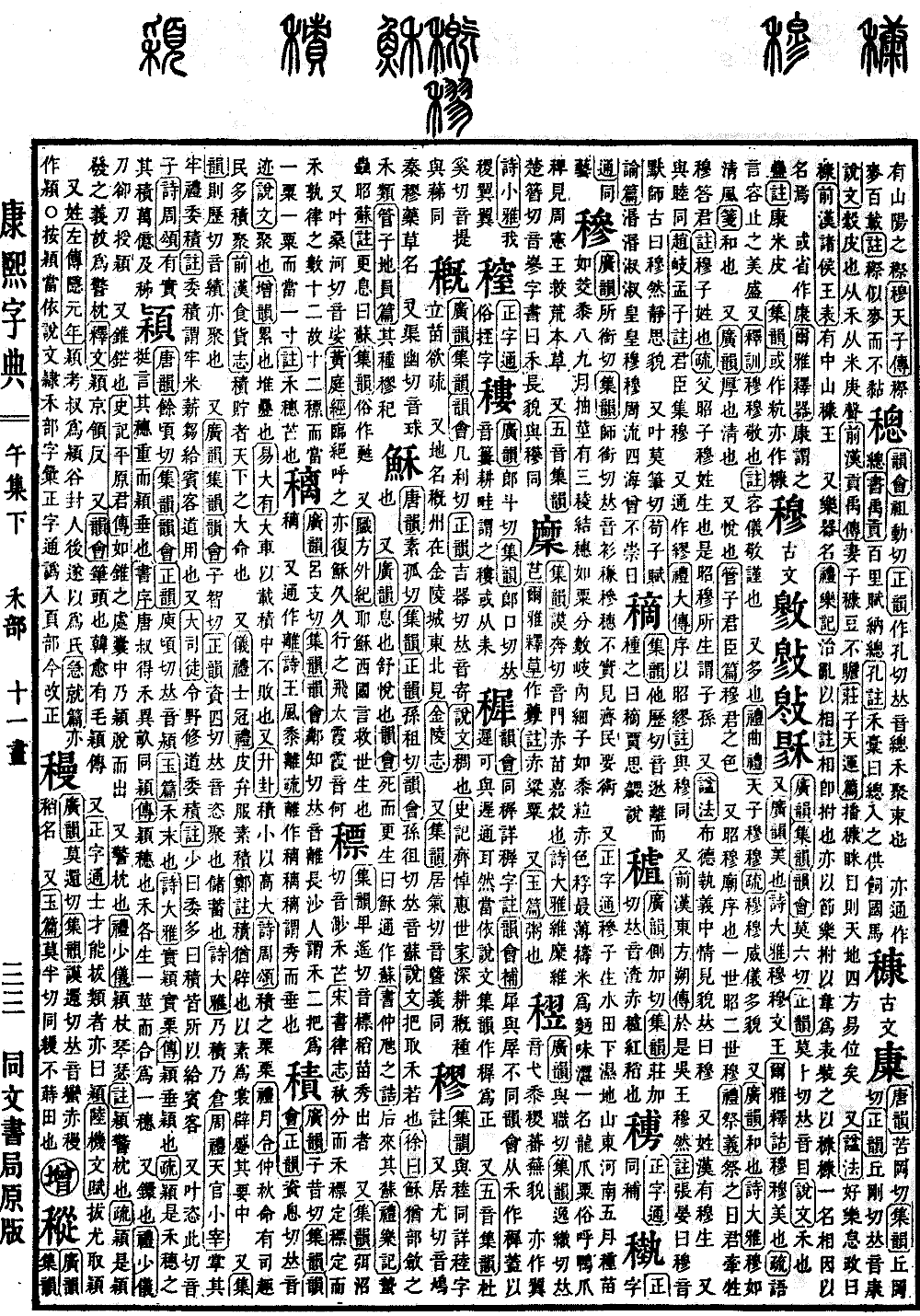
Wu Collection, Lower Volume
Radical: Grain (hé)
Kangxi Strokes: 16
Page 859, Entry 04
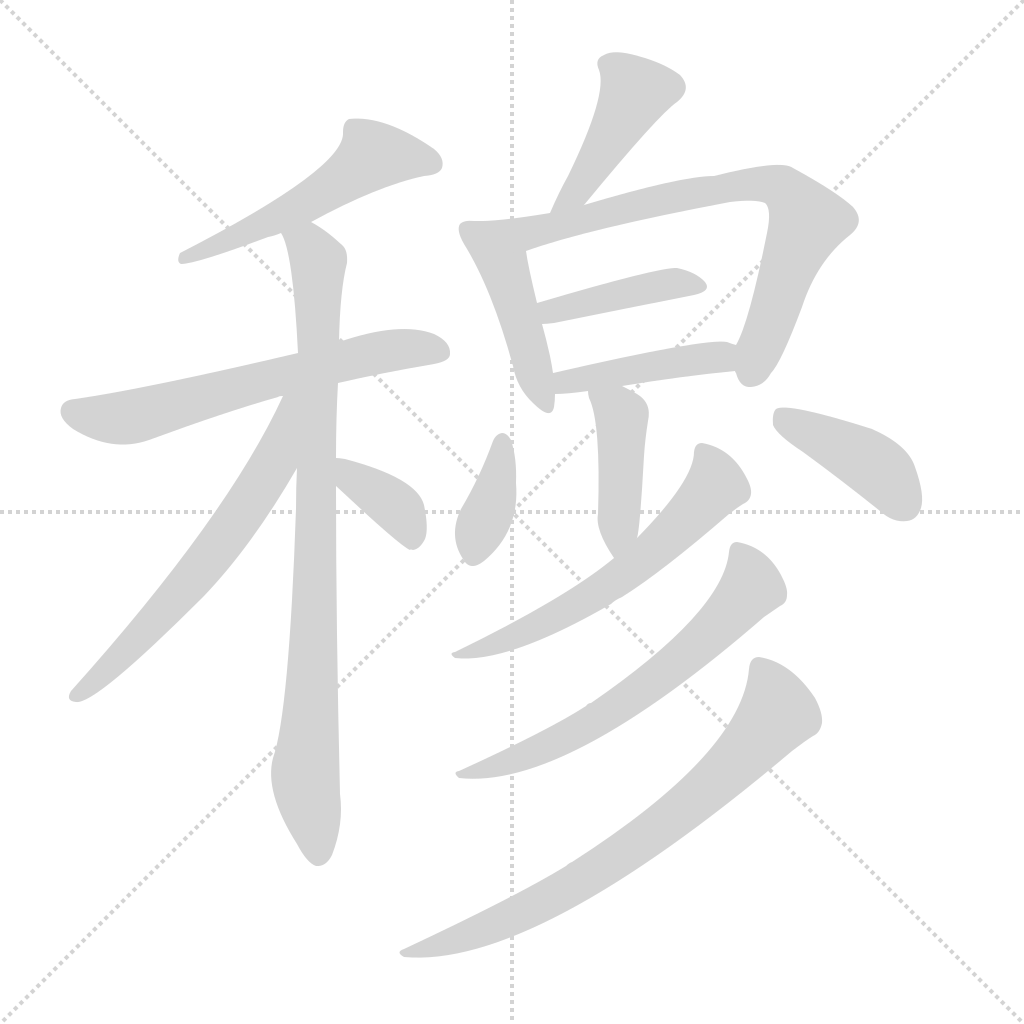
Ancient text. According to the Wide Dictionary of Sounds (Guangyun), the Collection of Rhymes (Jiyun), and the Collection of Rhymes and Explanations (Yunhui), the pronunciation is mo (entering tone). According to the Correct Pronunciation (Zhengyun), the pronunciation is mu (entering tone). Pronounced mu. According to the Analytical Dictionary of Characters (Shuowen), it means grain.
Also, according to the Wide Dictionary of Sounds (Guangyun), it means beautiful. In the Book of Odes (Shijing), it is written: The majestic (mumu) King Wen. According to the Literacy Encyclopedia (Erya), in the section Interpreting Ancient Terms, mumu means beautiful. The commentary states: This refers to the beauty and flourishing nature of one's speech and demeanor.
Also, in the section Interpreting Manners, mumu means respect. The commentary states: This refers to a respectful and cautious demeanor.
Also, it means abundant. In the Book of Rites (Liji), in the section Summary of the Rules of Propriety (Quli), it is written: The Son of Heaven is majestic (mumu). The commentary states: Mumu refers to the abundance of one's dignified demeanor.
Also, according to the Wide Dictionary of Sounds (Guangyun), it means harmonious. In the Book of Odes (Shijing), it is written: Harmonious (muru) like a clear breeze. The annotation states: It means harmonious.
Also, according to the Wide Dictionary of Sounds (Guangyun), it means thick and pure.
Also, it means pleased. In the Guanzi, in the section on Ruler and Minister, it is written: To please (mu) the ruler's expression.
Also, zhaomu refers to the order of ancestral temples. The first generation is zhao, and the second generation is mu. In the Book of Rites (Liji), in the section Meaning of Sacrifices (Jiyi), it is written: On the day of the sacrifice, the ruler leads the sacrificial animal, and the mu responds to the ruler. The annotation states: Mu refers to the descendants. The commentary states: The father is zhao, the son is mu. Being born means the descendants. This is what is meant by the descendants of zhao and mu.
Also, according to the Method of Posthumous Titles (Shifa), one who spreads virtue and upholds righteousness, with the inner temperament reflected in one's appearance, is called mu.
Also, a surname. In the Han dynasty, there was Mu Sheng.
Also, it is the same as the character for harmonious (mu). In the commentary on Mencius by Zhao Qi, it is written: The ruler and minister are gathered in harmony (mu).
Also, commonly written as the variant form (miao). In the Book of Rites (Liji), in the section Great Traditions (Dazhuan), it is written: Arranged by zhao and miao. The annotation states: It is the same as mu.
Also, in the History of the Former Han (Qian Han Shu), in the biography of Dongfang Shuo, it is written: Thereupon, the King of Wu was silent (muran). The annotation by Zhang Yan states: Mu is pronounced mo. Yan Shigu states: Muran means the appearance of quiet contemplation.
Also, rhymes with the pronunciation bi (entering tone). In the Xunzi, in the section on Theories of Rhapsody, it is written: Mumin shushu, huanghuang mumu. Circling the four seas, never reaching the sun.