Wei Collection, Middle Volume
Radical: Silk (mì)
Page 937, Entry 17
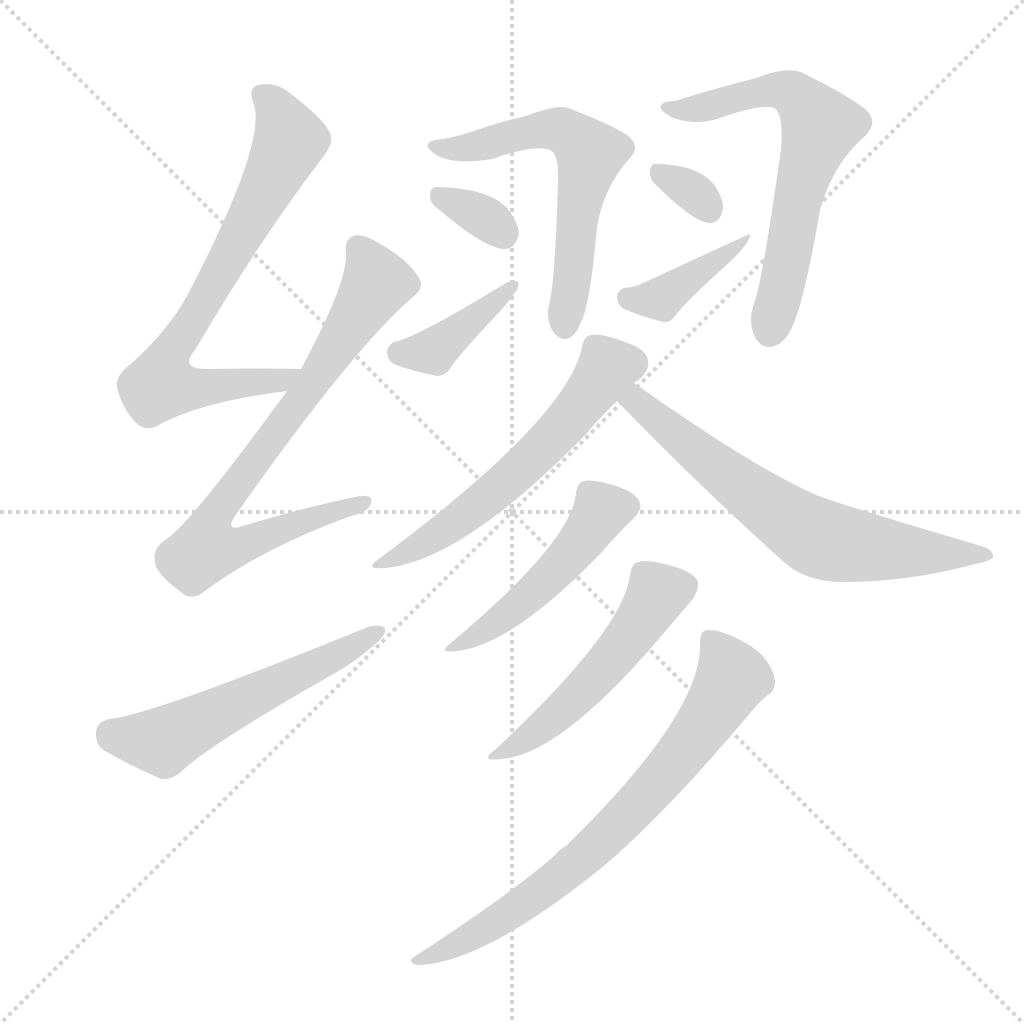
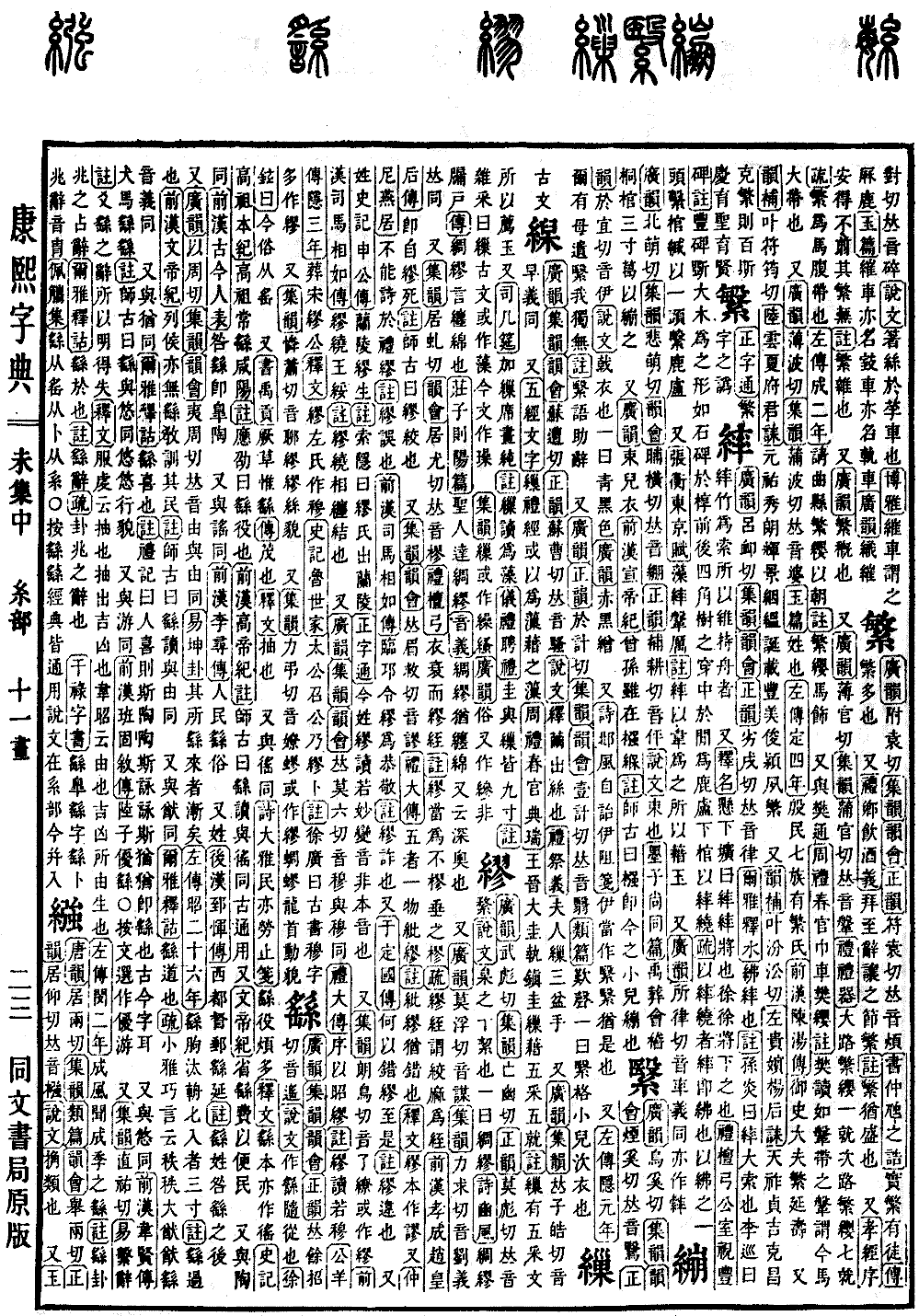
Pronounced miao. According to the Shuo Wen Jiezi (Shuowen Jiezi), it refers to ten bundles of hemp. Another source defines it as wrapping. In the Book of Odes (Shijing), Binfeng section, it describes winding around windows. The commentary states that chou-miao means to wrap tightly. In the Zhuangzi, Zeyang chapter, it describes a sage who understands profound principles. The Pronunciation and Meaning (Yinyi) section states that chou-miao means entanglement; it is also interpreted as meaning profound.
Also pronounced mou. Also pronounced liu. The meaning is the same.
Also pronounced jiu. In the Book of Rites (Liji), Tanguan section, it refers to wearing mourning garments and binding them with a belt made of twisted hemp. The commentary notes that miao should be understood as not hanging loose. The sub-commentary explains that miao-die refers to twisting hemp into a mourning belt. In the Book of Han (Hanshu), Biography of Empress Zhao of Emperor Cheng, it refers to hanging oneself. The commentary by Yan Shigu states that miao means to strangle or twist.
Also pronounced miu. In the Book of Rites (Liji), Dachuan section, it refers to having one error among five items. The commentary notes that pi-miao means error. The Explanation of Text (Shiwen) notes that miao was originally written as the character for error. In the Zhongni Yanju, it refers to not being able to mistake the Odes and the Rites. The commentary defines miao as error. In the Book of Han (Hanshu), Biography of Sima Xiangru, it refers to the magistrate of Linqiong feigning respect. The commentary defines miao as deceit. In the Biography of Yu Dingguo, it asks why one would deviate to such an extent. The commentary defines miao as to deviate.
Also a surname. In the Records of the Grand Historian (Shiji), Biography of Master Shen, it mentions Master Miao of Lanling. The commentary Suoyin states that the Miao clan originates from Lanling. The Zhengzitong notes that the modern surname Miao is pronounced miao due to phonetic change and is not the original pronunciation.
Also pronounced liao. The character liao is sometimes written as miao. In the Book of Han (Hanshu), Biography of Sima Xiangru, it refers to the ribbons winding around a crown. The commentary explains miao-rao as being intertwined.
Also pronounced mu. It is equivalent to the character mu. In the Book of Rites (Liji), Dachuan section, it refers to the order of the zhao and mu ancestral arrangement. The commentary notes that miao is pronounced mu. In the Gongyang Commentary (Gongyang Zhuan), Yin Year 3, it refers to the burial of Duke Miao of Song. The Explanation of Text (Shiwen) notes that the Zuo Commentary (Zuo Zhuan) writes this as mu. In the Records of the Grand Historian (Shiji), Annals of Lu, it refers to the Grand Duke and the Duke of Shao performing divination with respect. The commentary by Xu Guang states that in ancient texts, the character mu is often written as miao.
Also pronounced liao. Miao-miao describes the appearance of silk.
Also pronounced liao. The character liao is sometimes written as miao. Tiao-liao describes the appearance of a dragon head swaying.