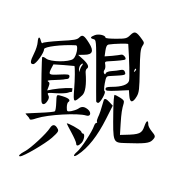
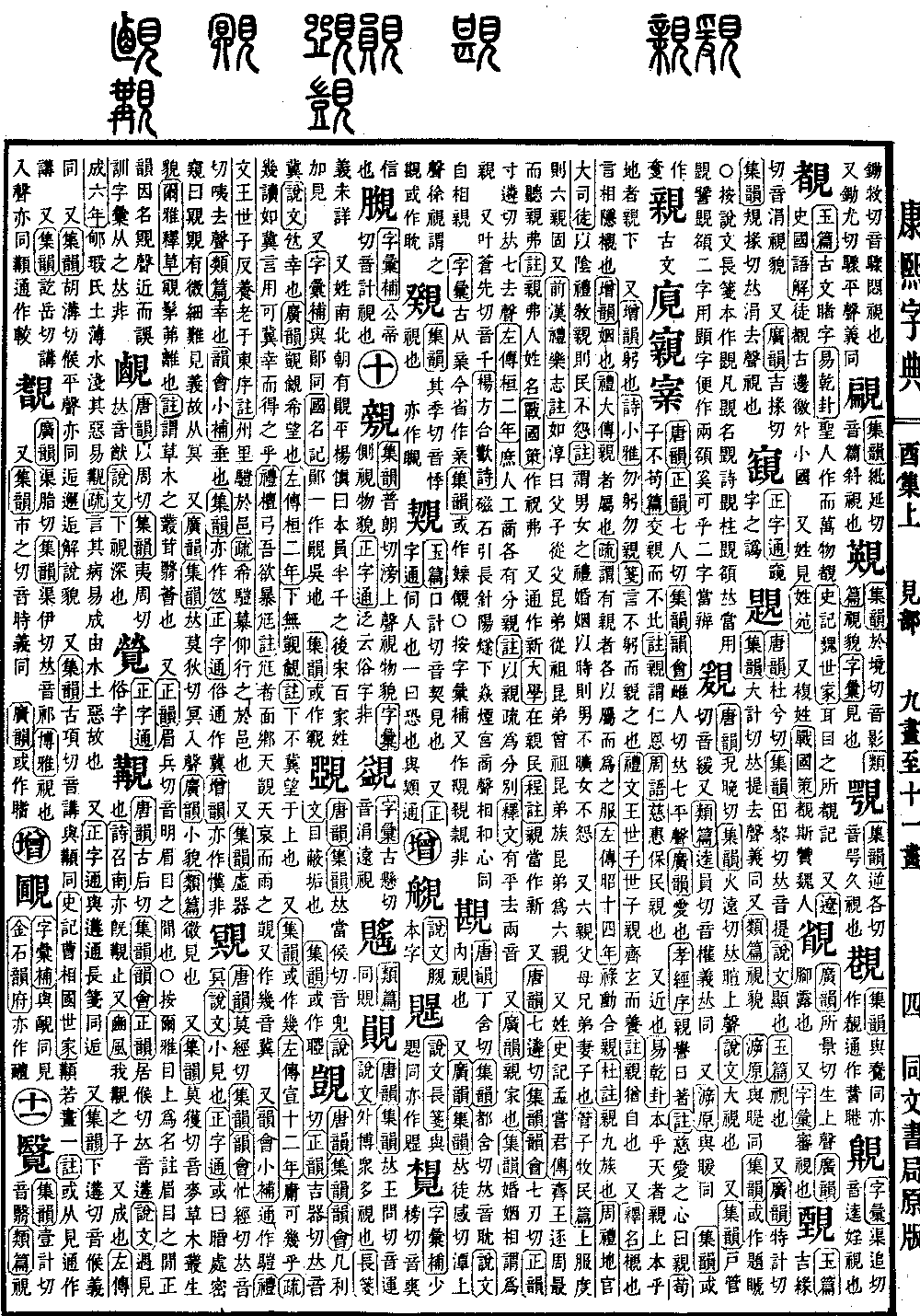
You Collection, Upper Volume
Radical: See (jiàn)
Kangxi Strokes: 17
Page 1136, Entry 29
Tang Rhyme (Tangyun) states: Pronounced ming.
Gathering of Rhymes (Jiyun) and Rhyme Collection (Yunhui) state: Pronounced ming.
Analytical Dictionary of Chinese Characters (Shuowen) states: To see slightly.
Correction of Characters (Zhengzitong) states: Some say to peer secretly in a dark place is called ming. Ming carries the sense of being minute and difficult to see, hence it is derived from the character for dark (ming).
Broad Rhymes (Guangyun) and Gathering of Rhymes (Jiyun) state: Pronounced mi (entering tone).
Broad Rhymes (Guangyun) states: Small appearance.
Classified Chapters (Leipian) states: To see faintly.
Gathering of Rhymes (Jiyun) states: Pronounced mai. The appearance of grasses and trees growing densely.
Literary Expositor (Erya), Explanation of Ancient Words (Shigu) states: Mingmao means flourishing and tangled.
Commentary states: This refers to the dense and obscured state of grasses and trees.
Corrected Rhymes (Zhengyun) states: Pronounced ming. The space between the eyebrows and eyes.
Critique: In the Literary Expositor (Erya), the part above the eyes is called ming; the commentary says this is the space between the eyebrows and eyes. The Corrected Rhymes (Zhengyun) mistakenly provided this definition because the sound is close to ming, and the Character Compendium (Zihui) followed this error, which is incorrect.
Textual Research: The Literary Expositor (Erya), Explanation of Grasses (Shicao) states: Mingmao means flourishing and tangled. According to the original book, this has been corrected from Explanation of Ancient Words (Shigu) to Explanation of Grasses (Shicao).