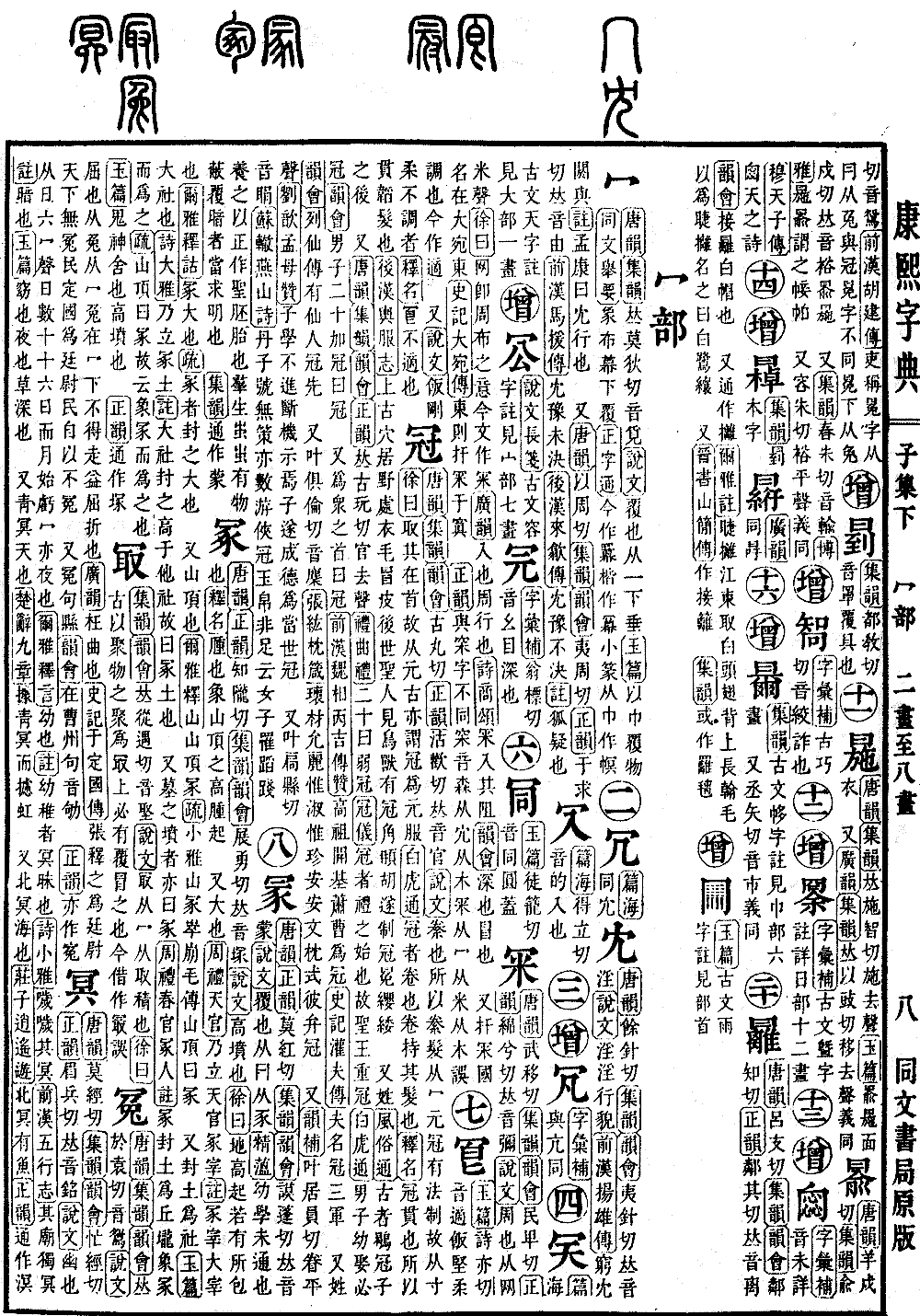
Zi Collection, Page Position: Lower
Radical: Cover (mì)
Míng
Kangxi Stroke Count: 10
Page 130, Number 28
Tang Rhymes (Tangyun) records the pronunciation as a fanqie of mo and jing. Collected Rhymes (Jiyun) and Rhyme Rhymes (Yunhui) record it as a fanqie of mang and jing. Correct Rhymes (Zhengyun) records it as a fanqie of mei and bing, sounding the same as ming.
Explanations of Scripts and Elucidations of Characters (Shuowen Jiezi) defines it as dim or dark. The character form is composed of sun (ri) and six (liu), with cover (mi) as the phonetic component. There are ten days in a cycle, and from the sixteenth day of each month, the moon begins to wane; cover (mi) also represents the night.
Approaching the Correct (Erya) defines it as small or young. The commentary notes it refers to an immature person in a state of ignorance and lack of clarity.
Book of Odes (Shijing) describes palaces as deep and dim.
Book of Han (Hanshu) mentions a temple was especially dark. The commentary defines it as dim.
Jade Chapters (Yupian) describes it as a far-reaching appearance, nighttime, or lush and deep vegetation.
It also refers to the sky (qingming). Songs of the South (Chu Ci) describes leaning against the blue sky to stretch out a long rainbow.
It also refers to the northern sea (beiming). Zhuangzi states there is a fish in the northern sea.
Correct Rhymes states it is also interchangeable with the character for sea pronounced ming.
It also refers to Xuanming, the god of water. Record of Ritual (Liji) states the deity of this season is Xuanming. The commentary notes that the sons of the lineage of Shaohao, named Xiu and Xi, served as water officials.
Collected Rhymes, Rhyme Rhymes, and Correct Rhymes also record it in the rising tone of ming.
Book of Odes says do not push that great carriage, as it will only raise dust and leave one in a daze; do not dwell on many worries, for that will only make one unable to escape anxiety.
Zhu Xi’s commentary defines the term mingming as a dim and unclear appearance.
Collected Rhymes also records it in the departing tone of ming with the same meaning.
Collected Rhymes, Rhyme Rhymes, and Correct Rhymes also record the pronunciation as mi. It means to cover. It is also the name for using ropes to snare birds and beasts.
Rituals of Zhou (Zhouli) mentions an official post called Mingshi, responsible for setting up crossbows and traps to capture fierce beasts.
According to a rhyming reading in the Records of the Grand Historian (Shiji), it describes a state where nothing can be seen in broad daylight, and the sky is dim with wind and rain. Clouds cover the sky above, appearing in five colors as well as blue and yellow.
Collected Rhymes also records the pronunciation mian. The term mianshun refers to the eyes being unable to see.