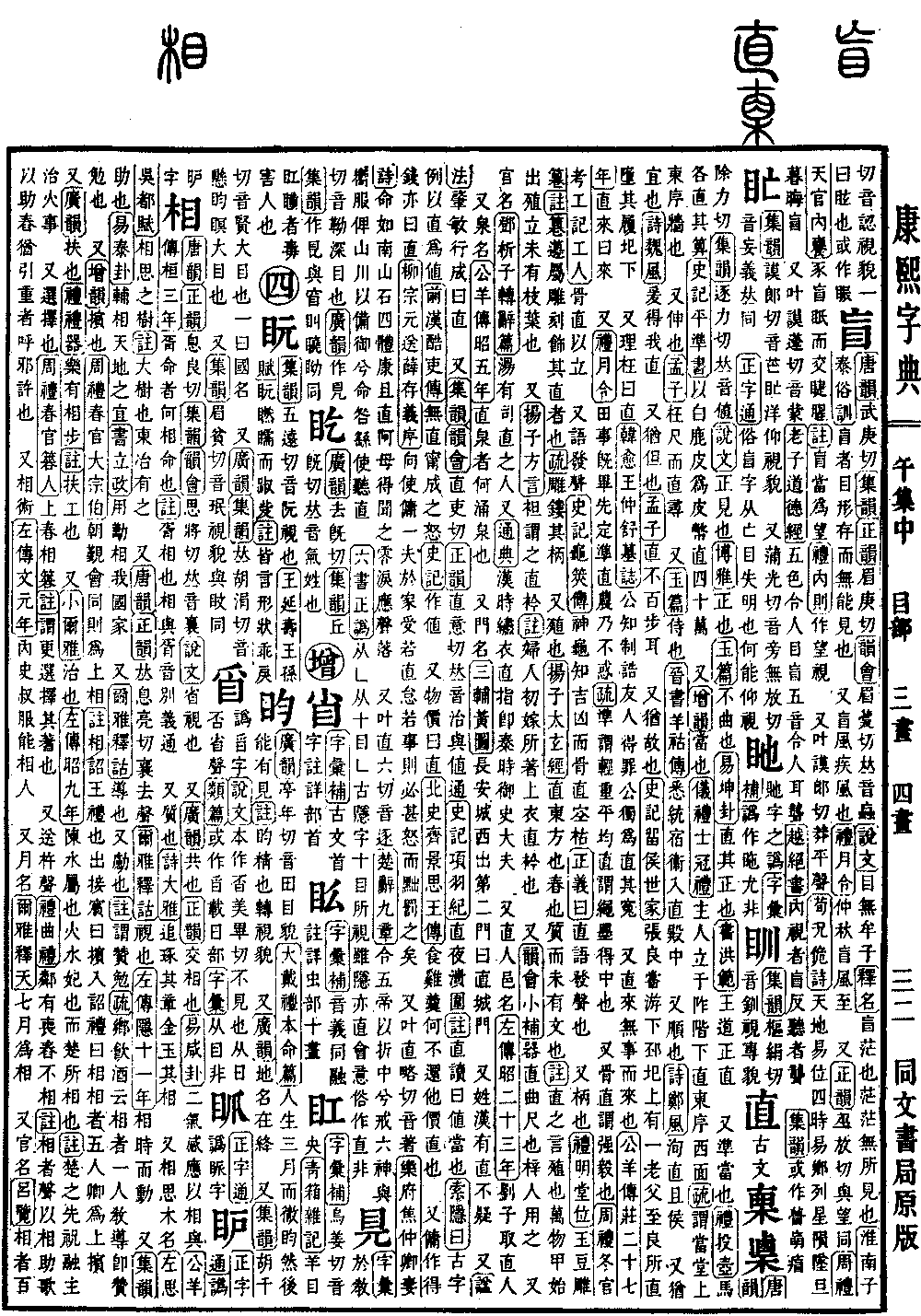
Wu Collection, Middle Volume
Radical: Eye (mù)
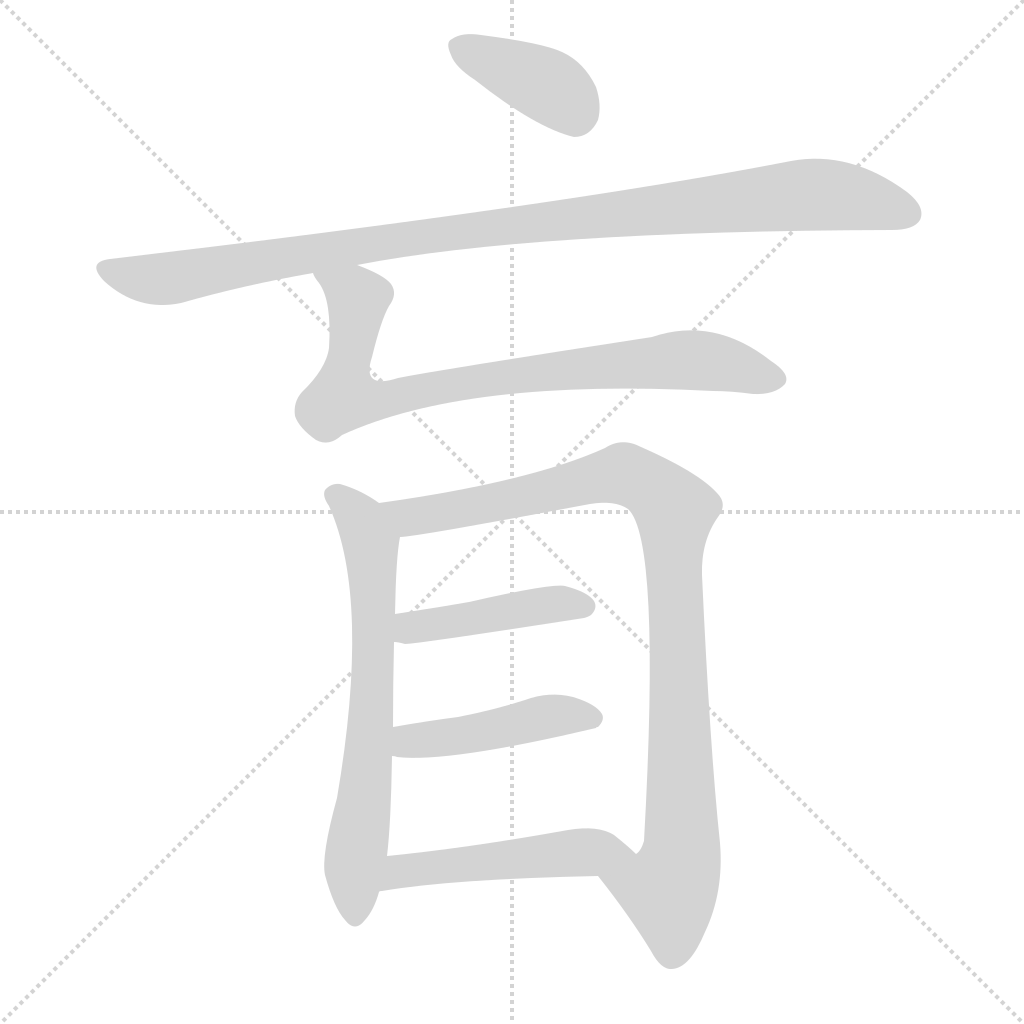
Entry: Blind. Kangxi strokes: 8. Page 800, Entry 01.
Pronounced mang.
According to the Explaining and Analyzing Characters (Shuowen Jiezi), it refers to eyes without pupils. According to the Explanations of Names (Shiming), to be blind is to be in a state of vast emptiness, where one cannot see anything. According to the Huainanzi, in the section on The Excellence of the People (Taizu Xun), a blind person still possesses the physical form of eyes but lacks the ability to see.
It also refers to blind winds, meaning gale-force winds. According to the Book of Rites (Liji), in the section on Monthly Ordinances (Yueling), such winds arrive during the mid-autumn season.
Also, per the Correct Rhymes (Zhengyun), it is pronounced wang. It is the same as the character for gazing. According to the Rites of Zhou (Zhouli), in the section on the Celestial Officials and Internal Cooks (Tianguan Neiyong), if a pig has eyes that look upward and eyelashes that cross, it is considered rank meat. The commentary notes that blind here should be read as gazing. According to the Book of Rites (Liji), in the section on Internal Rules (Neize), it is written as gazing and viewing.
Also, rhyming with lang, read as the flat tone of mang. According to the poem of Xun Kuang (Xunzi), the heavens and earth exchange positions, and the four seasons invert their order. The constellations fall, and the morning and evening are dim and unclear.
Also, rhyming with peng, read with the sound of meng. According to the Laozi, also known as the Classic of the Way and Virtue (Daodejing), the five colors blind the eyes, and the five sounds deafen the ears. According to the Records of the History of Yue (Yuejueshu), those who only look inward will go blind, and those who only listen to themselves will go deaf.
According to the Collected Rhymes (Jiyun), it is sometimes written as the variants meng or mang.
Textual research: In the Huainanzi, in the section on the Excellence of the People (Taizu Xun), it is stated that a blind person has the shape of an eye present but cannot see. Note that the phrase regarding the blind person appears in the section on the Excellence of the People (Taizu Xun), so the text has been corrected to refer to the Excellence of the People (Taizu Xun) based on the original book.