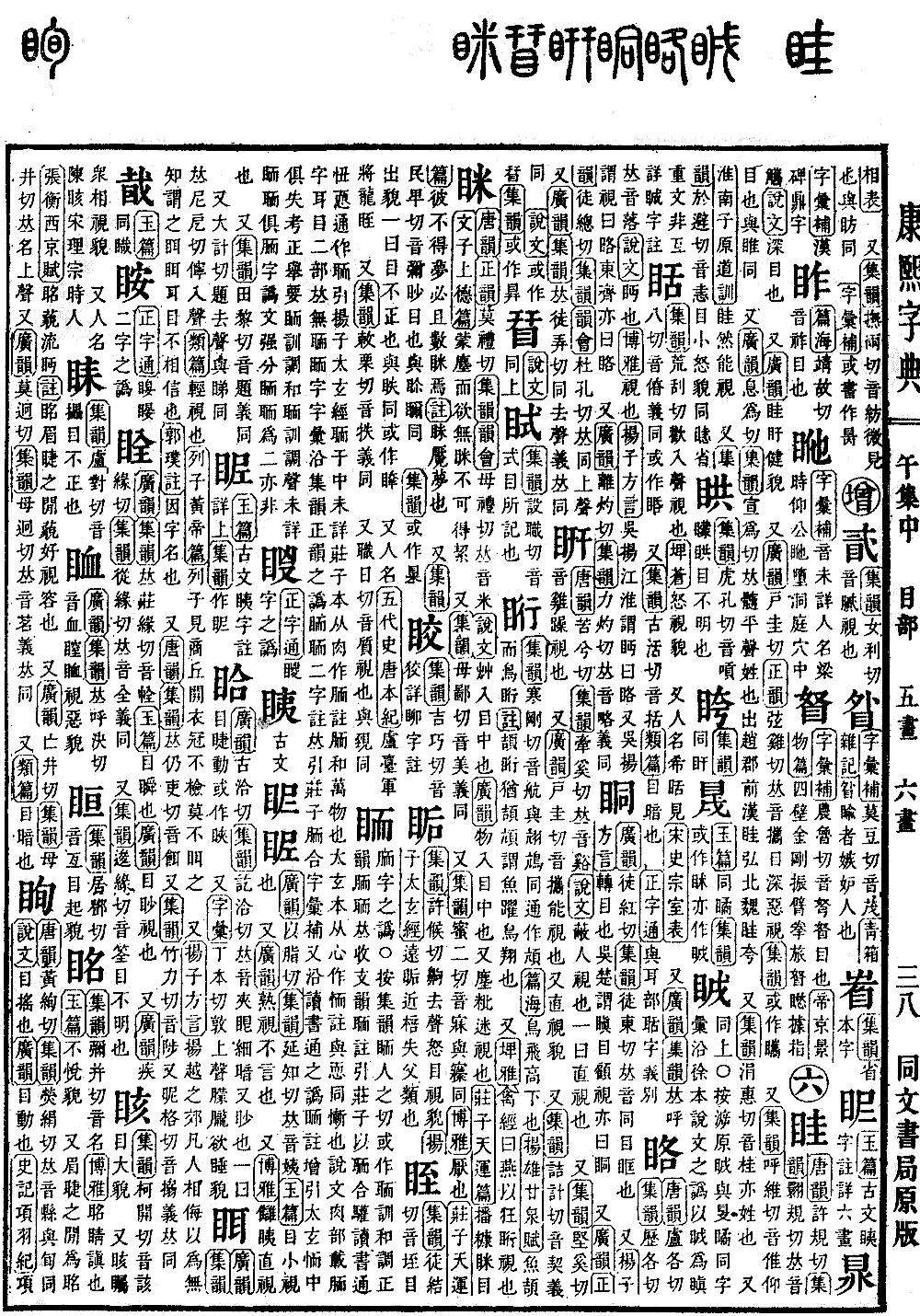
Wu Collection, Middle Volume
Radical: Eye (mù)
Mi
Kangxi strokes: 11
Page 806, Entry 21
Pronounced mi (rising tone)
Shuowen Jiezi (Dictionary of Explanations and Analyses of Characters): Grass entering the eyes.
Guangyun (Broad Rhymes): Objects or dirt entering the eyes. Also refers to dust or miscellaneous debris obscuring the vision.
Zhuangzi (The Book of Master Zhuang), Tianyun Chapter: Raised chaff obscures the eyes.
Wenzi (Book of Master Wen), Shangde Chapter: To be covered in dust yet expect not to have one's vision obscured is impossible; one cannot remain clean.
Also pronounced mei (rising tone). Same meaning.
Also pronounced mei (falling tone). Same as the character mi.
Guangya (Broad Refinements): To press down or suppress.
Zhuangzi (The Book of Master Zhuang), Tianyun Chapter: Those people do not obtain peace and will inevitably be repeatedly plagued by nightmares.
Commentary: Mi refers to being afflicted by nightmares while sleeping.
Also pronounced mi (rising tone). Refers to small eyes. Same as the character mi.
It is noted that this character was originally written with the element meaning small/near.
Mi
Pronounced mi (rising tone). Small eyes.
Also pronounced mi (falling tone). Squinting.
Note: The Zihui Bu (Supplement to the Collection of Characters) incorrectly writes this as another form, changing the pronunciation to mi and defining it as small eyes, which is incorrect.