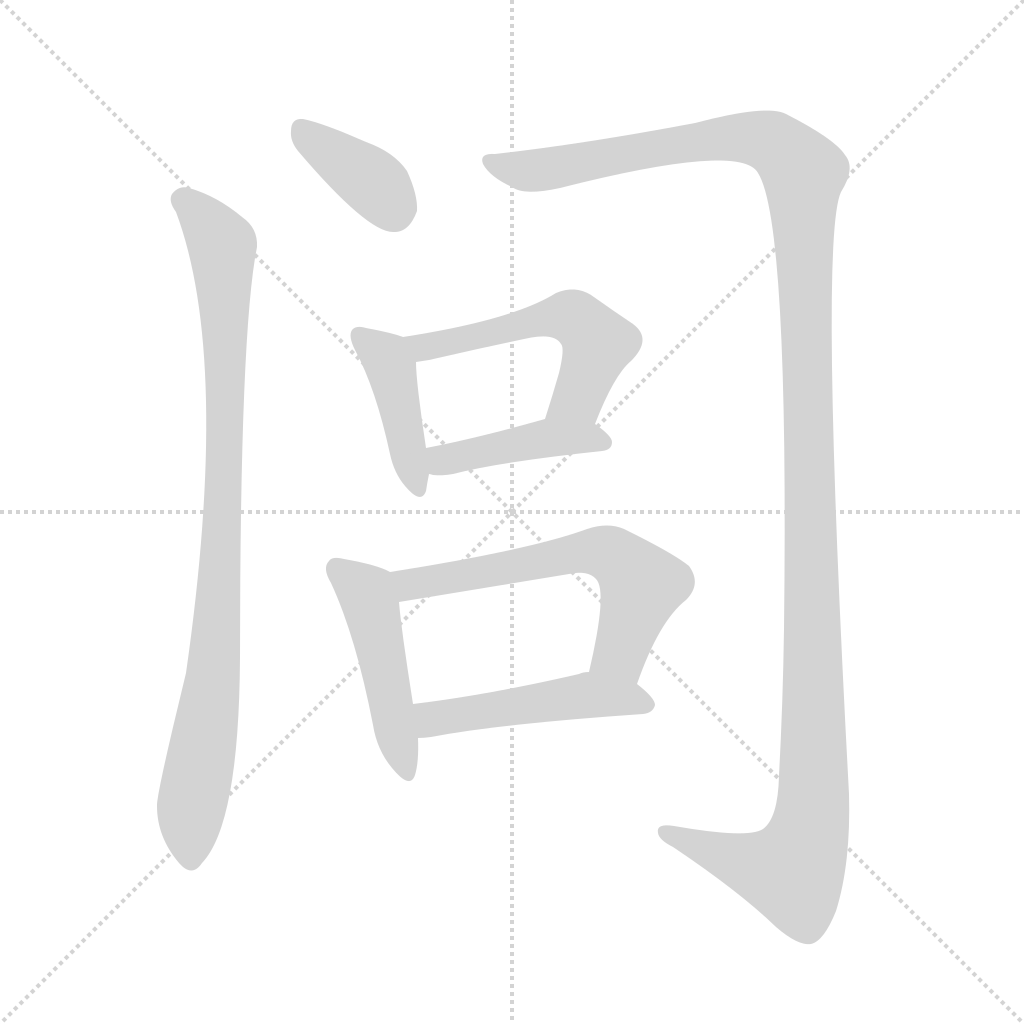
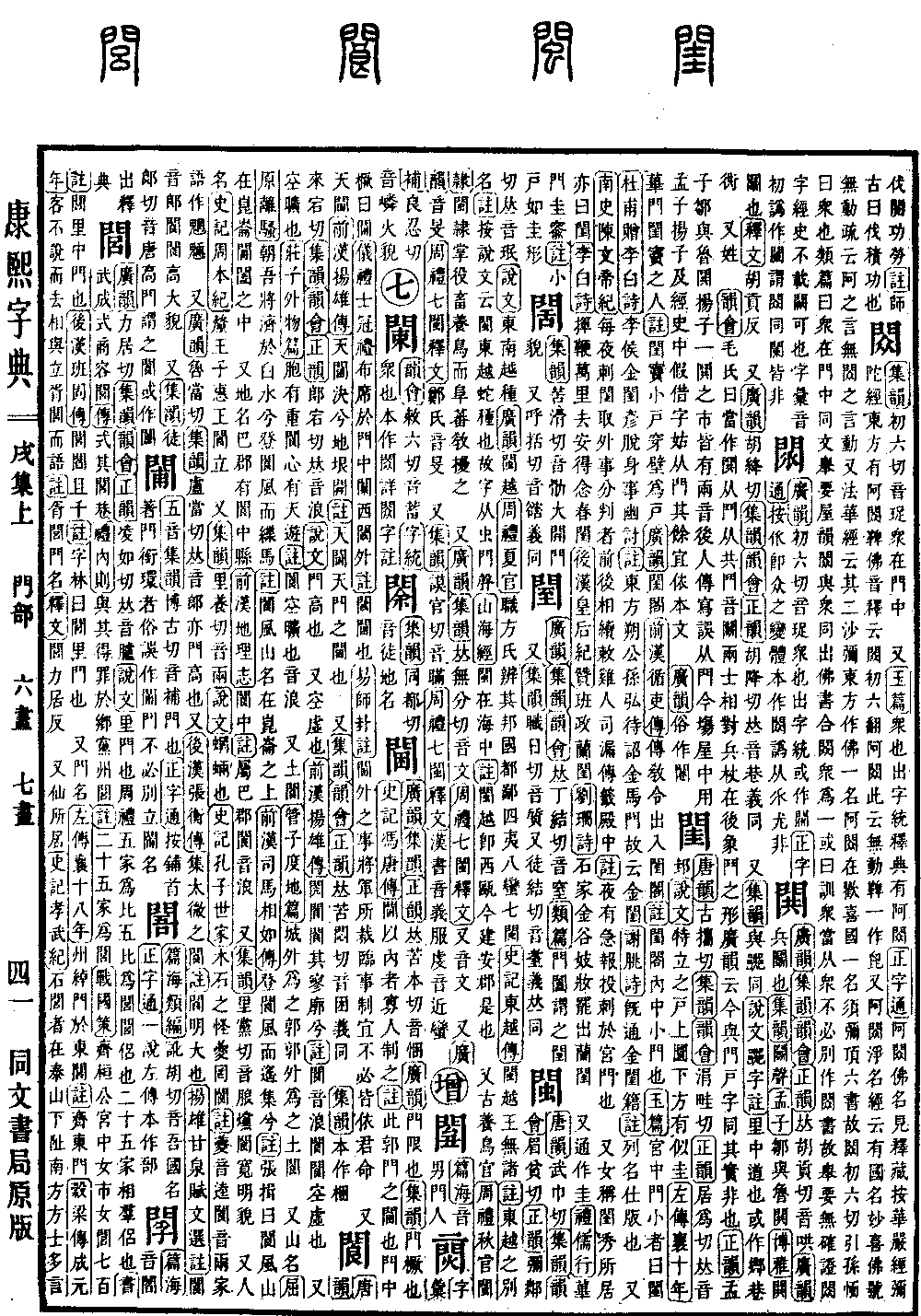
Xu Collection, Upper Volume
Radical: Gate (mén)
Kangxi stroke count: 15
Page 1335, Entry 01
Pronounced lu
Shuowen Jiezi: The gate of a village. In the Book of Rites (Liji), five households constitute a bi, and five bi constitute a lü. Lü implies companionship; twenty-five households group together as companions.
Book of Documents (Shujing): Respect the village gate of Shang Rong. Commentary: Respect the village alley.
Book of Rites (Liji): And regarding causing offense among the village or district. Commentary: Twenty-five households constitute a lü.
Strategies of the Changing States (Zhan Guo Ce): Duke Huan of Qi had seven hundred women in the palace and in the village. Commentary: Village or neighborhood, meaning the central gate.
History of the Later Han (Hou Hanshu): The village residents were nearly a thousand. Commentary: The Zilin dictionary says: village, a gate.
Also a gate name.
Zuo Tradition (Zuo Zhuan): Zhou Chuo stationed himself at the East Gate. Commentary: The east gate of Qi.
Gongyang Commentary (Gongyang Zhuan): The guest, displeased, departed, and they stood together at the Xu-lü gate to converse. Commentary: Xu-lü is a gate name.
Explication of Texts (Shiming): Lü is pronounced lu.
Also where immortals dwell.
Records of the Grand Historian (Shiji): Shi-lü is located at the southern foot of Mount Tai; many occultists claim this is the gate of an immortal.
Also the name of a courier station.
Spring and Autumn Annals (Chunqiu): Zhu Shuqi came to defect with Qilüqiu. Commentary: Northwest of Pingyang County, south of Gaoping, there is the Xianlü courier station.
Also an ancient official title.
Book of Rites (Liji): The Lüxu official manages the levies and orders of his respective village.
Rhapsody on Encountering Sorrow (Lisao) Preface: Qu Yuan was of the same surname as the House of Chu; serving King Huai, he was the Minister of the Three Lü.
Records of the Grand Historian (Shiji) Commentary: The duty of the Three Lü was to manage the three branches of the royal clan.
Also a stone name.
Five Tones Dictionary (Wuyin Jiyun): Weili (a legendary place). Sima says: Lü means to gather. It is a place where water gathers, located east of Fusang, also known as Wujiao. It is a stone forty thousand li in circumference and forty thousand li thick; seawater pouring into it never dries up.
Also a mountain name.
Erya: The beauty of the East includes the jade and jasper of Mount Yiwulü. Commentary: Yiwulü is a mountain name, currently located in Liaodong.
Also from Yangzi’s Dialects (Fangyan): The prow of a boat is called a heli. Commentary: Today in the Jiangdong region, the structure at the prow of a boat is called a feili.
Also a sword name.
Xunzi: Ganjiang, Moye, Juque, and Pilü; these are all excellent swords of antiquity. Commentary: The New Preface (Xinxu) says: Pilü and Juque are the excellent swords of the world.
Also from the Five Tones Dictionary: A plant name, shaped like mugwort.
History of the Former Han (Hanshu): Yanlü stretched out. Commentary: Yanlü is a type of mugwort; the seeds can be used to treat illnesses.
Also from the Rectification of Rhymes (Zheng Yun): Lü is a tree name.
Records of the Grand Historian (Shiji): Areca and binglü. Commentary: Both are annotated as palm trees. However, considering that palm bark is used to make ropes, binglü should refer to a palm, while renpin refers to areca nut.
Also from the Five Tones Dictionary: A beast name, like a donkey, with one horn and cloven hooves.
Classic of Mountains and Seas (Shanhaijing): In Mount Xianyong, there are many lümi beasts. Commentary: Guo says that lü is the same as the shu; it resembles a donkey but has cloven hooves and horns like an antelope. Also called mountain donkey.
Also a beautiful woman.
Strategies of the Changing States (Zhan Guo Ce): For a beautiful lü-woman, Zishe has none like the matchmaker. Commentary: Lü-shu; Xunzi writes it as lü-ju. Wei Zhao says: A beautiful woman from the states of Liang and Wei.
Also a surname.
Zuo Tradition (Zuo Zhuan): The clan member Ziyang and Lüqiuming treated each other with severity.
History of the Former Han (Hanshu): Lüqiuzi in thirteen chapters. Commentary: A man of the state of Wei.
Zhengzitong: Jianglü and Lükuai are both compound surnames. Han-Tang era: The scholar Lükuai Ban.
Also a person’s name.
Records of the Grand Historian (Shiji): King Helü of Wu.
History of the Former Han (Hanshu): Nannü, the ruler of the Eastern Yi, and others. Commentary: Nannü is the personal name of the ruler of the Wei.
Records of the Grand Historian (Shiji): The Marquis of Yülü.