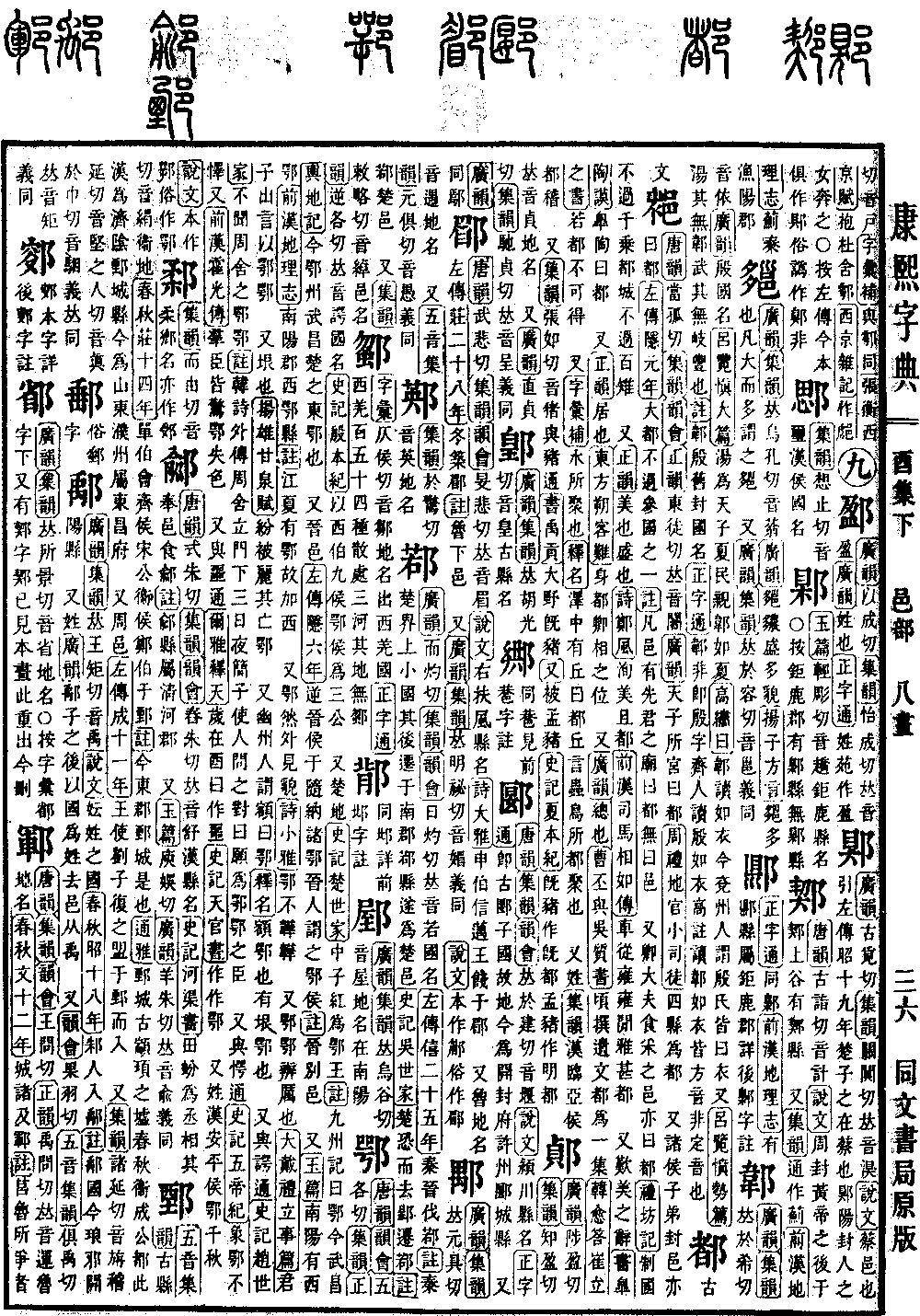
You Collection, Lower Volume, Radical: City (yì); Kangxi Dictionary stroke count: 16; Page: 1274, Entry 22.
According to the Tang Rhyme (Tángyùn) and Rhyme Compendium (Yùnhuì), the pronunciation is 'wǔgè qiè'. According to the Collected Rhymes (Jíyùn) and Correct Rhymes (Zhèngyùn), the pronunciation is 'nìgè qiè'. It is pronounced the same as 'è'.
Explanations:
1. A country name. The Records of the Grand Historian (Shǐjì), 'Annals of Yin', states that the Earl of the West (Xī Bó), Lord Jiǔ, and Lord È were collectively known as the Three Dukes.
2. A place in Chu. The Records of the Grand Historian, 'Hereditary House of Chu', records that Prince Hong was enfeoffed as King È. Note: The Record of the Nine Provinces (Jiǔzhōu jì) states that È is present-day Wuchang. The Record of Geography (Yúdì jì) states that present-day Ezhou Wuchang was the Eastern È of the state of Chu.
3. A city in Jin. The Zuo Commentary (Zuǒzhuàn), 'Sixth Year of Duke Yin', records that Duke Jin was welcomed in Suí and housed in È, and the people of Jin called him Marquis È. Note: È was another city of Jin.
4. The Jade Chapters (Yùpiān) records that Nanyang County has Xi'è. The Book of Han (Hànshū), 'Geography Treatise', records that Nanyang Commandery has Xi'è County. Note: The character 'Xi' (West) was added to distinguish it because Jiangxia also had an È.
5. Èrán, describing something exposed or evident. The Book of Odes (Shijing), 'Minor Odes', states: 'The calyxes are vibrant and flourishing'.
6. È'è, describing forthright and disputatious speech. The Elder Dai's Book of Rites (Dà Dài Lǐjì), 'Establishing Affairs' chapter, states: 'A junzi (noble person) should speak directly and argue forthrightly.'
7. Yín, meaning boundary. Yang Xiong's Rhapsody on the Sweet Springs (Gānquán fù) states: 'Luxuriantly spread without boundaries'.
8. People in You Province call the forehead 'è'. The Explanations of Names (Shìmíng) explains: 'È' refers to the forehead because it forms a boundary.
9. Also interchangeable with the character 'è'. The Records of the Grand Historian, 'Hereditary House of Zhao', states: 'Did not hear Zhou Shè's forthright speech'. Note: The Han-style External Commentary on the Book of Odes (Hán Shī Wàizhuàn) records: 'Zhou Shè stood at the gate for three days and nights. Jianzi sent someone to ask him, and he replied: "I wish to be a minister who speaks forthrightly."'"
10. Also interchangeable with the character 'è'. The Records of the Grand Historian, 'Annals of the Five Emperors', states: 'Xiang was startled and displeased'. The Book of Han, 'Biography of Huo Guang', states: 'All the officials were startled and lost color'.
11. Also interchangeable with the character 'è'. The Er Ya (Ěryǎ), 'Explanation of Heaven', states: 'The year in the You position is called 'zuò'è'. The Records of the Grand Historian, 'Treatise on Celestial Offices', writes it as 'zuò'è'.
12. A surname. During the Han dynasty, there was Marquis of Anping, È Qiānqiū.
13. The Shuowen Jiezi (Shuōwén Jiězì) originally wrote this character as a variant form pronounced zhuàn, which was popularly written as 'è'.