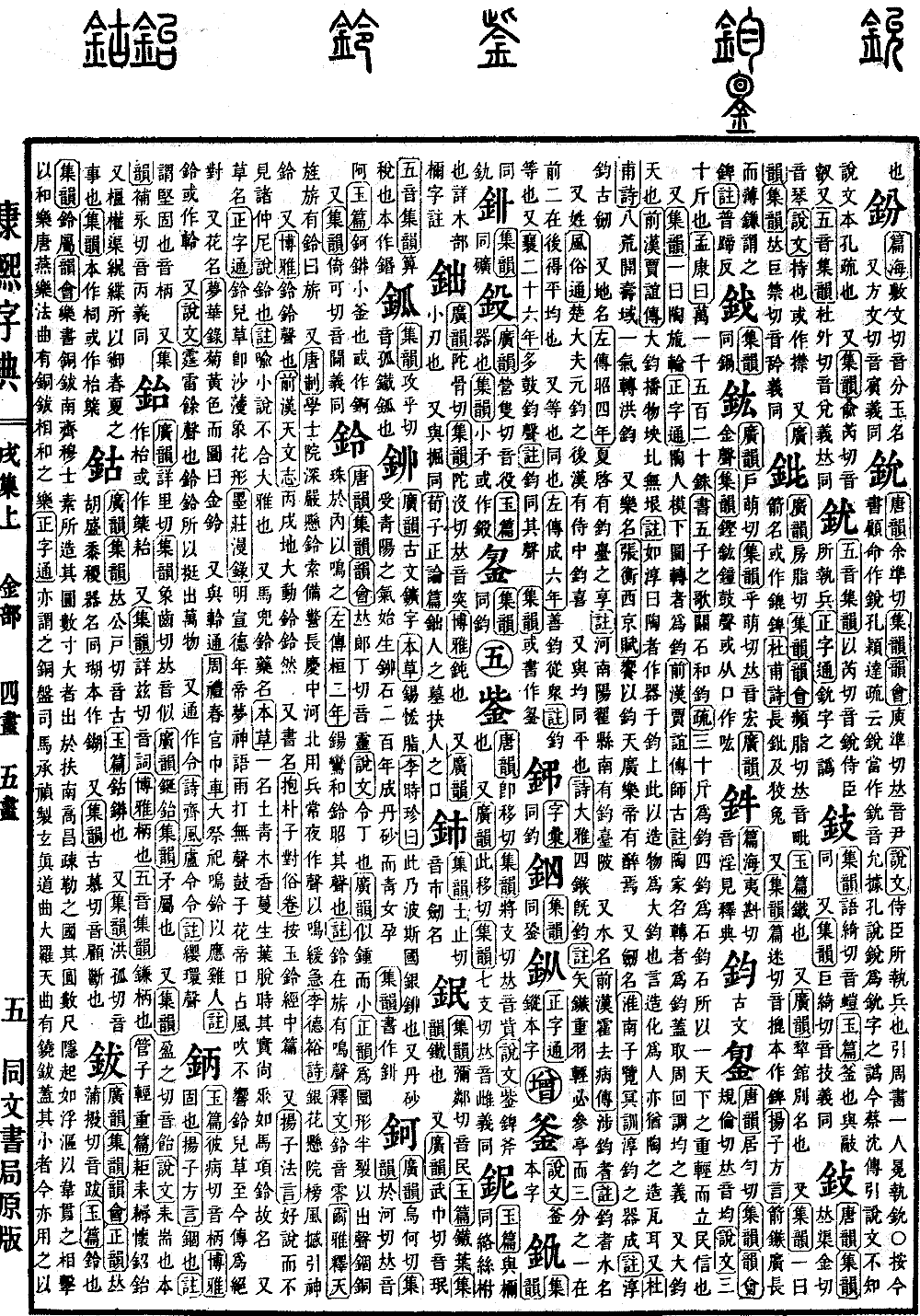
Xu Collection, Upper Volume
Radical: Metal (jīn)
Page 1299, Entry 28
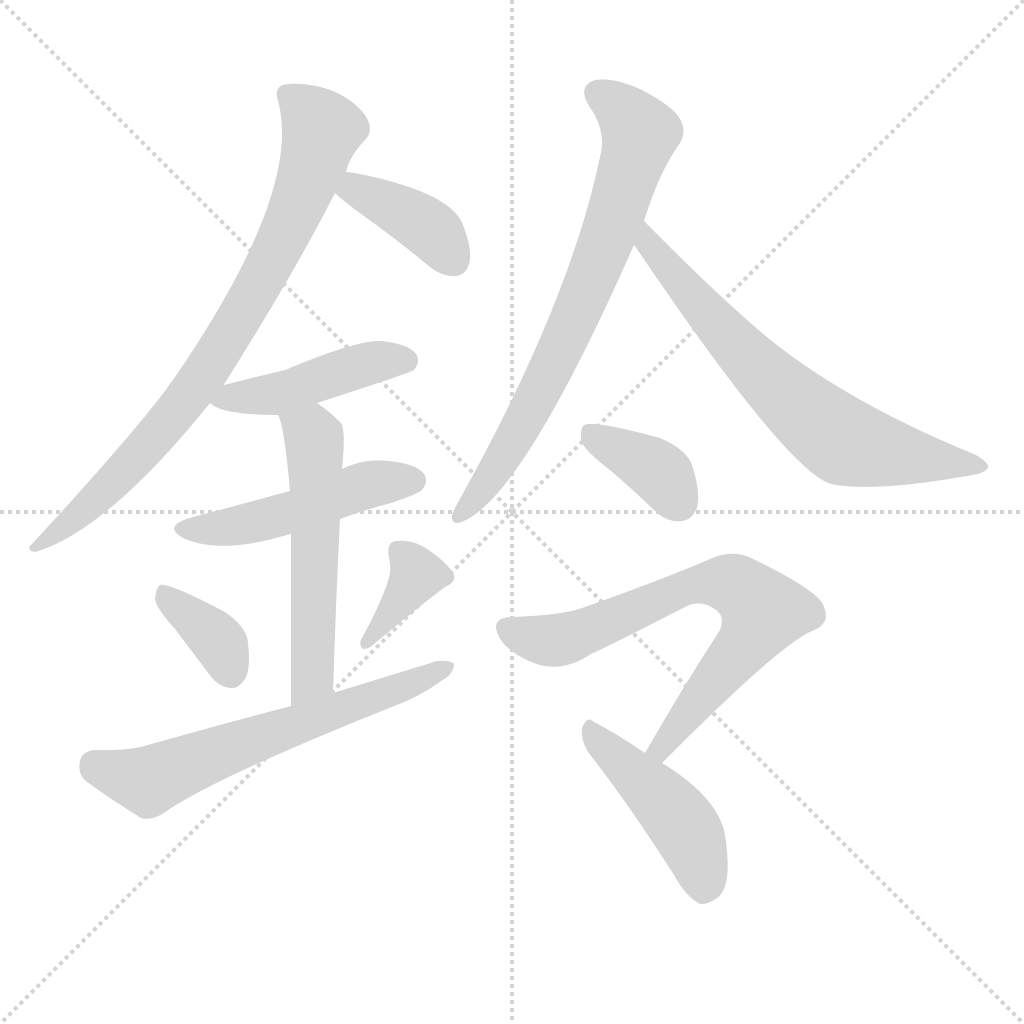
Pronounced líng.
According to the Explaining Graphs and Analyzing Characters (Shuowen Jiezi), it refers to the sound ling ding.
According to the Guangyun, it is like a bell but smaller.
According to the Zheng Yun, it is spherical in shape, split halfway to emit sound, with a copper bead sealed inside to ring.
In the Zuo Tradition (Zuo Zhuan), under the second year of Duke Huan: Bestow the luan and he bells to manifest their sounds. The commentary notes that bells are on the banners and have a ringing sound. The Interpretation of Texts (Shiwen) states that bell is pronounced líng.
In the Erya, it is stated that banners with bells are called qi.
According to the Tang System, the Academy of Scholars was very secure, and bells were hung on ropes to provide alerts. During the Changqing period, when troops were deployed in Hebei, they often made sounds at night to signal the urgency of the situation. Li Deyu wrote: Silver flowers hang on the academy placard, the wind shakes and draws the divine bell.
It also refers to the sound ling ling as described in the Bohya.
In the History of the Former Han (Qian Hanshu), under the Treatise on Astronomy: On the day of Bingxu, the earth shook greatly with a ling ling sound.
It also refers to the name of a book. In the Baopuzi, in the chapter titled Facing Customary Beliefs: Consult the middle volume of the Jade Bell Classic (Yuling Jing).
According to the Dialect (Fangyan) by Yang Xiong: Fond of speaking but not seen in the words of Confucius is called the Talk of Bells (shuoling). The commentary notes that this is a metaphor for minor literature that does not align with refined standards.
It also refers to the Birthwort (madouling), a medicinal name. According to the Materia Medica (Bencao), it is also called earth green wood fragrance. It grows in vines, and when the leaves fall, the fruit remains, shaped like a bell on a horse's neck, hence the name.
It also refers to a type of grass. According to the Zhengzitong: Bell grass, which is sand ginseng, is so named for the shape of its flower. In the Mozhuang Manlu, it is recorded that during the Xuande period of the Ming dynasty, the emperor dreamed of divine words: Rain strikes the silent drum-flower. The emperor spoke: The wind blows the silent bell grass. To this day, it is passed down as an absolute couplet.
It also refers to a type of flower. The Dreams of the Splendid Capital (Meng Hualu) describes chrysanthemums that are yellow and round as golden bells.
It is also used interchangeably with ling (a rail or bar). In the Rites of Zhou (Zhouli), Office of Spring, Carriage Keeper: At great sacrifices, ring the bells to respond to the crowing of the rooster official. The commentary notes that bell is sometimes written as ling.
According to the Explaining Graphs and Analyzing Characters, it is the lingering sound of thunder. Ling ling is the means by which all things are propelled forth.
It is also used interchangeably with ling (the character for order). In the Book of Odes (Shijing), Odes of Qi: The bronze bells of the hunting dogs ring ling ling. The commentary notes this refers to the sound of the harness rings.