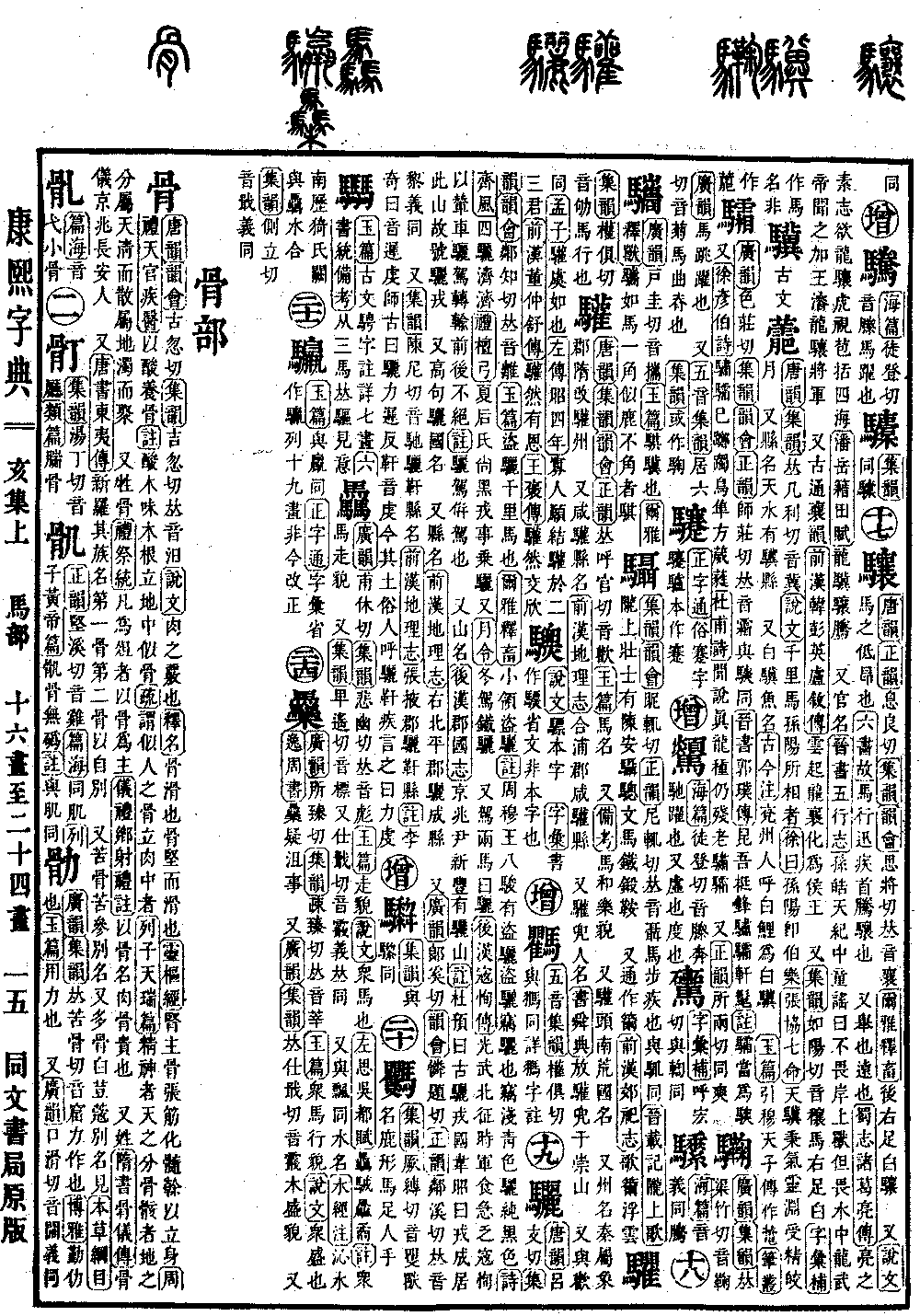
Hai Collection, Upper Volume
Radical: Horse (mǎ)
Kangxi Strokes: 29
Page 1447, Entry 24
Pronounced li.
In the Jade Chapter (Yupian), a Daoli is a horse that can travel a thousand li in a day.
In the Er Ya: Explanation of Domestic Animals (Er Ya: Shi Chu), it is defined as a black horse with a small neck. The commentary states that the Book of King Mu, Son of Heaven (Mu Tianzi Zhuan) notes that among the emperor's fine horses were the Daoli and the Luer, and that the Daoli was used as the right-side yoke horse.
In the Book of Odes: Odes of Qi (Shijing: Qi Feng), it is written: Four black horses, impressive and majestic.
In the Book of Rites: Tan Gong (Liji: Tan Gong), it is noted that the Xia dynasty valued the color black, and for military affairs, they rode black horses.
Also, in the Monthly Ordinances (Yueling), it mentions driving iron-black horses in winter.
It also refers to driving a pair of horses.
In the History of the Later Han: Biography of Kou Xun (Hou Hanshu: Kou Xun Zhuan), it is written that when Emperor Guangwu was on a northern campaign and army supplies were critically low, Kou Xun used carriages and black horses to transport grain, keeping the supply line constant. The commentary notes that this refers to horses harnessed together.
It is the name of a mountain. In the History of the Later Han: Treatises on Administrative Geography (Hou Hanshu: Junguo Zhi), it is recorded that in Xinfeng, under the jurisdiction of the Jingzhao Governor, is Mount Li. The commentary by Du Yu states this was the ancient state of Lirong. Wei Zhao states that the Rong people inhabited this mountain, hence it was called Lirong.
It is also the name of the state of Goguryeo.
It is the name of a county. In the History of the Former Han: Treatise on Geography (Hanshu: Dilizhi), it mentions Licheng County in Youbeiping Commandery.
Pronounced li. Same meaning as above.
Pronounced chi. Lijian is the name of a county. In the History of the Former Han: Treatise on Geography (Hanshu: Dilizhi), it mentions Lijian County in Zhangye Commandery. The commentary by Li Qi states the pronunciation is chi qian. Yan Shigu states that the first character is pronounced like li, and the second like qian; he notes that the local people spoke rapidly, causing the name to sound like liqian.
Correction: In the Er Ya: Explanation of Domestic Animals (Er Ya: Shi Chu), it mentions the Daoli. The commentary refers to the eight fine horses of King Mu of Zhou, including the Daoli. Daoli is also referred to as qieli. Qie signifies a light greenish-black, while li signifies pure black. Note: The citation regarding King Mu of Zhou previously did not match the original commentary. The text has been corrected to reflect the original: The commentary by Guo Pu on the Book of King Mu, Son of Heaven (Mu Tianzi Zhuan) states that among the emperor's fine horses were the Daoli and the Luer, and that the Daoli was used as the right-side yoke horse.