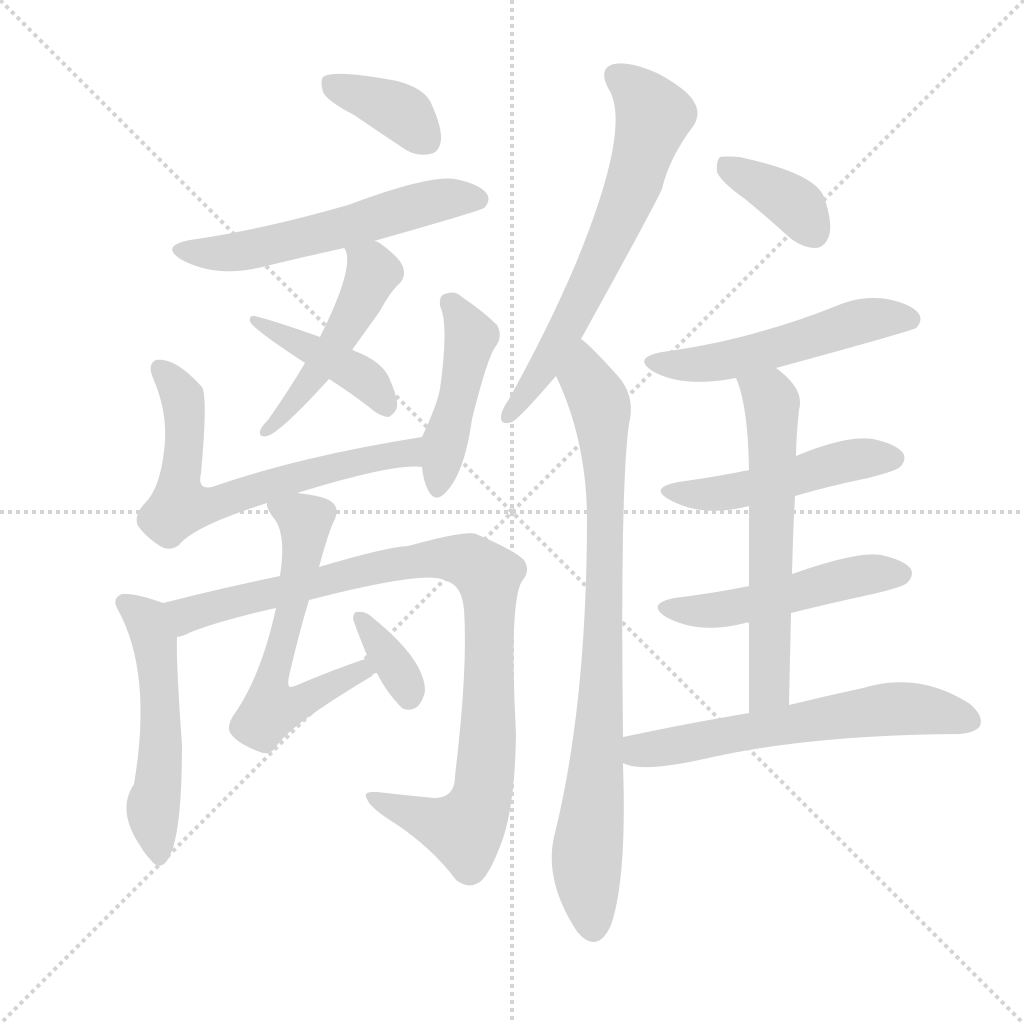
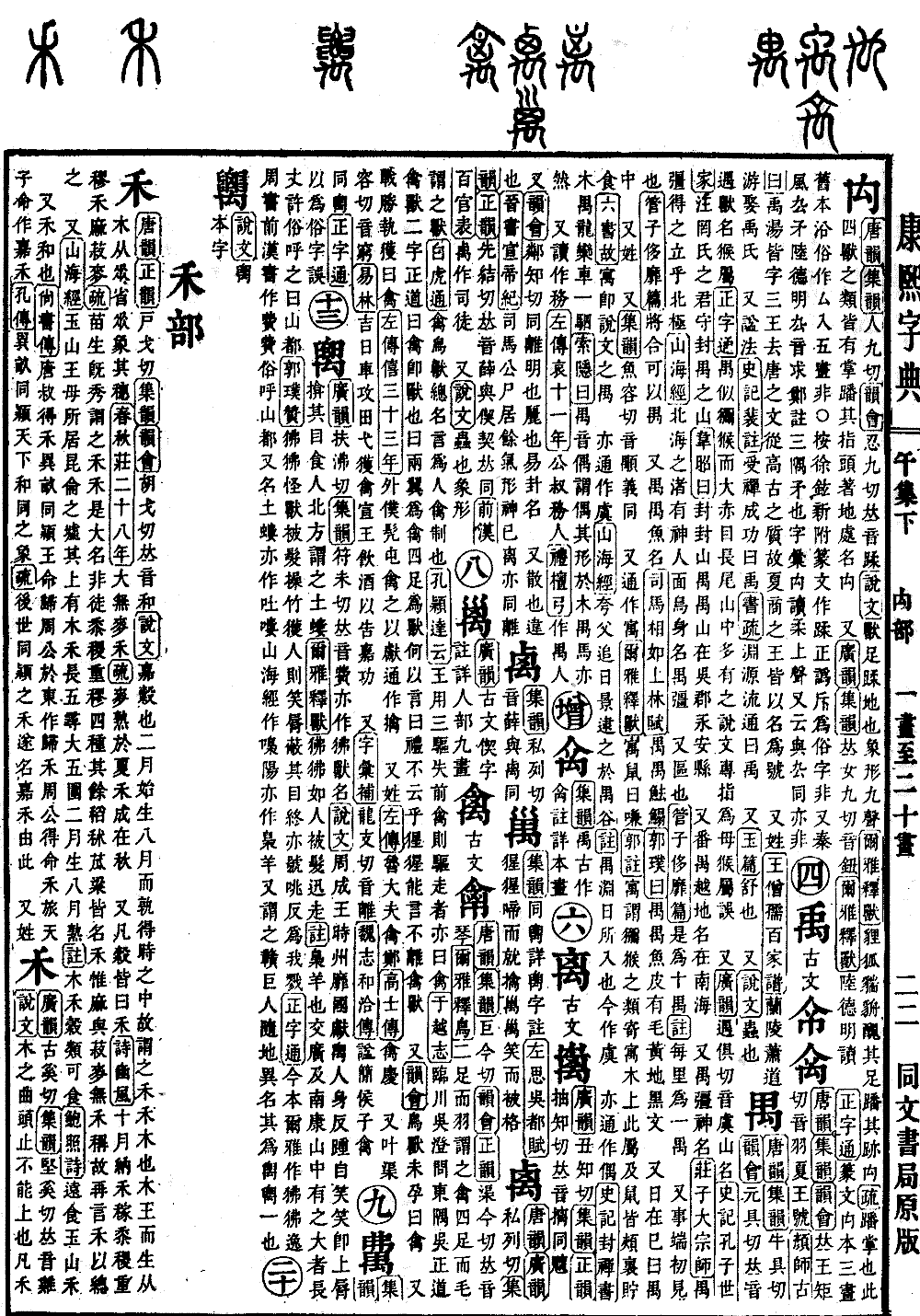
Xu Collection, Middle Volume; Radical: Short-tailed bird (zhuī); Kangxi strokes: 19; Page 848, Entry 01
Pronounced li. According to the Tang Rhyme (Tangyun), it is pronounced by combining lü and zhi. According to the Collected Rhymes (Jiyun) and the Rhyme Gathering (Yunhui), it is pronounced by combining lin and zhi. According to the Explaining Graphs and Analyzing Characters (Shuowen), it is the yellow oriole; when it sings, the silkworms hatch. Composed of the radical short-tailed bird and the phonetic element li. According to the Jade Chapters (Yupian), it is also written as li. According to the Broad Rhymes (Guangyun), today the character for oriole is used to denote the yellow oriole, and li is borrowed to denote separation. According to the Collected Rhymes (Jiyun), it is sometimes written as li.
Also, a hexagram name. Book of Changes (Yijing), Hexagram of Li: The judgment says, Li means to be attached. According to the Jade Chapters (Yupian), li means bright. Also, according to the Jade Chapters (Yupian), to disperse. According to the Broad Rhymes (Guangyun), near is called li, far is called separation. According to Yang Xiong's Dialects (Fangyan), canli means to divide; in the states of Qin and Jin, it is called li. Book of Changes (Yijing), Qian Hexagram: In advancing and retreating without constancy, one is not departing from the group. Book of Odes (Shijing), Song of Wang: The woman is separated. Also, according to the Jade Chapters (Yupian), to meet. According to Yang Xiong's Dialects (Fangyan), a net is called li. Book of Changes (Yijing), Xiaoguo Hexagram: Flying birds are caught in it. Former Han History (Qianhan Shu), Yang Xiong Biography, commentary on Rhapsody on Encountering Sorrow (Lisao): Ying Shao said, li is the same as encountering. Also, Book of Odes (Shijing), Xiaoya: Not separated from the village. Commentary: li means to pass through. Also, according to the Jade Chapters (Yupian), two. Record of Rites (Liji), Qu Li: Sitting in pairs and standing in pairs. Commentary: li means two, meaning two joined together. Also, according to the Jade Chapters (Yupian), to judge. Record of Rites (Liji), Record of Learning (Xueji): In the first year, examine the separation of the classics and distinguish aspirations. Commentary: separating the classics refers to breaking the sentences. Zhou Rites (Zhouli), Ministry of Summer: There is no uneven ground. Commentary: hua is read as a word for crooked, rectified so it is not crooked or separated. Also, Record of Rites (Liji), Mingtang Wei: The uncle's arranged chime stones. Commentary: li refers to the order of the suspended stones. Commentary: The uncle composed the arranged chime stones. Also, Ceremonial Rites (Yili), Great Archery Rite: Striking and passing the ropes. Commentary: li means to pass or to hunt. Also, according to the Jade Chapters (Yupian), it means to wear. Zuo Commentary (Zuozhuan), First Year of Zhao: Setting up guards and wearing the appropriate clothes. Commentary: li means to wear. Also, Er Ya, Explaining Kinship: A man calling his sister's son chu, and calling his chu's son a li grandson. Also, Xunzi, Non-Physiognomy: Li-li is an expression of not being intimate. Also, Er Ya, Explaining Glosses: The various terms describe entanglement. Commentary: This refers to the dense and tangled nature of grass and trees. Also, Qu Yuan, Encountering Sorrow (Lisao): Lengthening my pendants which are brilliant. Commentary: Brilliant (luoli) is a description of a crowded appearance. Xu Shen says it means a beautiful appearance; Shi Gu says it means scattered. Also, Former Han History (Qianhan Shu), Sacrificial Songs: Avoiding dispersion. Commentary: dispersion refers to one who has lost their place. Also, Sima Xiangru, Rhapsody on the Great Man: Rushing and rolling, joined in a dense display. Commentary: Linli refers to a tangled appearance. Yang Xiong, Rhapsody on Feathered Hunting: Drenching and vast. Also, Sima Xiangru, Rhapsody on the Great Forest: In front is the long li and behind is the brilliant emperor. Commentary: Fu Qian says both are names of deities; Shi Gu says the long li is a spiritual bird. Note: The Former Han History (Qianhan Shu), Rites and Music Treatise writes long li as long li (different character). Commentary says it is a star name. Zhang Heng, Rhapsody on Thought: Before the long li brushes its wings. Commentary: The long li is the Vermilion Bird deity of the South. Also, Er Ya, Explaining Music: A large zither is called li. Commentary: Its sounds have many variations, and the notes flow and disperse. Also, Former Han History (Qianhan Shu), Western Regions: Jibin produces glass (liuli). Commentary: Shi Gu says, the Book of Wei states that the Roman Empire produces ten types of glass: red, white, black, yellow, blue, green, pale, dark, red, and purple. Also, a horse name. Li Si, Petition Against the Expulsion of Guest Officials: Riding the delicate li horse. Also, a bird name. Book of Odes (Shijing), Beifeng: The child of the li bird. Commentary: Li is a bird. According to the commentary on Er Ya, Explaining Birds, it is written as li. Also, a grass name. Qu Yuan, Encountering Sorrow (Lisao): Gathering the river li and fragrant angelica. Commentary: Li is the wild ginger (míwú). Also, Sima Xiangru, Rhapsody on Zixu: The mountain pear (li). Commentary: Li is the mountain pear. Also, Pi Ya: Han Poetry says, the peony is the li grass; when about to separate, people give each other peonies. Another name is the plant that can separate. Also, a tree name. Historical Records (Shiji), Biography of Confucius, Commentary: The Huanglan says: in the cemetery, there are oak, elm, and luo-li trees. Also, a water name. Former Han History (Qianhan Shu), Emperor Wu Annals: Emerging from Lingling and the lower Li River. Also, a place name. Zuo Commentary (Zuozhuan), 15th Year of Cheng: Meeting with Wu at Zhongli. Commentary: Zhongli is a Chu city, a county in Huainan. Also, a country name. Former Han History (Qianhan Shu), Western Regions: Dongli country is a great country. Shiyiji: The country of Nili came to pay tribute. Also, according to the Broad Rhymes (Guangyun), a surname. Mencius's disciple Li Lou. Also, according to the Collected Rhymes (Jiyun), pronounced chi. Originally written as chi (a legendary dragon). See the entry for chi under the Insect radical. Also, according to the Collected Rhymes (Jiyun), pronounced li. Li-qi describes the appearance of baring the arms. Also, Sima Xiangru, Rhapsody on the Upper Forest: Li-mi and vast. Commentary: Li-mi means connected and unbroken. Li is pronounced li (lower tone). Also, according to the Broad Rhymes (Guangyun), Collected Rhymes (Jiyun), and Rhyme Gathering (Yunhui), pronounced li (falling tone). According to the Broad Rhymes (Guangyun), to go. Book of History (Shujing), Expedition of Yin: Abandoning offices and departing from one's post. Interpretation: Li is read as its standard pronunciation, or as li (falling tone). Record of Rites (Liji), Qu Li: The parrot can speak, but it does not depart from the birds. Also, same as the lychee. Sima Xiangru, Rhapsody on the Upper Forest: The lychee (li-zhi). Commentary: Jin Zhuo says, the lychee is as large as a hen's egg, with a rough skin; when peeled, the flesh is like a hen's egg, yellow in the middle, sweet and slightly sour. Shi Gu: Pronounced li (falling tone). Also, according to the Broad Rhymes (Guangyun), Collected Rhymes (Jiyun), and Rhyme Gathering (Yunhui), pronounced li (falling tone). Record of Rites (Liji), Monthly Ordinances: The official of the sky monitors the movements of the sun, moon, and stars; their mansions (su-li) must not be mistaken. Commentary: Li is read as li, the same as the li in pairs (li-ou). Mansion-pair refers to their groupings. The officials who manage astronomy must carefully monitor them, ensuring no errors. Interpretation: Li is read as li (falling tone), meaning to match. Also, leaf rhyme pronunciation li. Zhuo Wenjun, White-Headed Lament: Mournful and again mournful, no need to cry when marrying off a daughter. I wish to find a man of one heart, and not be separated until our hair turns white. Also, leaf rhyme pronunciation luo. Han Yu, Inscription for the Tomb of Vice-Magistrate Pei: Branches divided and clans separated, each forming their own family. Jia is pronounced ge. Corrections: Record of Rites (Liji), Sitting in pairs and standing in pairs. Commentary: Li means two. Two joined together is called li. Note: The commentary does not contain this text. Based on Chen's Collected Explanations citing Fang's commentary, it has been changed to "two joined together is called li." Yang Xiong, Rhapsody on School Hunting: Drenching and vast. Note: In accordance with the text in the Selections of Refined Literature (Wenxuan), School Hunting has been changed to Feathered Hunting. Sima Xiangru, Rhapsody on the Upper Forest: In front is the long li and behind is the brilliant emperor. Note: In accordance with the Han History (Hanshu) Rhapsody on the Upper Forest, Great Forest has been changed to Upper Forest.