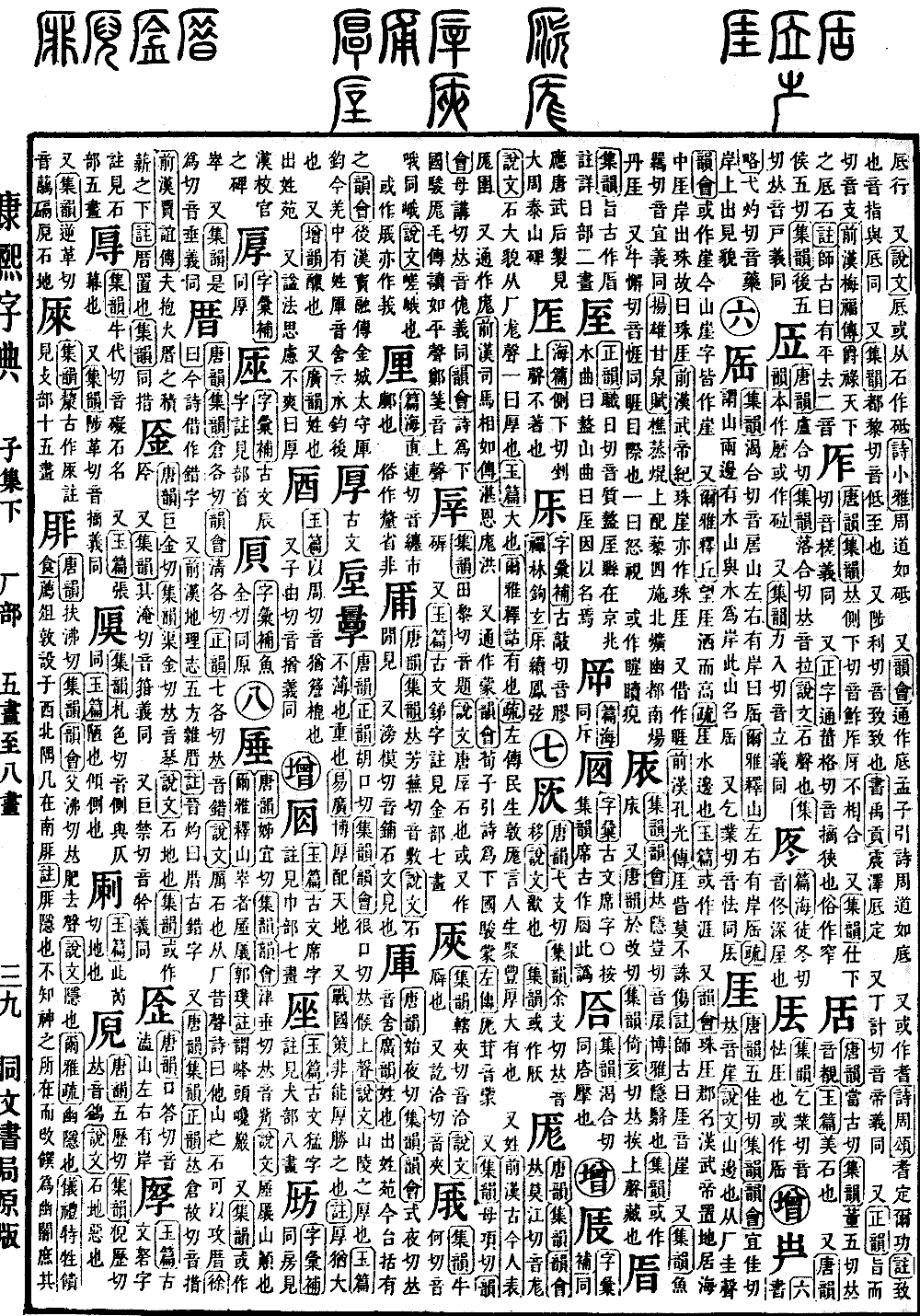
You Collection, Lower Volume
Radical: Village (lǐ)
Kangxi Strokes: 18
Page 161, Entry 03
Ancient character. Pronounced li.
Guangyun (Comprehensive Rhymes) and Jiyun (Collection of Rhymes) state it is pronounced li (level tone). Yunhui (Collection of Rhymes) states it is pronounced li (level tone).
Guangyun: To manage or govern.
Book of Documents (Shangshu), Canon of Yao: He managed the descent of the two daughters to the bend of the Gui River. Commentary: Managed the descent means being able to conduct them down according to principles of righteousness.
Yang Xiong, Eulogy for the New Dynasty (Jujin Meixin): Carrying the celestial path, promoting the earthly principles. Commentary: Principles means management. To carry the way of heaven and promote the principles of earth is to emulate and model oneself after them.
Also, from the Shuowen (Explanation of Characters): Family blessings.
Yang Xiong, Rhapsody on Ganquan: Accepting the blessings of the three spirits. Commentary: Blessings.
Also: To govern or regulate.
Book of Documents, Canon of Yao: Sincerely governing the hundred officials, so that all their achievements were prosperous. Commentary: Governed.
Also: A numerical unit. Same as the character for a tiny fraction (máo).
Book of Han, Biography of Dongfang Shuo: If you rectify the root, the ten thousand things will be ordered; miss it by a tiny fraction, and you will be off by a thousand miles.
Huainanzi, Teachings on the Art of the Ruler: Therefore, those who are overly concerned with calculations of tiny fractions will inevitably lose the great values of the world.
Also, from Yang Xiong, Regional Dialect (Fangyan): In the region of Chu, whenever humans or beasts give birth to twins, it is called a double birth.
Also, from Guangya (Broad Refinements): A pair.
Also, from Yang Xiong, Regional Dialect: To be greedy.
Also: To bestow or give.
Book of Odes (Shijing), Great Odes: What did he bestow upon them? He bestowed upon you these elegant women. Commentary: To give.
Also: He bestowed upon you the jade scepter and ladle. Commentary: To bestow.
Also: A mountain name.
Classic of Mountains and Seas (Shanhaijing): Li Mountain. Commentary: According to the Record of Famous Sites, Li Mountain is located west of Song County.
Also: A plant name.
Erya (Approaching Elegance), Explanations of Plants: A creeping flower. Originally written as this; common usage uses the radical for tooth.
Also: Zhili, a type of paper.
Zhengzitong (True Character Guide): Seaweed is originally named zhili. The people of Nanyue use sea moss to make paper, which has a distinct texture, hence it is called side-texture paper.
Also: A surname.
Classic of Mountains and Seas: In the midst of the Great Wilderness there is the Country of Great Men, with the Li surname. Commentary: According to the Record of Country Names, they are descendants of Emperor Hong.
Clan Records: During the Northern and Southern Dynasties, there was Li Yan.
Also: A personal name.
Classic of Mountains and Seas: Great Hao gave birth to Xianniao, and Xianniao gave birth to Chengli. Commentary: Chengli was the official in charge of water and earth.
Also: In the Deep Yin Mountains, there are people who eat beasts, called Jili.
Also: Equivalent to the character for a widow.
Han’s Commentary on the Odes (Han Shi Waizhuan): The widowed neighbor woman.
Book of the Later Han, Account of the Western Qiang: Accepting his widowed sister-in-law.
Also, Jiyun and Zhengyun (Correct Rhymes) state it is pronounced xi (level tone). Blessings.
Book of Han, Annals of Emperor Wen: The sacrificial officials prayed for blessings. Commentary: Ru Chun says: Blessings. Shigu says: Originally written as the character for happiness (xi), this is a loan usage.
Also, from Cangjie Pian: The leftover meat from a sacrifice.
Book of Han, Biography of Jia Yi: The Emperor was receiving blessings in the Xuan Room. Commentary: Xu Guang says: Sacrificial meat offerings. Ying Shao says: Leftover meat from a sacrifice.
Also: Equivalent to the character for joy (xi).
Records of the Grand Historian (Shiji), Annals of Lu: Ji You helped Zi Shen enter and take the throne, who became Duke Li.
Records of the Grand Historian, Account of the Xiongnu: Duke Li of Qi fought with them at the outskirts of Qi. Commentary: Pronounced xi.
Also, Records of the Grand Historian, Hereditary House of Confucius: The lord of the Wangmang clan guarded Mount Fengyu and held the Li surname. Commentary: Pronounced xi.
Also, Wuyin Jiyun (Five Tones Collection of Rhymes) states it is pronounced tai (level tone). A place name. Tai is sometimes written as this, where the Lord of Millet was enfeoffed.
Also: Equivalent to the character for barley.
Book of Han, Biography of Liu Xiang: He bestowed upon me barley. Commentary: Shigu says: Pronounced lai (rising tone), also pronounced lai (level tone).
Also, Zihuibu (Dictionary Supplement) states it is equivalent to the character for orach.
Strategies of the Warring States: The State of Qi attacked Li and Ju.
Also, Jiyun states it is pronounced lai (rising tone). To bestow.
Book of Odes, Great Odes: He bestowed upon you the jade scepter and ladle. Shen Zhong reads it thus.
Also, Yunbu (Rhyme Supplement) states it rhymes with the sound of li (entering tone).
Cao Zhi, Eulogy: Respectfully serving the suburban temples, with bright virtue and reverence. The essence of the sun accumulates kindness, gathering the blessings of heaven.