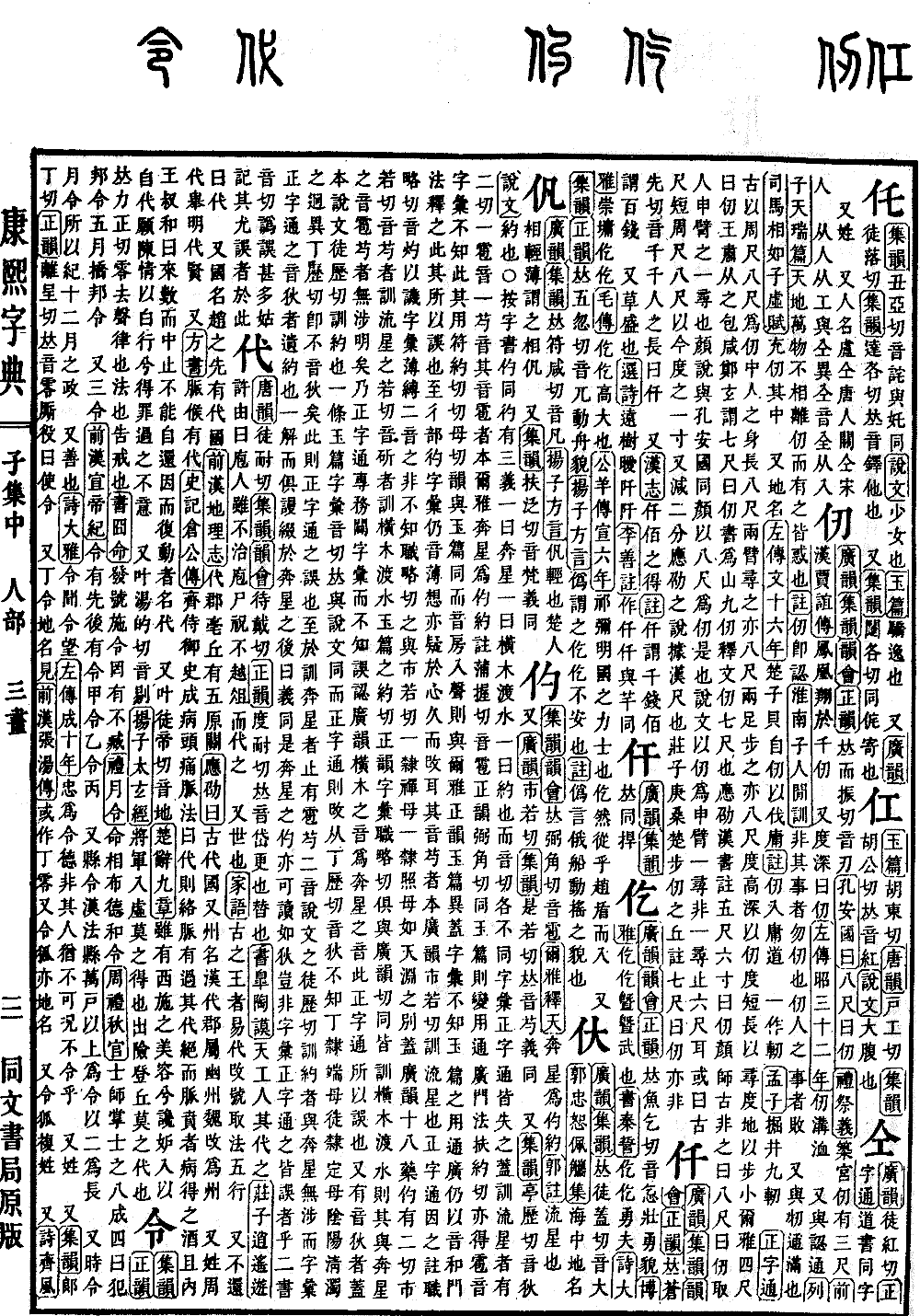
Zi Collection, Middle Volume
Radical: Person (rén)
令
Kangxi strokes: 5
Page 93, entry 12
According to Collection Rhymes (Jiyun) and Orthography Rhymes (Zhengyun), pronounced lìng (falling tone). It means law, regulation, or to warn and instruct. In the Book of Documents (Shujing), the chapter Instructions of Jiong (Jiongming) states: Issuing orders and commands must be appropriate. In the Book of Rites (Liji), the chapter Monthly Ordinances (Yueling) states: The minister distributes virtue and harmony in accordance with these ordinances. In the Rites of Zhou (Zhouli), the Autumn Official section notes: The Master of the Ministry of Justice manages the eight standards, the fourth being violating state regulations, the fifth being falsifying state regulations. There is also the reference to the three regulations. In the History of the Former Han (Qianhan), Biography of Emperor Xuan, it is noted: Regulations have an order of precedence, including the first, second, and third regulations.
Also refers to a county magistrate. Under Han law, a county with over ten thousand households was administered by a ling, while those with fewer were administered by a zhang.
Also refers to seasonal ordinances and monthly ordinances used to record the government affairs of the twelve months.
Also means good or virtuous. The Book of Odes (Shijing), in the Great Odes (Daya) section, mentions: Good reputation and good expectations. The Zuo Tradition (Zuozhuan), in the tenth year of Duke Cheng, states: Loyalty is a virtuous quality; even if one is not the right person, one should still act virtuously.
Also a surname.
According to Collection Rhymes (Jiyun) and Orthography Rhymes (Zhengyun), pronounced líng. Subservient service is called shi-ling.
Also Dingling, a place name, as seen in the Biography of Zhang Tang in the History of the Former Han (Qianhan). Sometimes written as Dingling in a variant form.
Also Linghu, a place name. Also Linghu, a double-character surname.
In the Book of Odes (Shijing), Qi Odes (Qifeng) section, it mentions: The lu-ling-ling. The commentary notes: Lu is a hunting dog; ling-ling is the sound of the ring beneath the dog's chin.
Also interchangeable with ling (the wagtail bird). In the Book of Odes (Shijing), Lesser Odes (Xiaoya) section: The wagtail is on the plain; brothers are in urgent distress. This refers to the wagtail bird.
Also ling-shi, which refers to a brick. Interchangeable with ling-di.
According to Collection Rhymes (Jiyun), pronounced líng. Lingzhi, a county name located in Liaoxi.
According to Extended Rhymes (Guangyun) and Collection Rhymes (Jiyun), pronounced lián. Also a county name. In the Geography Treatise of the History of the Former Han (Qianhan), Jincheng Prefecture had a Lingju County.
According to Collection Rhymes (Jiyun), pronounced lǐng. The head of a government office.
Also rhyming as liáng. Han Yu's Creek Hall Poem (Xitangshi) says: All the Duke's four borders are both wealthy and strong. Calling the Duke our father, who would violate the Duke's command? Rhymes with bang.
The Explanation of Scripts and Analysis of Characters (Shuowen) places this under the seal radical (jie). It is composed of the components for gathering and seal. It means the issuing of commands. Master Xu says: The first component is the character for gather, indicating that people are regulated and controlled. This is an associative compound.
Textual Correction: Regarding the entry for county magistrate: Han law states that counties with over ten thousand households were administered by a ling, while those with fewer were administered by a zhang. We have corrected the text to reflect the History of the Former Han (Hanshu).