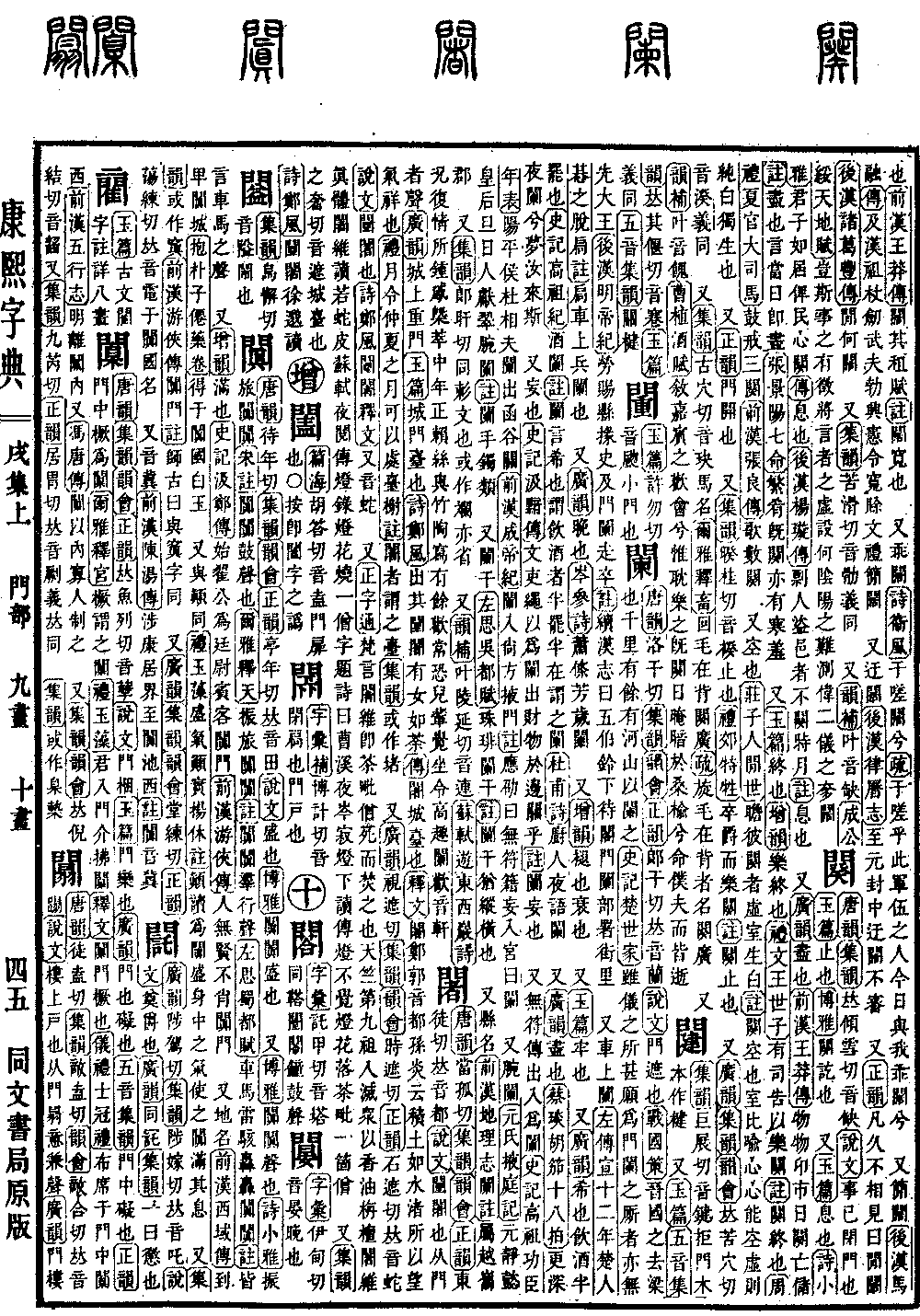
Xu Collection, Upper Volume
Radical: Gate (mén)
Kangxi Strokes: 17
Page 1339, Entry 01
Pronounced lan
Shuowen Jiezi (Explanation of Words and Phrases): A barrier at a door.
Strategies of the Warring States (Zhanguoce): The distance between the State of Jin and the State of Liang is more than a thousand li, with mountains and rivers to serve as a barrier to them.
Records of the Grand Historian (Shiji), Biography of the House of Chu: Although it is what I most desire to become a gatekeeper for the great king, there is no one who precedes the great king.
Book of the Later Han (Houhan Shu), Annals of Emperor Ming: Bestowed rewards upon the county clerks and the gate guards.
Commentary: The Continuation of the Book of the Han (Xu Han Zhi) states: The five commanders under the bells wait at the pavilions to manage the gate guards and patrol the streets.
Also, a guardrail on a carriage.
Zuo Tradition (Zuo Zhuan), 12th year of Duke Xuan: Commentary on removing the crossbar, the crossbar is the weapon railing on a carriage.
Also, late.
Poem by Cen Can: The fragrant years are desolate and late.
Also, to fade or to decline.
Also, a prison.
Also, sparse. To finish drinking halfway.
Records of the Grand Historian (Shiji), Annals of Gaozu: The wine was drawing to a close.
Commentary: The word means sparse. It refers to when the drinkers are half gone and half remaining; this is called lan.
Poem by Du Fu: The kitchen staff spoke in the late night.
Also, to come to an end.
Cai Yan, Eighteen Songs of a Nomad Flute: The night is deep and coming to an end, oh, I dream that you have come here.
Also, recklessly.
Records of the Grand Historian (Shiji), Biography of Ji An: The civil officials prosecuted him, saying that he had recklessly moved property out through the border pass.
Commentary: The word means recklessly.
Also, entering or exiting without a travel permit is called lan.
Records of the Grand Historian (Shiji), Table of Meritorious Officials under Gaozu: Marquis of Yangping, Du Xiangfu, passed through Hangu Pass without a permit.
Book of the Former Han (Qianhan Shu), Annals of Emperor Cheng: Recklessly entered the Shangfang side gate.
Commentary: Ying Shao said: Entering the palace without a pass or registration is called lan.
Also, a wrist ornament.
Yuan Family Imperial Garden Records (Yuanshi Yeting Ji): On the morning of the day of Empress Jingyi of the Yuan, people offered emerald wrist ornaments.
Commentary: The word is a type of bracelet.
Also, lan-gan.
Zuo Si, Rhapsody on the Capital of Wu (Wudu Fu): Pearls and shells scattered in disorder.
Commentary: The term means longitudinal and latitudinal or in disorder.
Also, a county name.
Book of the Former Han (Qianhan Shu), Treatise on Geography: Belonged to Yuexi Commandery.
Also, pronounced lan (variant). It is a decorative pattern. Sometimes written as lan (variant). Also shortened.
Also, rhyming as lian.
Su Shi, Poem on Traveling East and West Cliffs: Moreover, where emotions are concentrated, sighs gather in middle age. Relying on strings and bamboo, one finds ample joy. I always fear the children will notice, and seat them to make the high interest wane. The sound of joy is xuan.
Textual Research: Du Fu poem should read, The kitchen staff spoke in the late night. I have corrected it according to the original poem to read, The kitchen staff spoke in the late night.