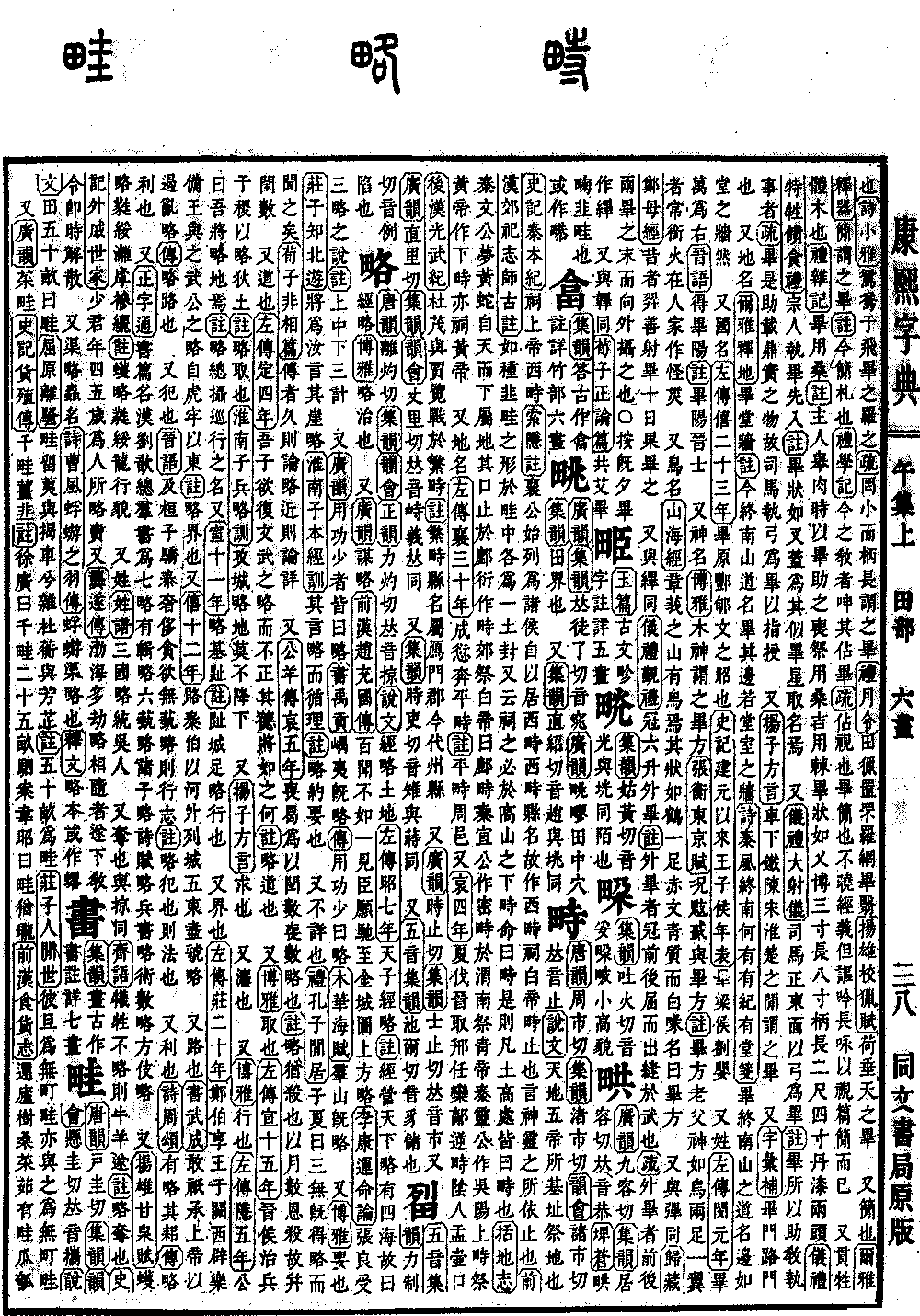
Wu Collection, Upper Volume
Radical: Field (tián)
Kangxi Strokes: 11
Page 762, Entry 09
Tang Rhymes (Tangyun) states pronunciation is lue. Collected Rhymes (Jiyun), Rhyme Compendium (Yunhui), and Orthodox Rhymes (Zhengyun) state pronunciation is lue.
According to Explaining Graphs and Analyzing Characters (Shuowen): To manage land.
Zuo Tradition (Zuo Zhuan), Seventh Year of Duke Zhao: The Son of Heaven manages the land. Commentary: Managing the world, possessing the four seas. Thus it is called management.
Broad Elegance (Boya): lue means to govern.
Also, Extensive Rhymes (Guangyun): strategy.
Former Han History (Qian Han Shu), Biography of Zhao Chongguo: Hearing a hundred times is not as good as seeing once; I wish to gallop to Jincheng to plan top-level strategies.
Li Kang’s Treatise on Fate (Yunming Lun): Zhang Liang received the teachings of the Three Strategies. Commentary: Refers to upper, middle, and lower plans.
Also, Extensive Rhymes (Guangyun): Using little effort is called lue.
Book of Documents (Shu), Tribute of Yu: The Yi region is already managed. Commentary: Using little effort is called lue.
Mu Hua, Sea Rhapsody (Hai Fu): The mountains are already managed.
Also, Broad Elegance (Boya): essentials.
Master Zhuang (Zhuangzi), Knowledge Wandered North: I will tell you its outline.
Huainanzi, Original Way (Benjing Xun): Its words are concise and follow principles. Commentary: lue means summarized or essential.
Also, vague or not detailed.
Book of Rites (Liji), Confucius’s Leisurely Abode: Zixia said: The three not-haves are obtained; I have heard it in summary.
Master Xun (Xunzi), Against Physiognomy (Feixiang Pian): If the transmitter is distant, the discussion is simplified; if near, the discussion is detailed.
Also, Gongyang Tradition (Gongyang Zhuan), Fifth Year of Duke Ai: Why count the intercalary month in mourning? Because the mourning number is simplified. Commentary: lue means to diminish. Because the gratitude diminishes month by month, the intercalary month is included.
Also, a path.
Zuo Tradition (Zuo Zhuan), Fourth Year of Duke Ding: You wish to restore the path of King Wen and King Wu but do not correct your virtue; what will you do? Commentary: lue means path.
Also, Broad Elegance (Boya): to take.
Zuo Tradition (Zuo Zhuan), Fifteenth Year of Duke Xuan: The Jin Duke governed the troops at Ji to take the Di territory. Commentary: lue means to take.
Huainanzi, Training on Military Strategy (Binglue Xun): Attacking cities and taking territory, none do not surrender.
Also, Yangzi’s Dialects (Fangyan): to seek.
Also, a law.
Also, Broad Elegance (Boya): to walk.
Zuo Tradition (Zuo Zhuan), Fifth Year of Duke Yin: The Duke said: I will march through the territory. Commentary: lue is the name for total inspection and travel.
Also, Eleventh Year of Duke Xuan: to walk the foundation. Commentary: The foundation is the foot of the city wall. lue means to walk.
Also, boundaries.
Zuo Tradition (Zuo Zhuan), Twenty-first Year of Duke Zhuang: The Zheng Earl entertained the King at the west gate of Que, the music was complete, and the King gave him the territories of Duke Wu, from Hulao eastward. Commentary: lue means boundary.
Also, Twelfth Year of Duke Xi: Bribed the Qin Earl with five cities outside the Yellow River, reaching the Guo boundary in the east.
Also, a road.
Book of Documents (Shu), Success of Martiality (Wucheng): Daring to respectfully accept the mandate of God to stop chaotic paths. Commentary: lue means road.
Also, to invade.
Discourses of Jin (Jinyu): When Huanzi was arrogant, extravagant, and greedy beyond measure, he invaded and acted on his own will. Commentary: lue means to invade.
Also, a standard.
Also, sharp.
Book of Odes (Shijing), Zhou Hymns (Zhou Song): With sharp plowshares. Commentary: lue means sharp.
Also, Orthodox Character Compendium (Zhengzitong): Name of book sections. Liu Xin of the Han dynasty organized all books into seven categories: Compendium, Six Classics, Various Masters, Poetry and Odes, Military Texts, Technical Arts, and Occult Arts.
Also, Yang Xiong, Ganquan Rhapsody: Winding and swaying, glistening and trailing. Commentary: Winding and swaying refers to the appearance of a dragon moving.
Also, a surname. Surname Register (Xingpu): Lue Tong of the Three Kingdoms, a man from Wu.
Also, to snatch. Same as lue (to plunder).
Discourses of Qi (Qiyu): If the sacrificial animals are not snatched, cattle and sheep will flourish. Commentary: lue means to snatch.
Records of the Grand Historian (Shiji), Biographies of External Relatives: When Shaojun was four or five years old, he was snatched and sold by someone.
Also, Biography of Gong Sui: In Bohai, there were many who were robbed and followed by others. Sui issued an edict, and they immediately dispersed.
Also, Qulue, name of an insect.
Book of Odes (Shijing), Odes of Cao, Wings of the Ephemera: Ephemera is Qulue. Explication of Characters (Shiwen): lue sometimes is written as a variant.