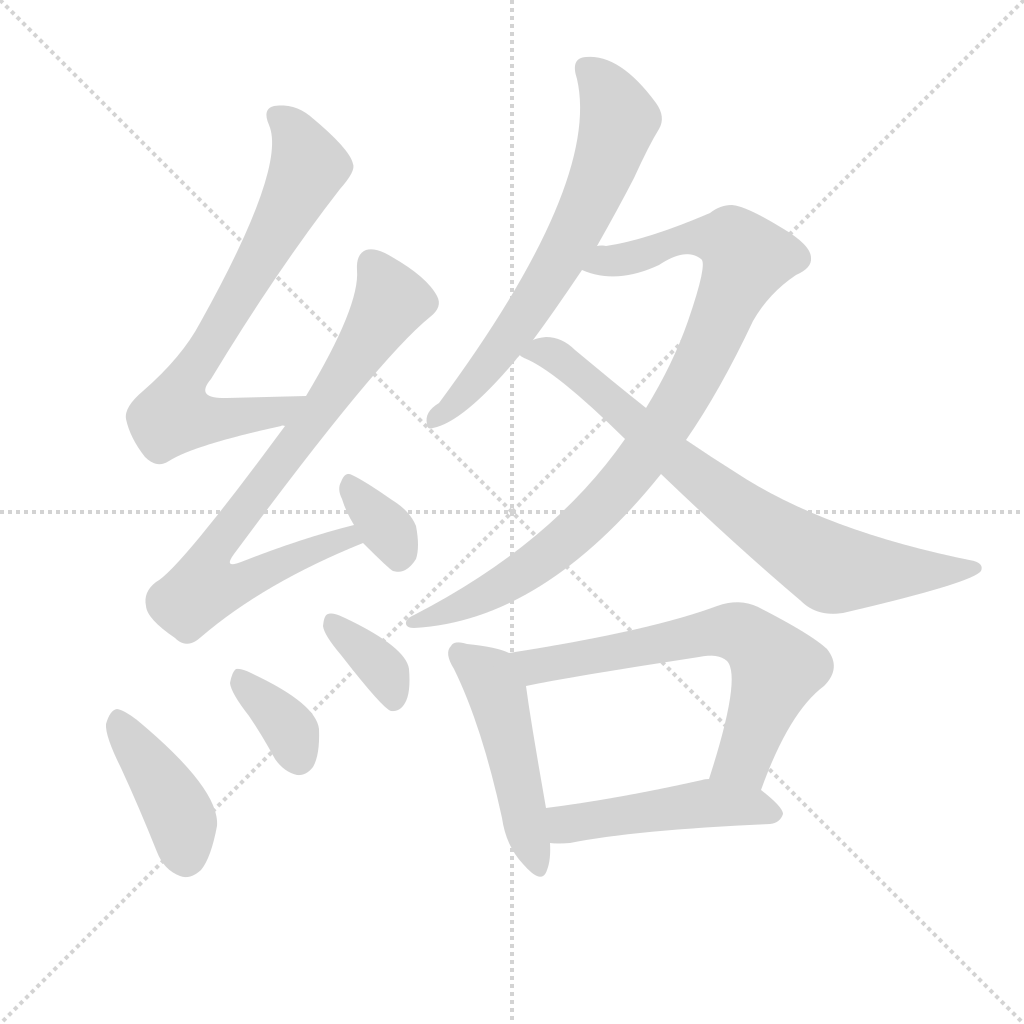
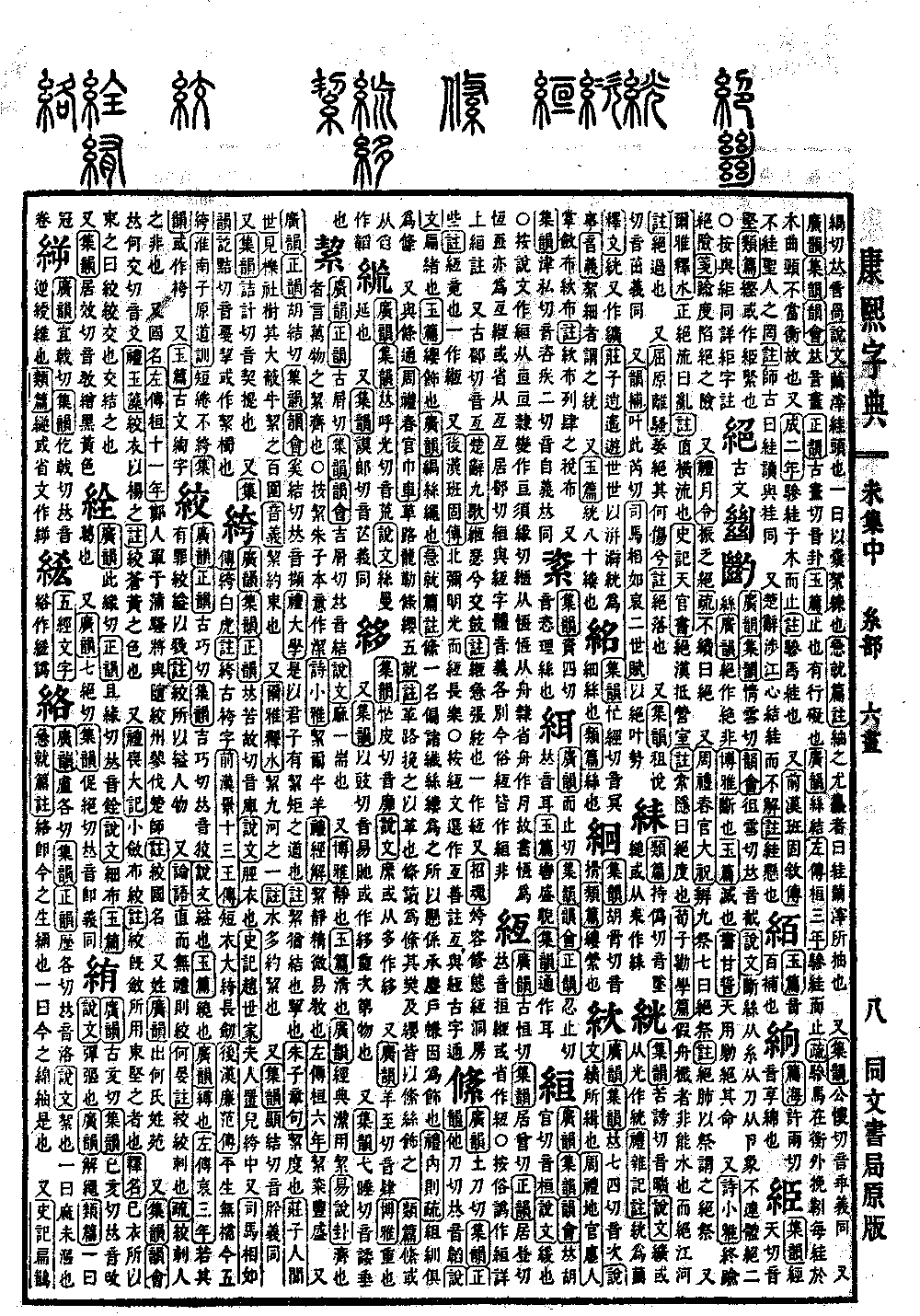
Wei Collection, Middle Volume
Radical: Silk (mì)
Kangxi Strokes: 12
Page 922, Entry 26
Pronounced luo.
According to the Shuo Wen Jie Zi (Explicating Graphs and Analyzing Characters), it refers to floss silk. Another interpretation suggests it refers to hemp that has not yet been soaked. The annotations to the Urgent Learning Chapter (Jijiupian) state that this refers to what is currently known as raw silk. Another theory suggests it refers to present-day silk padding.
In the Records of the Grand Historian (Shiji), Biography of Bian Que: within the meridians and collaterals. The commentary states this refers to the twelve main meridians and the twelve collateral vessels.
In the History of the Former Han (Qian Hanshu), Biography of Yang Xiong: wrapping and binding the heavens and the earth. The commentary states this refers to enveloping them.
In the Songs of Chu (Chuci), Summoning of the Soul: Zheng silk binding. The commentary states that the character means to bind or tie.
In Ban Gu, Western Capital Rhapsody (Xidu Fu): enclosing the mountains and binding the fields. The commentary states that the character means to encircle.
In Ban Gu, Eastern Capital Rhapsody (Dongdu Fu): extending through the terrestrial network. The commentary states that the character means a net.
According to Yang Xiong, Regional Speech (Fangyan): a well-rope is sometimes called a luo.
According to Yang Xiong, Regional Speech (Fangyan): a device for turning a silk-reeling frame is called a ge.
Also a surname.
Pronounced ke. The meaning is the same as above.
Rhyme supplement, rhyming with lu gu. In the Songs of Chu (Chuci), Summoning of the Soul: Qin baskets and Qi threads, Zheng silk binding.